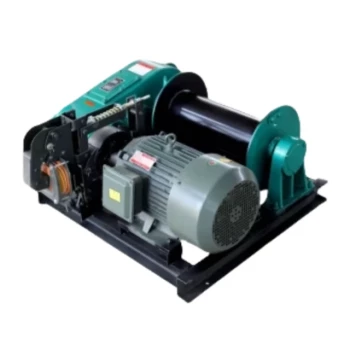
In essence, a capstan electric winch is a specialized pulling tool that uses the principle of friction, rather than a storage spool, to move a load. It achieves this with a rotating drum (the capstan) that grips the rope, allowing for continuous pulling operations over an unlimited distance. This design makes it uniquely suited for long-haul tasks like pulling cable through conduit or managing extensive marine rigging.
The critical distinction of a capstan winch is its design for continuous pulling over unlimited distances. Unlike a standard drum winch that stores rope on a spool, a capstan uses a rotating drum and friction to pull the rope through the system without storing it, offering unmatched versatility for long pulls.

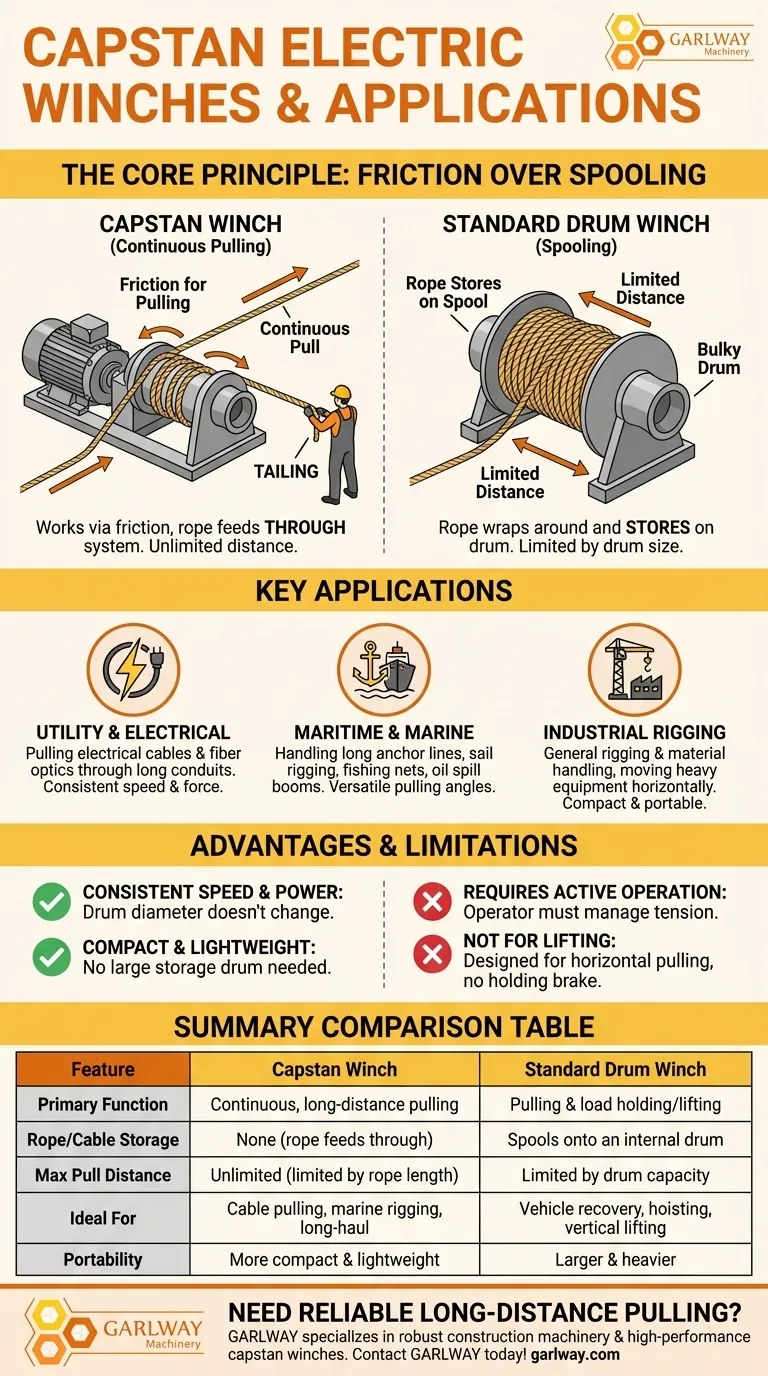
The Core Principle: Friction Over Spooling
To grasp the value of a capstan winch, it's essential to understand how it differs from the more common drum winch.
How a Standard Drum Winch Works
A traditional winch features a large drum that the rope or cable wraps around and is stored on. Its pulling distance is fundamentally limited by the amount of rope the drum can hold.
As the rope layers onto the drum, the effective diameter increases, which can slightly decrease pulling speed and power.
The Capstan Mechanism
A capstan winch works on a simpler, more elegant principle. The operator wraps the rope around the rotating capstan drum a few times.
The electric motor turns the drum, and the friction between the rope and the drum's surface generates the immense pulling force. The operator simply maintains light tension on the free end of the rope (a process called "tailing") to manage the pull.
The Unlimited Pull Advantage
Because the rope does not accumulate on the winch, the pulling length is limited only by the length of the rope you have available. The winch itself is merely the engine that moves the rope through the system.
Key Applications and Use Cases
The unique design of capstan winches makes them the superior choice for specific, demanding jobs.
Utility and Electrical Contracting
This is a primary application. Contractors use capstan winches to pull electrical cables and fiber optic lines through hundreds or thousands of feet of underground conduit with consistent speed and force.
Maritime and Marine Operations
In a marine environment, capstan winches are indispensable. They are used for handling long anchor lines, managing complex sail rigging, hauling in fishing nets, and deploying oil spill booms. Their ability to pull from various angles is a significant asset on a ship's deck.
Industrial Rigging
Within factories or large construction sites, capstan winches are used for general rigging and material handling, allowing crews to move heavy equipment horizontally over long distances with a compact and often portable tool.
Understanding the Trade-offs
While powerful, capstan winches are not a universal solution. Their strengths come with specific limitations.
Advantage: Consistent Speed and Power
A capstan winch pulls at a constant speed and with consistent power. This is because the drum's diameter never changes, unlike a spooling winch where the pull can slow as the drum fills with rope.
Advantage: Compact and Lightweight
Without the need for a large, heavy drum to store cable, the winch unit itself can be significantly smaller, lighter, and more portable than a traditional drum winch of comparable power.
Limitation: Requires Active Operation
A capstan winch is not a "set it and forget it" tool. It requires an operator to actively manage the free end of the rope to maintain friction and guide the line.
Limitation: Designed for Pulling, Not Lifting
Most capstan winches are rated for horizontal pulling, not for lifting or suspending loads. Their friction-based system is not designed to act as a brake to hold a load vertically, which is a critical safety feature of dedicated hoisting or drum winches.
Making the Right Choice for Your Task
Selecting the correct winch comes down to understanding the core nature of your work.
- If your primary focus is long-distance, continuous pulling: A capstan winch is the ideal solution, especially for tasks like pulling electrical cable through conduit or handling long marine lines.
- If your primary focus is vehicle recovery or hoisting a load: A traditional drum winch is the correct and safer choice, as it's designed to securely spool and hold a load under tension.
- If your primary focus is portability and consistent speed: A capstan winch offers a compact, lightweight design ideal for jobs where the tool needs to be moved frequently.
Understanding this fundamental difference in operation—friction versus storage—is the key to selecting the right tool for the job.
Summary Table:
| Feature | Capstan Electric Winch | Standard Drum Winch |
|---|---|---|
| Primary Function | Continuous, long-distance pulling | Pulling and load holding/lifting |
| Rope/Cable Storage | None (rope feeds through) | Spools onto an internal drum |
| Max Pull Distance | Unlimited (limited by rope length) | Limited by drum capacity |
| Ideal For | Cable pulling, marine rigging, long-haul tasks | Vehicle recovery, hoisting, vertical lifting |
| Portability | Typically more compact and lightweight | Often larger and heavier due to drum |
Need a reliable solution for long-distance pulling?
GARLWAY specializes in robust construction machinery, including high-performance capstan winches designed for demanding applications. Whether you're a contractor pulling cable or a marine operator handling rigging, our winches deliver consistent power and portability.
Contact GARLWAY today to discuss your project needs and find the perfect pulling solution!
Visual Guide
Related Products
- Electric and Hydraulic Winch for Heavy Duty Applications
- Small Electric Winch 120V and 240V for Compact Applications
- 12000 lb Heavy Duty Electric Boat Winch
- 12000 lb Electric Boat Trailer Winch with Windlass Anchor Warn
- Heavy Duty Electric Boat Winch Windlass Anchor
People Also Ask
- What are the differences between electric and hydraulic winches? Choose the Right Winch for Your Job
- What are some common uses for a heavy-duty winch? Power Your Construction & Industrial Projects
- What are electro-hydraulic winches and their applications? The Integrated Power Solution for Heavy-Duty Operations
- How do winches assist in bridge launching? Accelerate Bridge Placement with Controlled Pulling Power
- What are the benefits of using heavy-duty winches for large projects? Boost Efficiency & Safety