
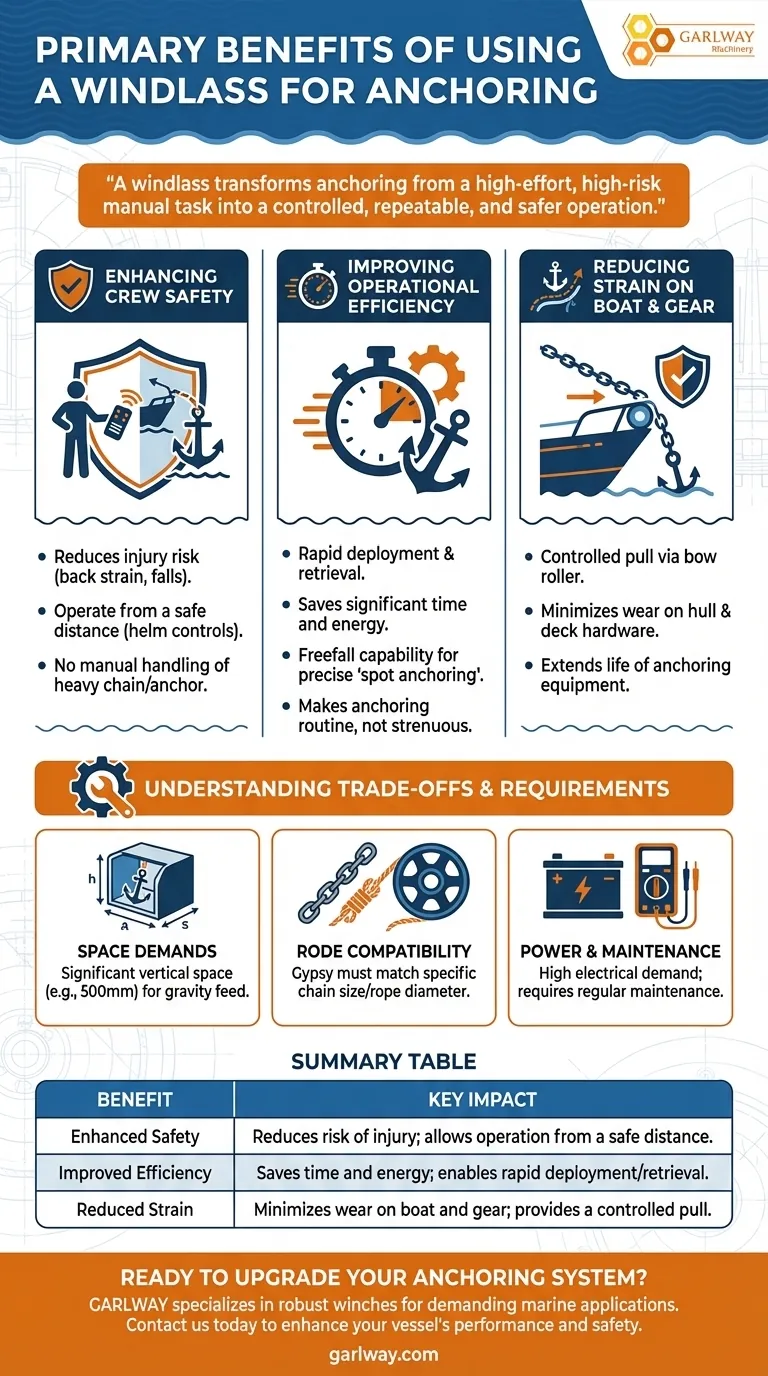
Beyond simple convenience, a windlass fundamentally changes the anchoring process by introducing mechanical advantage. Its primary benefits are a significant increase in safety, greater operational efficiency, and a marked reduction in physical strain and equipment wear, transforming a demanding task into a controlled procedure.
A windlass transforms anchoring from a high-effort, high-risk manual task into a controlled, repeatable, and safer operation. It's not just about lifting the anchor; it's about managing your boat's position with precision and security, especially when conditions are challenging.
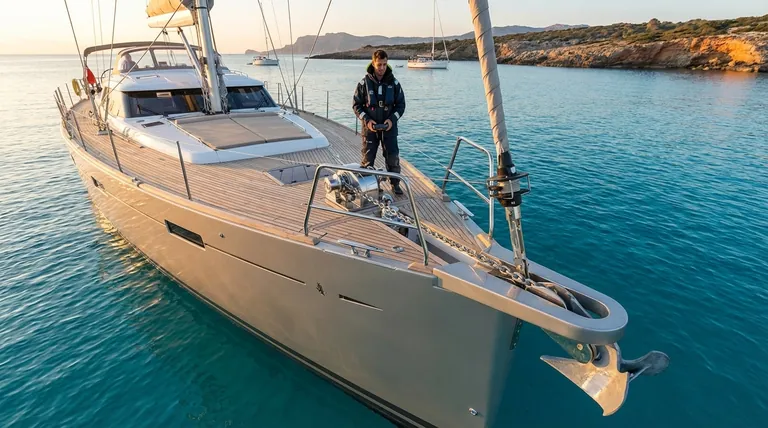
The Core Advantages of a Windlass System
A windlass isn't merely a luxury; it's a piece of core operational equipment that delivers tangible benefits in safety and performance. Understanding these advantages reveals why it's a standard feature on most modern cruising vessels.
Enhancing Crew Safety
The most critical benefit of a windlass is the improvement in crew safety. It allows the operator to deploy and retrieve the anchor from a safe distance, often with remote controls at the helm.
This drastically reduces the risk of injury associated with manual anchoring, such as back strain from lifting heavy loads or falls overboard while on a pitching bow in rough seas.
By mechanizing the process, you eliminate the need to wrestle with a heavy chain and anchor, ensuring a more secure and less physically taxing experience.
Improving Operational Efficiency
A windlass saves significant time and energy. It allows for rapid deployment and retrieval of the anchor, which is crucial when you need to set or move your position quickly.
Certain windlass types offer a freefall capability, which allows the anchor to drop swiftly. This is invaluable for "spot anchoring" accurately in strong wind or current.
For larger boats or those with heavy ground tackle, the efficiency gained makes anchoring a simple, routine task rather than a major physical undertaking.
Reducing Strain on Boat and Gear
Manually hauling an anchor often results in the chain or rope scraping against the hull, gelcoat, or deck hardware, causing unnecessary wear and tear over time.
A windlass provides a direct, controlled pull through a bow roller, guiding the anchor rode correctly and minimizing contact with the boat itself. This preserves your vessel's finish and extends the life of your anchoring equipment.
Understanding the Trade-offs and Requirements
While highly beneficial, integrating a windlass system requires careful consideration of its demands. It is not a simple drop-in accessory; it's an integrated system.
Space and Installation Demands
A windlass requires significant and specific space. A vertical windlass, for instance, needs a substantial amount of free vertical space—often at least 500mm—in the anchor locker beneath it.
This is necessary for gravity to pull the chain or rope off the gypsy and pile it correctly. An anchor well that is too shallow will cause the rode to jam the windlass from below.
Rode Compatibility is Non-Negotiable
A windlass is not a one-size-fits-all device. The notched wheel that grips the rode, called the gypsy, must be perfectly matched to your specific chain size or rope diameter.
Using an incorrectly sized rode will cause it to slip under load or jam in the mechanism, rendering the windlass useless when you need it most. For rope, specific types like an 8-stand plait are often required for proper grip.
Power and Maintenance Considerations
Electric windlasses place a high, short-term demand on your boat's electrical system. This requires adequate battery capacity and heavy-gauge wiring to function correctly without causing a significant voltage drop.
Like any mechanical system exposed to the harsh marine environment, a windlass also requires regular maintenance, including cleaning, lubrication, and inspection of electrical connections.
Making the Right Choice for Your Vessel
Selecting the right approach depends entirely on your boat, your budget, and how you sail.
- If your primary focus is safety in challenging conditions: A windlass is a critical upgrade, allowing you to manage anchoring without sending crew to an exposed bow.
- If your primary focus is convenience and solo operation: An electric windlass with remote controls at the helm dramatically simplifies the process, making it a push-button task.
- If your primary focus is reliability and budget on a smaller boat: A manual windlass provides essential mechanical advantage and safety without the cost and complexity of an electrical system.
Ultimately, a properly specified windlass provides confidence and control every time you drop anchor.
Summary Table:
| Benefit | Key Impact |
|---|---|
| Enhanced Safety | Reduces risk of injury; allows operation from a safe distance. |
| Improved Efficiency | Saves time and energy; enables rapid deployment/retrieval. |
| Reduced Strain | Minimizes wear on boat and gear; provides a controlled pull. |
Ready to upgrade your anchoring system with confidence?
GARLWAY specializes in robust construction machinery, offering reliable winches and other heavy-duty equipment ideal for demanding marine and industrial applications. Our solutions provide the power and durability you need for safe, efficient operations.
Contact GARLWAY today to discuss how our winches can enhance your vessel's performance and safety.
Visual Guide
Related Products
- Quick Windlass Portable Winch for Truck and Boat Best Boat Winch
- Warn Winch Windlass Boat Trailer Winch
- Electric Hoist Winch Boat Anchor Windlass for Marine Applications
- Heavy Duty Electric Boat Winch Windlass Anchor
- 12000 lb Electric Boat Trailer Winch with Windlass Anchor Warn
People Also Ask
- What features were incorporated into the upgraded portable winch system? Boost Your Recovery Power & Safety
- What are some uses mentioned for portable winches beyond vehicle recovery? Essential Versatility for Property & Work
- How could the twisting issue with a portable winch be mitigated? Achieve Safe, Centered Pulls with Proper Rigging
- What are the primary uses of a portable winch for a truck? Boost Your Truck's Capability and Self-Reliance
- What is the single rope traction force of the quick winch without a pulley block? 0.5 to 40 Tons Explained


