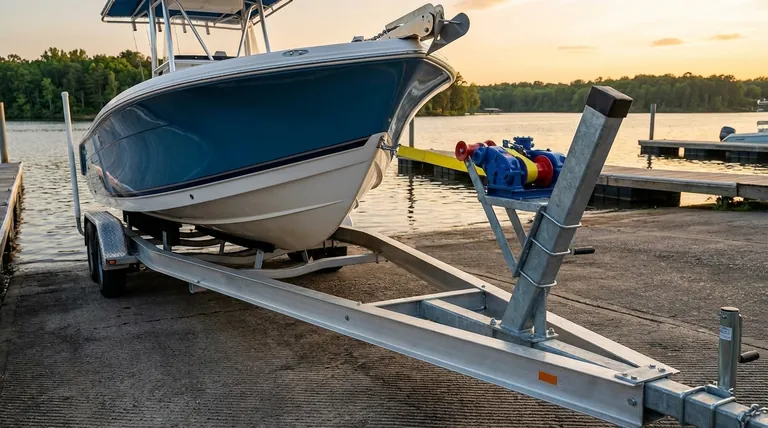
At its core, a boat winch attaches directly to the winch post or stand on a boat trailer. This dedicated, reinforced mounting point is specifically engineered to handle the significant pulling forces required to load your boat from the water safely and securely.
The winch's attachment point is less about a single component and more about a complete system. Proper mounting requires precise alignment with the boat's bow eye to ensure a straight, unimpeded pull, which is critical for both safety and preventing equipment damage.
The Anatomy of the Mounting System
A boat winch doesn't just bolt on anywhere. It connects to a specific part of the trailer designed to bear the load of your boat's full weight as it's being pulled from the water.
The Winch Post (or Stand)
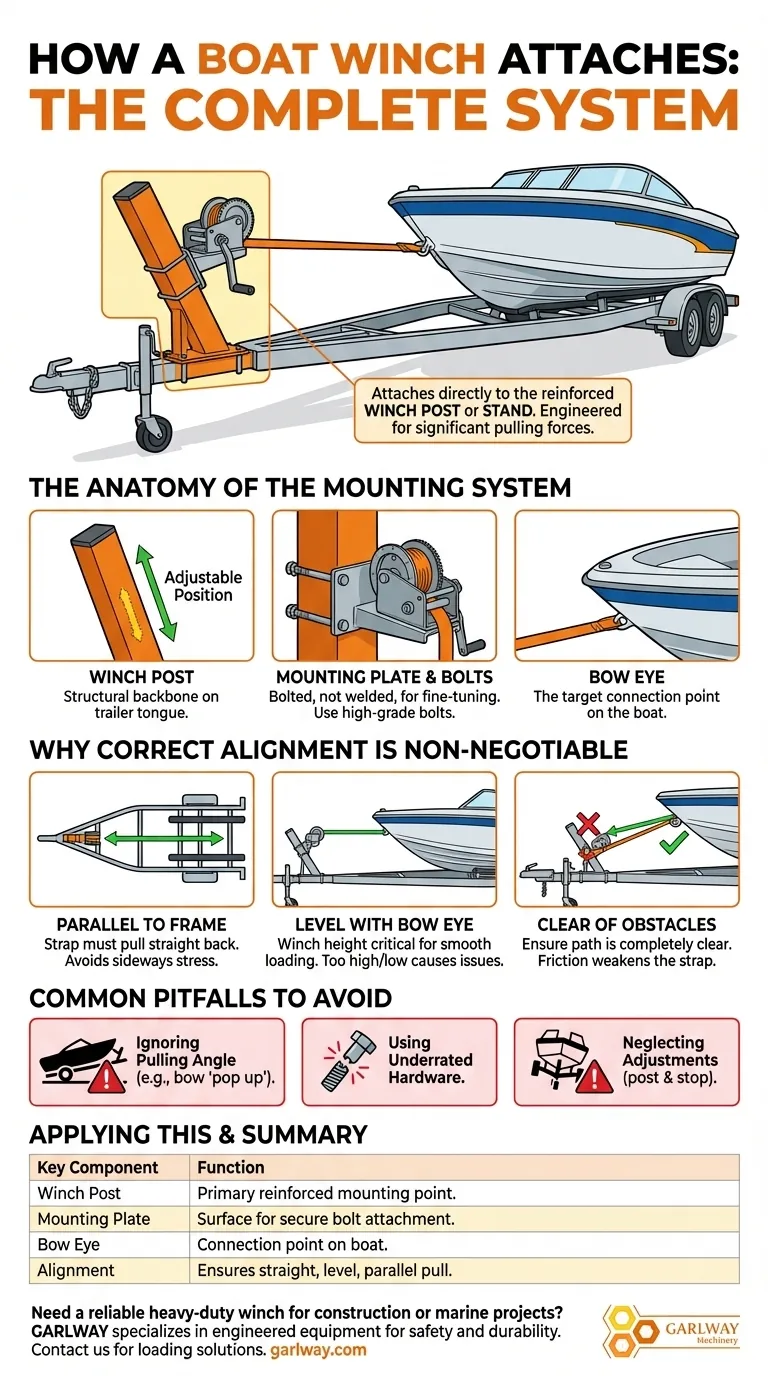
The primary mounting point is the winch post, a heavy-duty vertical support located at the very front of the trailer tongue. It is the structural backbone of the entire winching operation.
This post is typically adjustable, allowing you to move it forward or backward to perfectly match the length of your boat and ensure a secure fit against the bow stop.
The Mounting Plate and Bolts
The winch itself is almost always bolted, not welded, to a mounting plate on the winch post. This allows for replacement and fine-tuning of the winch's position.
Using high-grade, corrosion-resistant bolts is essential, as these fasteners are subjected to immense stress during loading.
Why Correct Alignment is Non-Negotiable
Simply attaching the winch is not enough. How it is aligned determines its effectiveness and safety. The goal is to create the straightest possible line of pull from the winch to the boat's bow eye.
Parallel to the Trailer Frame
The winch must be positioned so that the strap or cable pulls straight back, parallel to the trailer's main frame.
An off-center pull can cause the boat to load crookedly onto the bunks or rollers, and it places dangerous sideways stress on the winch strap and the winch mechanism itself.
Level with the Bow Eye
The height of the winch is critical. The winch strap should be about the same height as the bow eye on the front of your boat when it's ready to be loaded.
If the winch is too high, it will pull the bow down. If it's too low, it will pull the bow up. Either scenario prevents the boat from loading smoothly onto the trailer rollers and can damage the boat's hull.
Clear of Any Obstacles
Ensure the path between the winch drum and the bow eye is completely clear. The winch strap must not rub against the bow roller, the trailer frame, or any other component.
Constant friction, even if minor, will quickly fray and weaken the strap, creating a significant failure risk.
Common Pitfalls to Avoid
Incorrect mounting is a common source of frustration and potential danger. Understanding these mistakes is key to ensuring a secure and reliable setup.
Ignoring the Pulling Angle
The most frequent error is a poor vertical angle. A winch mounted too low can cause the boat's bow to "pop up" during retrieval, making it difficult to get the boat properly seated on the trailer.
Using Underrated Hardware
Never substitute the manufacturer-provided mounting bolts with lower-grade hardware. The bolts must be strong enough to handle the winch's maximum rated pulling capacity without shearing.
Neglecting Adjustments
Your trailer and winch setup must be customized to your specific boat. Failing to adjust the winch post and bow stop can lead to poor alignment and an insecure fit, allowing the boat to shift during transport.
Applying This to Your Goal
Your approach should be guided by your specific task, whether it's routine maintenance or a full installation.
- If your primary focus is replacing an old winch: Prioritize matching the new winch's size and bolt pattern to the existing post, ensuring its height maintains a level pull to your boat's bow eye.
- If your primary focus is installing a new winch system: Position the winch post first, then mount the winch to achieve a straight and level line of pull to the boat after it is properly seated on the trailer.
- If your primary focus is ensuring safe operation: Regularly inspect the mounting bolts for tightness and check that the winch strap is free from wear and tear caused by rubbing against any obstacles.
Properly securing your winch is the foundation for safe and stress-free boat loading and transport.
Summary Table:
| Key Component | Function |
|---|---|
| Winch Post | The primary, reinforced mounting point on the trailer tongue. |
| Mounting Plate | The surface the winch bolts onto for secure attachment. |
| Bow Eye | The point on the boat's bow where the winch strap connects. |
| Alignment | Ensures a straight, level pull parallel to the trailer frame. |
Need a reliable winch for your construction or marine project? GARLWAY specializes in heavy-duty winches, concrete mixers, and batching plants for construction companies and contractors worldwide. Our equipment is engineered for maximum safety and durability. Contact us today to find the perfect solution for your loading and hauling needs!
Visual Guide
Related Products
- Electric 120V Boat Winch by Badlands
- 12000 lb Electric Boat Trailer Winch with Windlass Anchor Warn
- Heavy Duty Electric Boat Winch Windlass Anchor
- 12000 lb Heavy Duty Electric Boat Winch
- Quick Windlass Portable Winch for Truck and Boat Best Boat Winch
People Also Ask
- How do electric boat winches work? Unlock Effortless Launching & Retrieval
- How much current does an electric boat winch draw? Plan Your Electrical System for Peak Performance
- Can I run a winch straight from a battery? Essential Power Setup for Safe Operation
- What are the types of electric winches available? Choose the Right Winch for Your Job
- What are the uses of electric winches in mining and tunneling? Enhance Safety and Efficiency Underground