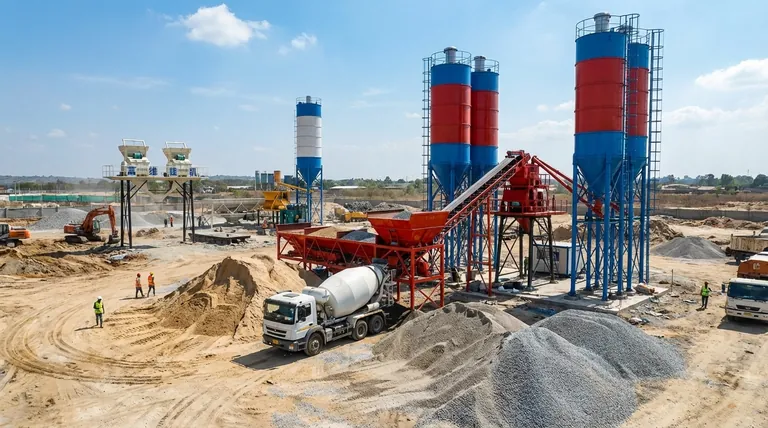
At its core, a concrete plant is a factory for manufacturing one of the world's most critical building materials. Its primary applications fall into three main categories: producing ready-mix concrete for delivery, creating precast concrete components in a controlled setting, and supplying massive volumes for large-scale civil infrastructure projects. These core functions support nearly every facet of modern construction.
A concrete plant's application is defined not just by what it makes, but by how and where that concrete will be used. The fundamental choice is between centralized production for broad distribution (ready-mix) and dedicated production for specialized products (precast) or massive projects (infrastructure).
The Three Pillars of Concrete Production
While the end product is always concrete, the operational model and purpose of the plant differ dramatically based on the target market. Understanding these distinctions is key to grasping their role in the industry.
Ready-Mix Concrete: Supplying the Urban Core
A ready-mix plant is the most common type. It operates as a central hub, producing concrete to specific customer orders and dispatching it in mixer trucks to various job sites.
This model is designed for flexibility and efficiency. It serves a wide range of customers simultaneously, from small residential foundations to large commercial buildings, providing the backbone for urban and suburban development.
Precast Applications: Manufacturing with Concrete
Precast concrete plants function more like traditional manufacturing facilities. Instead of delivering liquid concrete, they produce finished, standardized components in a highly controlled factory environment.
These components—such as wall panels, pipes, beams, and blocks—are then cured and transported to the construction site for assembly. This method offers superior quality control, reduces on-site labor, and can significantly accelerate project timelines.
Civil Infrastructure: Building on a Massive Scale
For major civil infrastructure projects like dams, bridges, highways, and airports, a dedicated concrete plant is often built directly on-site. The sheer volume and continuous demand for concrete make delivery from an off-site ready-mix plant impractical.
These on-site plants are engineered for high-output, consistent production to feed paving machines or large formworks without interruption, ensuring the structural integrity and efficiency of these monumental undertakings.
Specialized and Emerging Applications
Beyond the big three, concrete plant technology is adapted for several other industrial and environmental purposes, showcasing its versatility.
Mining and Industrial Uses
In the mining industry, concrete plants are used to produce material for structural support within tunnels and shafts. They also provide concrete for foundations for heavy machinery and processing facilities.
Construction Waste Recycling
Modern plants can be configured to incorporate recycled materials, such as crushed concrete from demolished structures, as a partial substitute for virgin aggregate. This application is critical for improving sustainability in the construction industry.
Dry Mix Mortar Production
While distinct from concrete, the same batching technology can be adapted to produce dry mix mortars, plasters, and grouts. These plants precisely combine sand, cement, and additives, packaging the final product for sale.
Common Pitfalls and Clarifications
To fully understand the role of a concrete plant, it's important to clear up common misconceptions about its function and limitations.
A Plant is a Batching System, Not Just a Mixer
The critical function of a concrete plant is not merely mixing, but precise batching. Its sophisticated systems weigh and measure exact quantities of cement, water, sand, and aggregates to produce a consistent, high-quality product that meets specific engineering requirements.
Plants Consume Aggregates, They Don't Produce Them
A concrete plant is a consumer of raw materials. While it processes sand and gravel as part of the concrete mix, it does not produce these aggregates itself. Aggregate production is a separate mining and crushing operation that supplies the plant.
Versatility Depends on Configuration
The term "concrete plant" covers a vast range of equipment, from small mobile units producing a few cubic meters per hour to massive stationary facilities capable of hundreds. The plant's design and scale are always dictated by its intended application.
Making the Right Choice for Your Goal
The optimal type of concrete plant operation is entirely dependent on the project's strategic objectives.
- If your primary focus is supplying multiple, varied construction sites: A ready-mix plant is the standard solution for its flexibility and logistical efficiency.
- If your primary focus is producing high-quality, standardized components at scale: A precast facility provides the controlled environment needed for consistent, manufactured results.
- If your primary focus is a single, large-scale infrastructure project: A dedicated, on-site batching plant is necessary to meet high-volume, continuous demand.
Ultimately, the concrete plant is a versatile tool whose true value is unlocked by correctly aligning its configuration with the specific demands of the project at hand.
Summary Table:
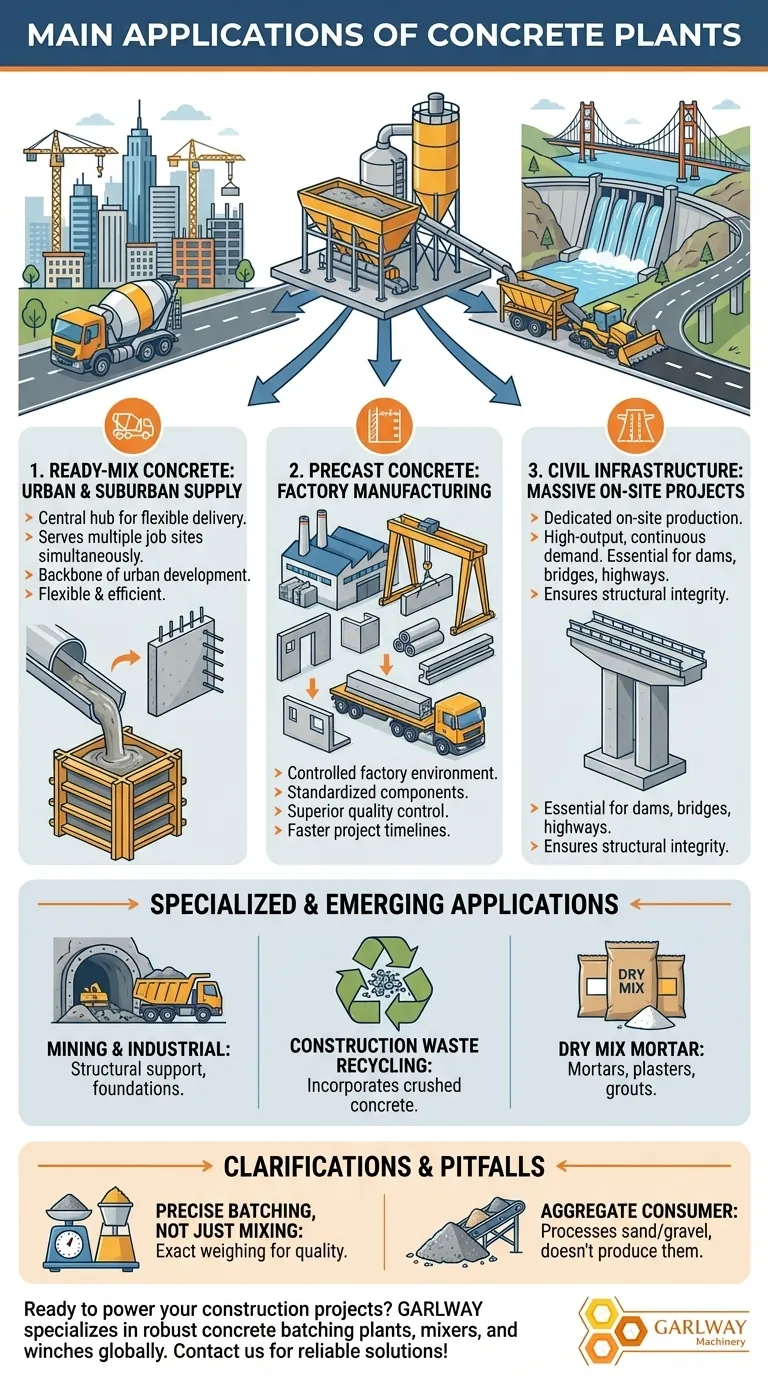
| Application | Primary Function | Key Characteristics |
|---|---|---|
| Ready-Mix Concrete | Supply liquid concrete to various job sites | Flexibility, serves multiple customers, urban development |
| Precast Concrete | Manufacture finished components in a factory | Superior quality control, reduced on-site labor, faster timelines |
| Civil Infrastructure | On-site supply for massive projects (dams, bridges) | High-output, continuous production, ensures structural integrity |
Ready to power your construction projects with the right concrete solution?
GARLWAY specializes in providing robust and efficient concrete batching plants, concrete mixers, and winches for construction companies and contractors globally. Whether you need a mobile unit for a specific project or a high-capacity stationary plant, our equipment is engineered for reliability and performance.
Contact GARLWAY today to discuss your project requirements and discover how our machinery can enhance your productivity and profitability.
Visual Guide
Related Products
- HZS180 Ready Mix Concrete Plant for Foundations with Sand and Cement
- HZS35 Small Cement Concrete Mixing Batch Plant
- HZS75 Concrete Batching Plant Cement Mixer Price Concrete Mixer Bunnings Mixing Plant
- HZS120 Ready Mix Concrete Batching Plant Commercial Mud Cement Mixer
- Commercial Electric Concrete Mixer Machine HZS 50 Small Batch Plant for Sale
People Also Ask
- What is a ready mix concrete batching plant? The Engine of Modern Construction
- What is the name of the machine used in ready mix? Unpacking the Complete Concrete System
- What systems are included in a ready-mix concrete plant? A Guide to the 6 Core Systems
- How does a ready-mix concrete plant work? A Guide to Efficient, High-Quality Production
- What are the components of a ready mix concrete plant? A Guide to Precision and Efficiency