
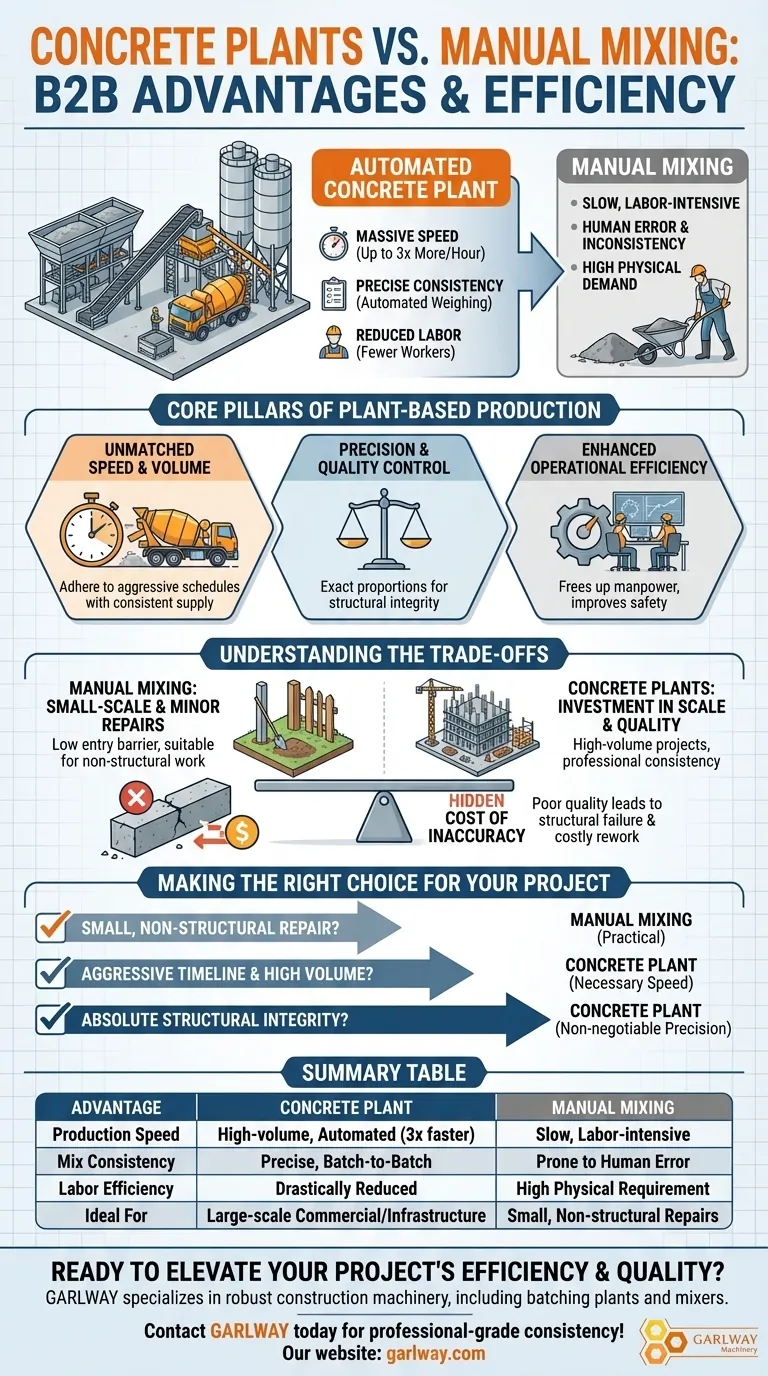
The primary advantages of a concrete plant over manual mixing are a massive increase in production speed, vastly improved product consistency, and a significant reduction in labor requirements. An automated plant can produce up to three times more concrete per hour while ensuring that every batch meets precise quality specifications, a level of control that is nearly impossible to achieve by hand.
The choice between a concrete plant and manual mixing is fundamentally a choice between industrial-scale predictability and small-scale convenience. While manual mixing has its place, a concrete plant is essential for any project where volume, speed, and structural integrity are critical concerns.
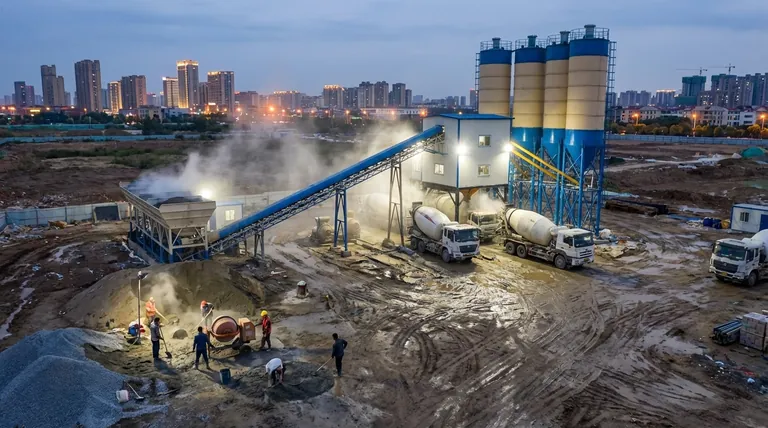
The Core Pillars of Plant-Based Production
The shift from manual labor to an automated concrete plant is driven by three key factors: speed, precision, and efficiency. Each of these directly impacts project timelines, budgets, and the final quality of the structure.
Unmatched Speed and Volume
A concrete batching plant is designed for high-throughput production. By automating the process of measuring, loading, and mixing, it can generate vast quantities of concrete in a fraction of the time required by a manual team.
This capability allows projects to adhere to aggressive schedules, as a consistent supply of concrete is always available for large pours.
Precision and Quality Control
The most significant advantage of a plant is its ability to produce a perfectly consistent mix, batch after batch. Automated weighing equipment ensures that the proportions of cement, aggregate, and water are exact every time.
Manual weighing and mixing are prone to human error, leading to inaccurate measurements. These inaccuracies can severely compromise the strength, durability, and overall quality of the finished concrete.
Enhanced Operational Efficiency
Concrete plants drastically reduce the time and physical labor needed for production. They can produce larger quantities of concrete with fewer workers, freeing up manpower for other critical tasks on the job site.
This reduction in labor effort not only saves time but also improves working conditions and lowers the risk of on-site injuries associated with heavy manual work.
Understanding the Trade-offs
While the benefits of a concrete plant are clear for large-scale operations, the correct choice always depends on the specific demands of the project. Acknowledging the context is key to making a sound decision.
Manual Mixing: The Case for Small-Scale Work
Manual mixing remains a viable option for very small, non-structural applications. For tasks like setting a single fence post or patching a small sidewalk, the setup cost and logistics of a concrete plant are not justifiable.
Its main advantage is its low barrier to entry and suitability for minor repairs where precise mix consistency is not a structural requirement.
Concrete Plants: The Investment in Scale
A concrete batching plant represents a significant investment in equipment and logistics. It is designed for projects that demand high volumes of concrete on a recurring basis, such as commercial building construction, infrastructure projects, or precast manufacturing.
The efficiency and quality it provides only deliver a return on investment when deployed at a sufficient scale.
The Hidden Cost of Inaccuracy
The primary risk of relying on manual mixing for larger or structural jobs is the cost of poor quality. An inconsistent batch of concrete can lead to structural weaknesses, failed inspections, and the need for costly rework.
The precision offered by an automated plant is a form of insurance against these potentially catastrophic and expensive failures, making it the standard for modern construction.
Making the Right Choice for Your Project
Selecting the appropriate mixing method comes down to balancing project scale, quality requirements, and budget.
- If your primary focus is a small, non-structural repair: Manual mixing is often the most practical and cost-effective solution.
- If your primary focus is meeting aggressive project timelines with high volume: A concrete plant is the only method that can deliver the necessary speed and output.
- If your primary focus is ensuring absolute structural integrity and quality: The automated precision of a concrete plant is non-negotiable.
Ultimately, choosing an automated concrete plant is an investment in professional-grade consistency, safety, and efficiency.
Summary Table:
| Advantage | Concrete Plant | Manual Mixing |
|---|---|---|
| Production Speed | High-volume, automated (up to 3x faster) | Slow, labor-intensive |
| Mix Consistency | Precise, batch-to-batch uniformity | Prone to human error and inconsistency |
| Labor Efficiency | Drastically reduced manpower | High physical labor requirement |
| Ideal For | Large-scale commercial and infrastructure projects | Small, non-structural repairs |
Ready to elevate your project's efficiency and quality?
For construction companies and contractors working on large-scale projects, the precision, speed, and labor savings of an automated concrete batching plant are essential for success. GARLWAY specializes in providing robust and reliable construction machinery, including concrete batching plants, concrete mixers, and winches, designed to meet the rigorous demands of global construction sites.
Invest in professional-grade consistency and unlock superior operational efficiency. Contact GARLWAY today to discuss the perfect concrete production solution for your next project!
Visual Guide
Related Products
- HZS120 Ready Mix Concrete Batching Plant Commercial Mud Cement Mixer
- HZS35 Small Cement Concrete Mixing Batch Plant
- HZS75 Concrete Batching Plant Cement Mixer Price Concrete Mixer Bunnings Mixing Plant
- HZS180 Ready Mix Concrete Plant for Foundations with Sand and Cement
- Commercial Electric Concrete Mixer Machine HZS 50 Small Batch Plant for Sale
People Also Ask
- What is a ready mix concrete batching plant? The Engine of Modern Construction
- What is the name of the machine used in ready mix? Unpacking the Complete Concrete System
- What is the core component of a concrete batching plant? The Mixer Unit Defines Your Concrete Quality
- What are the types of concrete mixers used in batching plants? Choose the Right Mixer for Your Project
- What are the advantages and disadvantages of concrete batching plants? Maximize Quality & Efficiency





