For moving bulk powders and granular materials, the most common and widely adopted method is the screw conveyor. Its dominance is a direct result of a robust, simple design that provides a cost-effective and reliable solution for a vast range of industrial applications.
While the screw conveyor is the default choice for its simplicity and cost, the truly optimal method for conveying powder is dictated by your material's characteristics, the required distance, and your process's sensitivity to product degradation.
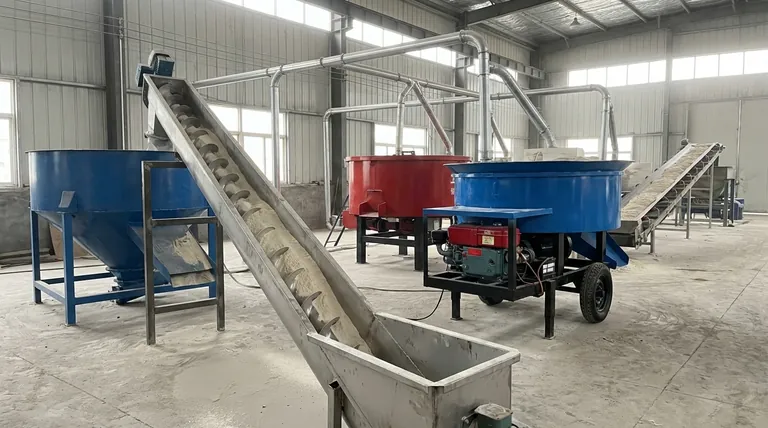
Why Screw Conveyors Dominate
The screw conveyor, also known as an auger conveyor, operates on a straightforward principle: a rotating helical screw blade moves material forward within a trough or tube. This mechanical simplicity is the foundation of its widespread use.
Mechanical Simplicity and Reliability
The design involves very few moving parts, which directly translates to lower maintenance requirements and greater operational uptime. This inherent reliability makes it a trusted workhorse in many industries.
Cost-Effectiveness
Compared to more complex systems, screw conveyors have a significantly lower initial purchase price and installation cost. This accessibility makes them the go-to economic choice for countless standard applications.
Unmatched Versatility
Screw conveyors can handle an enormous variety of materials, from fine powders to granular solids. They can be configured to operate at various inclines and are easily adapted for tasks beyond simple transport, such as dosing, mixing, or cooling.
Exploring the Alternatives
While common, the screw conveyor is not always the best solution. Understanding the alternatives is critical for optimizing a process, especially when dealing with sensitive materials or complex facility layouts.
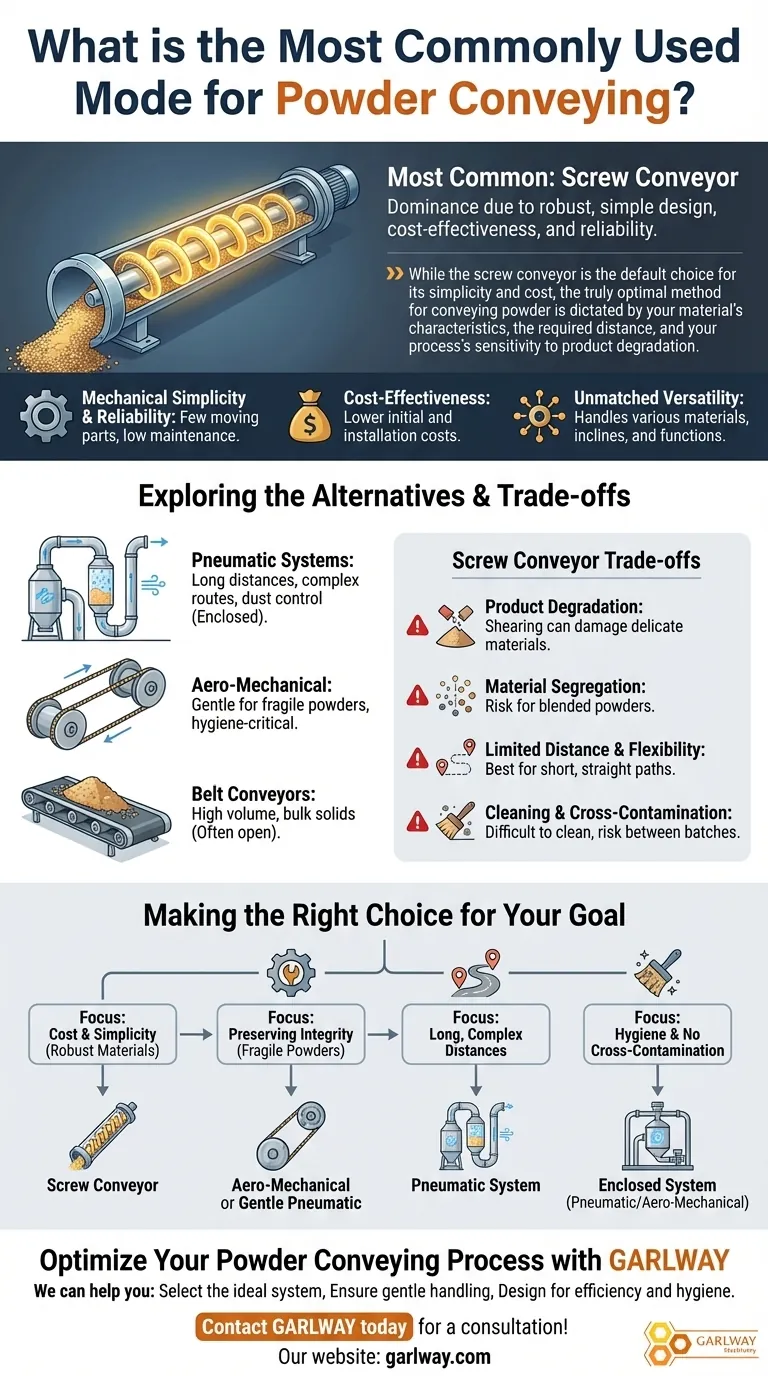
Pneumatic Conveying Systems
These systems use a stream of air to move material through a network of sealed pipes. They excel at moving powders over long distances and around obstacles where a straight-line mechanical conveyor is impractical. They are also fully enclosed, which is ideal for dust control.
Aero-Mechanical Conveyors
An aero-mechanical conveyor uses a high-speed rope assembly with evenly spaced discs that travel within a sealed tube. This method creates an air stream that fluidizes and gently moves the material, making it excellent for fragile products that must not be degraded.
Belt Conveyors
A belt conveyor is a simple and efficient way to move large volumes of material, but it is typically open to the environment. While effective for bulk solids, it is often less suitable for fine, dusty powders unless it is fully enclosed, which adds to its cost and complexity.
Understanding the Trade-offs of Screw Conveyors
Trusting the screw conveyor by default can lead to significant process issues if its limitations are not considered. Its primary drawbacks are related to the mechanical force it exerts on the material.
Potential for Product Degradation
The shearing and tumbling action of the rotating screw can easily break down friable or delicate materials. This can alter the particle size distribution, damage crystals, or compromise the quality of the final product.
Risk of Material Segregation
For blended powders with varying particle sizes and densities, the conveying action can cause segregation. Finer particles may sift to the bottom, resulting in an inconsistent product mix at the discharge point.
Limited Distance and Flexibility
Screw conveyors are inefficient for moving materials over very long distances. Furthermore, they are primarily limited to straight-line paths, making them less flexible for complex plant layouts compared to pneumatic systems.
Cleaning and Cross-Contamination
Thoroughly cleaning a screw conveyor can be a time-consuming and difficult process. This presents a major risk of cross-contamination between batches, a critical concern in the food, pharmaceutical, and chemical industries.
Making the Right Choice for Your Goal
Selecting a conveyor is not just about moving material from point A to point B; it's about protecting product quality and maximizing process efficiency.
- If your primary focus is cost and simplicity for robust materials: The screw conveyor is almost always the correct starting point.
- If your primary focus is preserving the integrity of fragile powders: An aero-mechanical or a gentle dense-phase pneumatic conveyor is a superior choice.
- If your primary focus is moving powder over long, complex distances: A pneumatic conveying system offers routing flexibility that mechanical systems cannot match.
- If your primary focus is hygiene and preventing cross-contamination: A fully enclosed and easily cleaned system like a pneumatic or aero-mechanical conveyor is essential.
Choosing the right system ensures your conveying process is an asset to your operation, not a liability.
Summary Table:
| Conveyor Type | Best For | Key Advantage | Main Limitation |
|---|---|---|---|
| Screw Conveyor | Robust materials, short distances | Cost-effective, mechanically simple | Risk of product degradation |
| Pneumatic System | Long, complex routes, dust control | Flexible routing, fully enclosed | Higher initial cost |
| Aero-Mechanical | Fragile powders, hygiene-critical | Gentle handling, easy to clean | Limited distance/capacity |
| Belt Conveyor | Bulk solids, high volume | Simple and efficient | Often open, not ideal for fine powders |
Optimize Your Powder Conveying Process with GARLWAY
Choosing the right conveying system is critical for protecting your product quality and maximizing operational efficiency. GARLWAY specializes in providing robust construction machinery, including customized conveying solutions for construction companies and contractors globally.
We can help you:
- Select the ideal system based on your specific material properties and process requirements.
- Ensure gentle handling of fragile materials to prevent degradation.
- Design for efficiency and hygiene, minimizing downtime and cross-contamination risks.
Let our experts help you move your materials more effectively. Contact GARLWAY today for a consultation and discover how our expertise in winches, concrete mixers, and batching plants extends to optimizing your entire material handling process!
Visual Guide
Related Products
- Auto Concrete Cement Mixer Machine New
- HZS25 Best Cement Mixer for Quick Mix Concrete at Bunnings
- Portable Electric Small Cement Mixer Concrete Machine
- Shaft Mixer Machine for Cement and Regular Concrete Mixing
- Concrete Cement Mixer Machine Drum Mixer for Construction
People Also Ask
- What are the four factors to consider when selecting a concrete mixer? Optimize Your Construction Project
- What are the two main types of concrete mixers and their uses? Choose the Right Mixer for Your Project
- What is a concrete mixer and what does it do? Achieve Consistent, High-Strength Concrete
- What are the benefits of using a concrete mixer on construction sites? Boost Efficiency and Quality
- How should water be added when mixing concrete? A Guide to Achieving Perfect Strength & Workability