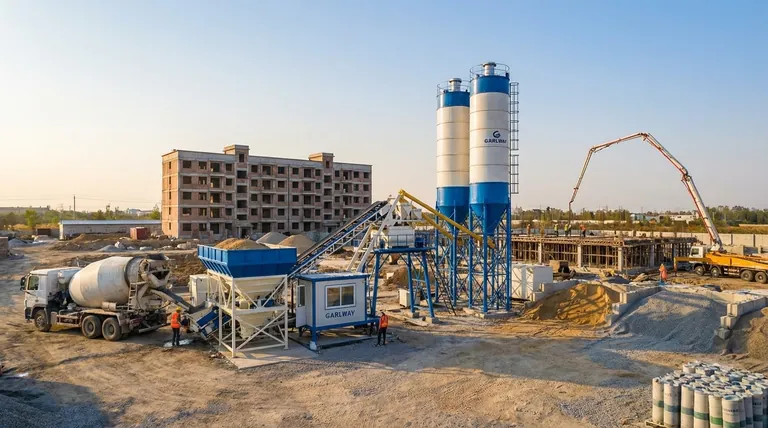
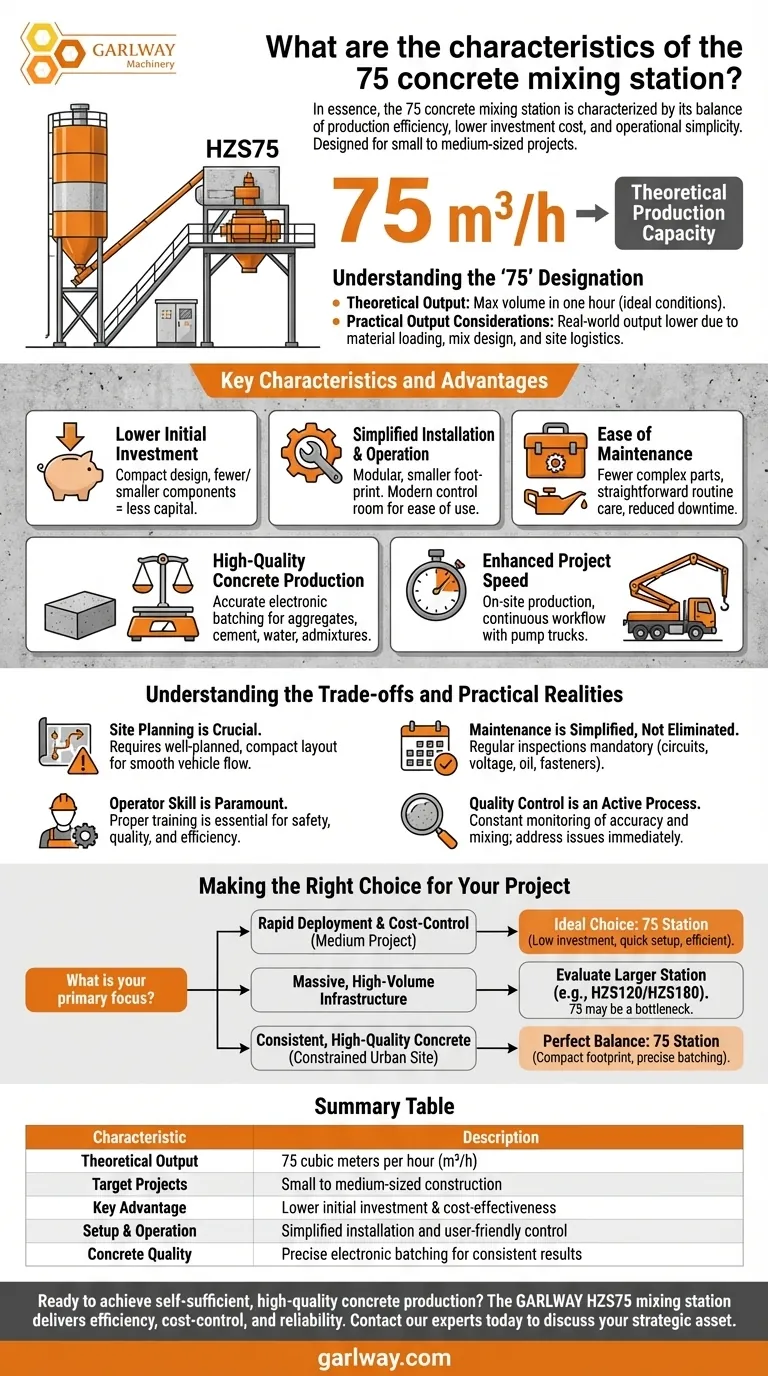
In essence, the 75 concrete mixing station is characterized by its balance of production efficiency, lower investment cost, and operational simplicity. It is specifically designed for small to medium-sized construction projects, offering accurate batching for high-quality concrete without the significant footprint or financial outlay of larger industrial plants.
The core takeaway is that the "75" station is not simply a smaller piece of equipment; it is a strategic asset for projects that require on-site, quality-controlled concrete production with a focus on cost-effectiveness, rapid setup, and ease of maintenance.
Understanding the "75" Designation
The number "75" in a model like the HZS75 typically refers to its theoretical production capacity.
Theoretical Output of 75 m³/h
This figure represents the maximum volume of concrete the station can produce in one hour under ideal conditions. It serves as a benchmark for comparing different models and planning project timelines.
Practical Output Considerations
Real-world output will often be slightly lower than the theoretical maximum. Factors like material loading times, specific concrete mix designs, and overall site logistics will influence the actual production rate.
Key Characteristics and Advantages
The design of the 75 mixing station is centered around practicality and efficiency for its target projects.
Lower Initial Investment
Compared to larger-capacity stations, the 75 model requires less initial capital. This is due to its more compact design, which involves fewer and smaller pieces of equipment.
Simplified Installation and Operation
Its smaller footprint and modular nature make it significantly easier and faster to install on a job site. For operators, it can be equipped with a modern, high-performance control room that simplifies monitoring and ensures safe, convenient operation.
Ease of Maintenance
With fewer complex components, routine maintenance is more straightforward. This reduces downtime and lowers long-term operational costs, a critical factor for smaller construction teams.
High-Quality Concrete Production
Despite its smaller scale, the 75 station features accurate electronic batching systems for aggregates, cement, water, and admixtures. This precision ensures the production of consistent, high-quality concrete that meets stringent project specifications.
Enhanced Project Speed
By producing concrete on-site, projects avoid the delays and logistical challenges of relying on third-party suppliers. When paired with equipment like concrete pump trucks, it enables a continuous and rapid construction workflow, especially for small to medium-sized builds.
Understanding the Trade-offs and Practical Realities
While advantageous, opting for a 75 station requires a clear understanding of its operational requirements and limitations.
Site Planning is Crucial
The station's efficiency is heavily dependent on a well-planned site layout. The layout must be compact to save space but also designed for smooth vehicle flow, with separate entrances and circular roads to prevent traffic jams.
Maintenance is Simplified, Not Eliminated
"Easier to maintain" does not mean "maintenance-free." Regular inspections are mandatory for safe and reliable operation. This includes checking all electrical circuits for proper grounding, monitoring power supply voltage, checking gear oil levels, and ensuring all fasteners and safety guards are secure.
Operator Skill is Paramount
The quality of the final product depends on the skill of the personnel operating the station. Proper training on the control system, material calculation, and safety protocols is essential to prevent accidents and ensure the concrete mix meets design requirements.
Quality Control is an Active Process
During operation, operators must constantly monitor measurement accuracy and mixing times. Any abnormality, such as a leak at a discharge outlet, must be identified and repaired immediately to prevent waste and maintain quality.
Making the Right Choice for Your Project
Selecting the right mixing station is about aligning the equipment's capabilities with your specific project goals.
- If your primary focus is rapid deployment and cost-control for a medium-sized project: The 75 station's low initial investment, quick setup, and operational efficiency make it an ideal choice.
- If your primary focus is supplying a massive, high-volume infrastructure project: You should evaluate a larger station (e.g., HZS120 or HZS180), as the 75's capacity could become a production bottleneck.
- If your primary focus is achieving consistent, high-quality concrete on a constrained urban site: The 75 station offers a perfect balance of a compact footprint and precise batching capabilities.
Ultimately, the 75 concrete mixing station provides project teams with self-sufficient, high-quality, and efficient concrete production without the overhead of a large-scale industrial plant.
Summary Table:
| Characteristic | Description |
|---|---|
| Theoretical Output | 75 cubic meters per hour (m³/h) |
| Target Projects | Small to medium-sized construction |
| Key Advantage | Lower initial investment & cost-effectiveness |
| Setup & Operation | Simplified installation and user-friendly control |
| Concrete Quality | Precise electronic batching for consistent results |
Ready to achieve self-sufficient, high-quality concrete production for your next project? The GARLWAY HZS75 mixing station is engineered to deliver the perfect balance of efficiency, cost-control, and reliability for construction companies and contractors.
Contact our experts today to discuss how this station can be the strategic asset your project needs.
Visual Guide
Related Products
- HZS75 Concrete Batching Plant Cement Mixer Price Concrete Mixer Bunnings Mixing Plant
- HZS90 Large Multiquip Concrete Mixers for Construction
- Portable Cement Mixer with Lift Concrete Machine
- Commercial Electric Concrete Mixer Machine HZS 50 Small Batch Plant for Sale
- HZS25 Best Cement Mixer for Quick Mix Concrete at Bunnings
People Also Ask
- What is the core component of a concrete batching plant? The Mixer Unit Defines Your Concrete Quality
- What are the advantages and disadvantages of concrete batching plants? Maximize Quality & Efficiency
- What are the types of concrete mixers used in batching plants? Choose the Right Mixer for Your Project
- What types of admixtures are used in concrete batching plants? Enhance Performance & Durability
- What types of projects are concrete batching plants commonly used for? Essential for Large-Scale Construction