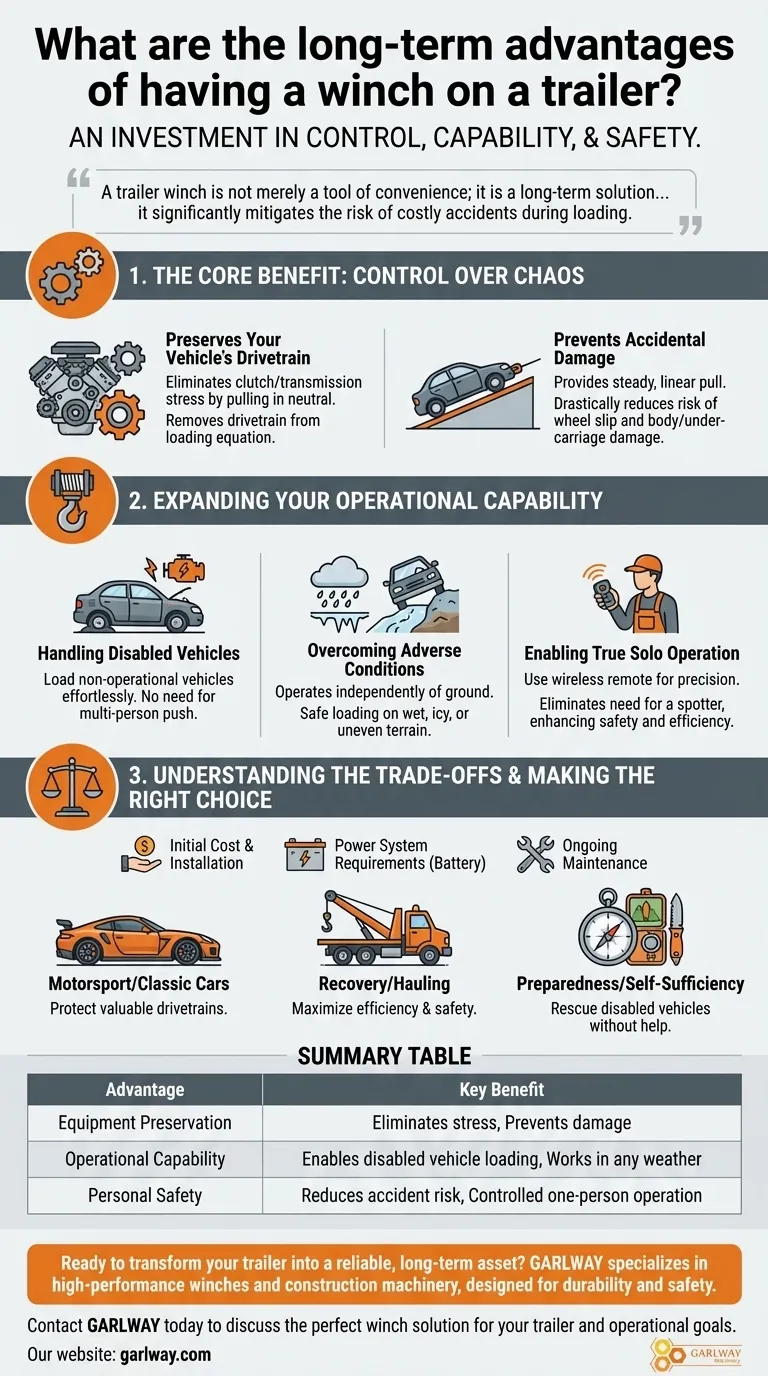
In the long term, a winch on a trailer is an investment that pays dividends in three critical areas: equipment preservation, operational capability, and personal safety. It fundamentally transforms the act of loading from a high-risk, multi-person task into a controlled, predictable, one-person operation, protecting both your vehicle and yourself from unnecessary wear and tear.
A trailer winch is not merely a tool of convenience; it is a long-term solution that provides the capability to handle any vehicle in any condition, reduces cumulative stress on your equipment, and significantly mitigates the risk of costly accidents during loading.
The Core Benefit: Control Over Chaos
The primary function of a winch is to replace uncontrolled force (like driving or pushing) with slow, manageable, and reversible power. This principle is the source of all its long-term advantages.
It Preserves Your Vehicle's Drivetrain
Driving a car, especially one with a manual transmission, up steep trailer ramps puts significant stress on the clutch. This repeated, high-torque slipping action accelerates wear far more than regular driving.
A winch completely eliminates this problem. By pulling the vehicle in neutral, it removes the entire drivetrain from the loading equation, preserving the clutch and transmission for their intended purpose.
It Prevents Accidental Damage
Manually pushing a vehicle or "feathering" the clutch to get it onto a trailer introduces a high degree of risk. A slight misalignment or a wet ramp can easily lead to a wheel slipping off, causing damage to the vehicle's bodywork, undercarriage, or the trailer itself.
A winch provides a steady, linear pull. This gives you precise control to guide the vehicle perfectly onto the trailer, drastically reducing the chance of expensive loading errors over the life of your equipment.
Expanding Your Operational Capability
A winch-equipped trailer is fundamentally more versatile than one without. It prepares you for scenarios that would otherwise be impossible to handle alone.
Handling the Inevitable: Disabled Vehicles
The most compelling reason for a winch is its ability to load a non-operational vehicle. A car with a dead battery, a failed engine, or a locked-up drivetrain cannot be driven onto a trailer.
Without a winch, this situation requires multiple people, come-alongs, or other cumbersome methods. With a winch, it becomes a straightforward, manageable task for one person.
Overcoming Adverse Conditions
Loading on wet, icy, or uneven ground is inherently dangerous. Tires can easily lose traction, causing the vehicle to slide unpredictably.
A winch operates independently of ground conditions. Its consistent pulling force ensures the vehicle can be loaded safely and securely, regardless of the weather or terrain.
Enabling True Solo Operation
Many tasks require a second person purely for safety or physical assistance. A winch often eliminates the need for a spotter or helper during loading.
Using a wireless remote, you can stand wherever you have the best view, guiding the vehicle onto the trailer with precision and complete control, enhancing both efficiency and safety.
Understanding the Trade-offs
While the advantages are significant, a winch is an investment that requires consideration of its own costs and responsibilities.
Initial Cost and Installation
A quality winch, mounting plate, and a dedicated battery system represent a notable upfront expense. This initial investment must be weighed against the potential costs of vehicle damage or the inconvenience of being unable to move a disabled car.
Power System Requirements
A powerful winch requires a reliable power source. This often means installing a separate deep-cycle battery on the trailer to avoid draining the tow vehicle's battery and to ensure consistent power during a long pull.
Ongoing Maintenance
Like any mechanical system, a winch requires occasional maintenance. This includes checking the battery, inspecting the synthetic rope or steel cable for wear, and ensuring electrical connections are clean and secure.
Making the Right Choice for Your Goal
Ultimately, the decision to add a winch depends on how you use your trailer and the problems you want to solve.
- If your primary focus is motorsport or classic cars: A winch is essential for protecting valuable, often irreplaceable, drivetrains and bodies from loading stress and accidents.
- If your primary focus is recovery or frequent hauling: A winch is a non-negotiable tool of the trade that ensures you are prepared for any vehicle condition, maximizing your efficiency and safety.
- If your primary focus is preparedness and self-sufficiency: A winch provides the critical capability to rescue your own or others' disabled vehicles without relying on outside help.
A winch transforms your trailer from a simple hauler into a capable and reliable piece of recovery equipment.
Summary Table:
| Advantage | Key Benefit |
|---|---|
| Equipment Preservation | Eliminates stress on clutch/transmission; prevents accidental body damage. |
| Operational Capability | Enables loading of disabled vehicles; works in any weather or terrain. |
| Personal Safety | Reduces risk of accidents; allows for controlled, one-person operation. |
Ready to transform your trailer into a reliable, long-term asset?
GARLWAY specializes in high-performance winches and construction machinery, designed for durability and safety. Our winches provide the controlled power construction companies and contractors need to protect their equipment and enhance on-site efficiency.
Contact GARLWAY today to discuss the perfect winch solution for your trailer and operational goals.
Visual Guide
Related Products
- 12000 lb Electric Boat Trailer Winch with Windlass Anchor Warn
- Portable Small Trailer Winch
- Best 18000 Pound Drum Anchor Trailer Winch
- Warn Winch Windlass Boat Trailer Winch
- Quick Windlass Portable Winch for Truck and Boat Best Boat Winch
People Also Ask
- How does an electric boat trailer winch differ from a manual one? Effort vs. Control Explained
- What size winch do I need for my boat? Get the Right Capacity for Safe Hauling
- How should a boat trailer winch be properly used? A Step-by-Step Guide for Safe Loading
- What maintenance steps are specific to boat trailer winches? Ensure Safety & Reliability at the Ramp
- How strong of a winch do I need for my boat? Get the Right Pulling Power for Trailering & Anchoring