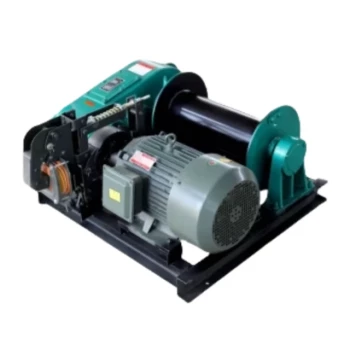
At their core, electric hoists are fundamental tools for industrial material handling. They are most commonly applied in manufacturing facilities, on construction sites, in warehouses, and within heavy industries like mining and shipbuilding to vertically lift, lower, and transport heavy objects with precision and efficiency.
The true value of an electric hoist lies not just in its lifting capability, but in its role as a force multiplier for productivity. It automates strenuous tasks, enhances workplace safety, and provides a powerful, space-efficient alternative to manual labor or larger conveyor systems.
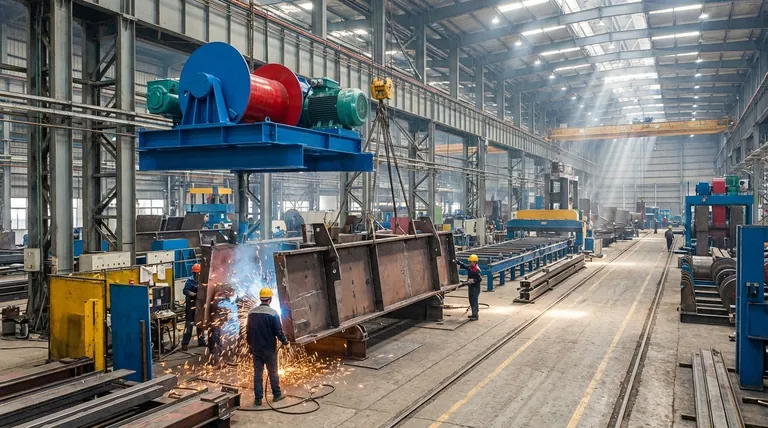
Core Industrial Applications
An electric hoist's utility is defined by the environment it serves. Its design—combining an electric motor, a durable wire rope or chain, and a control system—makes it uniquely suited for a range of demanding tasks.
In Manufacturing and Assembly
Electric hoists are indispensable on the modern factory floor. They automate the repetitive lifting and positioning of heavy components, directly boosting production speed.
You will find them integrated into assembly lines for tasks like placing engine blocks in the automotive industry or positioning large parts for welding and fabrication. This minimizes manual labor and improves workplace ergonomics.
On Construction and Infrastructure Sites
In construction, power and capacity are paramount. Electric hoists are used for the installation and movement of large concrete structures, steel beams, and heavy mechanical equipment.
Their application extends to major infrastructure projects, including bridge construction, power plant development, and tunnel management, where they handle materials in challenging or constrained environments.
Within Warehousing and Logistics
Efficiency is the primary driver in logistics. Electric hoists are often integrated into overhead crane or monorail systems to load and unload heavy freight and move inventory.
They offer a significant advantage in areas where forklifts may not be feasible, providing vertical lifting capability without occupying valuable floor space.
In Specialized and Heavy Industries
The most demanding environments rely on the durability of electric hoists. In mining, they are critical for hoisting materials and equipment from deep shafts.
Similarly, in shipbuilding and metallurgy, they are used to maneuver massive sections and components with the precision required for complex assembly and processing.
The Functional Advantage: Why Choose an Electric Hoist?
Understanding where hoists are used is only half the picture. The real insight comes from understanding why they are the superior choice for these applications.
Speed and Efficiency
Electric hoists operate significantly faster than manual or pneumatic alternatives. This speed translates directly into reduced cycle times and increased operational throughput, making them ideal for high-volume production and logistics.
Power and Capacity
Driven by powerful electric motors, these hoists are engineered to handle substantial loads. Their large rope or chain capacity allows them to lift heavy objects to significant heights, a requirement common in construction and mining.
Precision and Control
Modern electric hoists feature sophisticated control systems, often with variable speed options. This allows operators to position heavy and often expensive materials with exceptional accuracy, reducing the risk of damage during assembly or installation.
Versatility and Integration
An electric hoist can function as a standalone unit suspended from a fixed point or be integrated into a larger system. They are the core lifting component of overhead cranes, jib cranes, and gantry cranes, making them a highly adaptable solution.
Key Considerations and Trade-offs
While powerful, the effective deployment of an electric hoist depends on a clear understanding of its operational requirements and limitations.
The Need for a Stable Structure
An electric hoist is only as strong as its mounting point. Proper installation on a structural frame, I-beam, or crane system is critical for safe operation. The support structure must be professionally rated to handle the maximum load.
Maintenance Is Non-Negotiable
Safety and longevity depend entirely on regular maintenance. Pre-operation checks, routine inspections of the wire rope and braking system, and professional servicing are essential to prevent equipment failure.
Power Source Dependency
Unlike a manual hoist, an electric model requires a reliable source of electricity. This can be a limiting factor on remote job sites or during power outages, where a backup plan would be necessary.
Making the Right Choice for Your Goal
To apply this knowledge effectively, align the hoist's primary benefit with your specific operational objective.
- If your primary focus is increasing production speed: An electric hoist is ideal for automating repetitive lifting tasks on an assembly line or in a manufacturing cell.
- If your primary focus is handling exceptionally heavy materials: Its high capacity makes it the standard choice for construction, shipbuilding, and infrastructure projects.
- If your primary focus is improving workplace safety: The hoist is a direct solution for eliminating manual lifting, thereby reducing strain injuries in warehouses and workshops.
- If your primary focus is optimizing a constrained space: Integrated into an overhead system, a hoist provides powerful lifting capability without the large footprint of mobile equipment.
Ultimately, understanding these core applications allows you to leverage an electric hoist not just as a tool, but as a strategic asset for operational efficiency and safety.
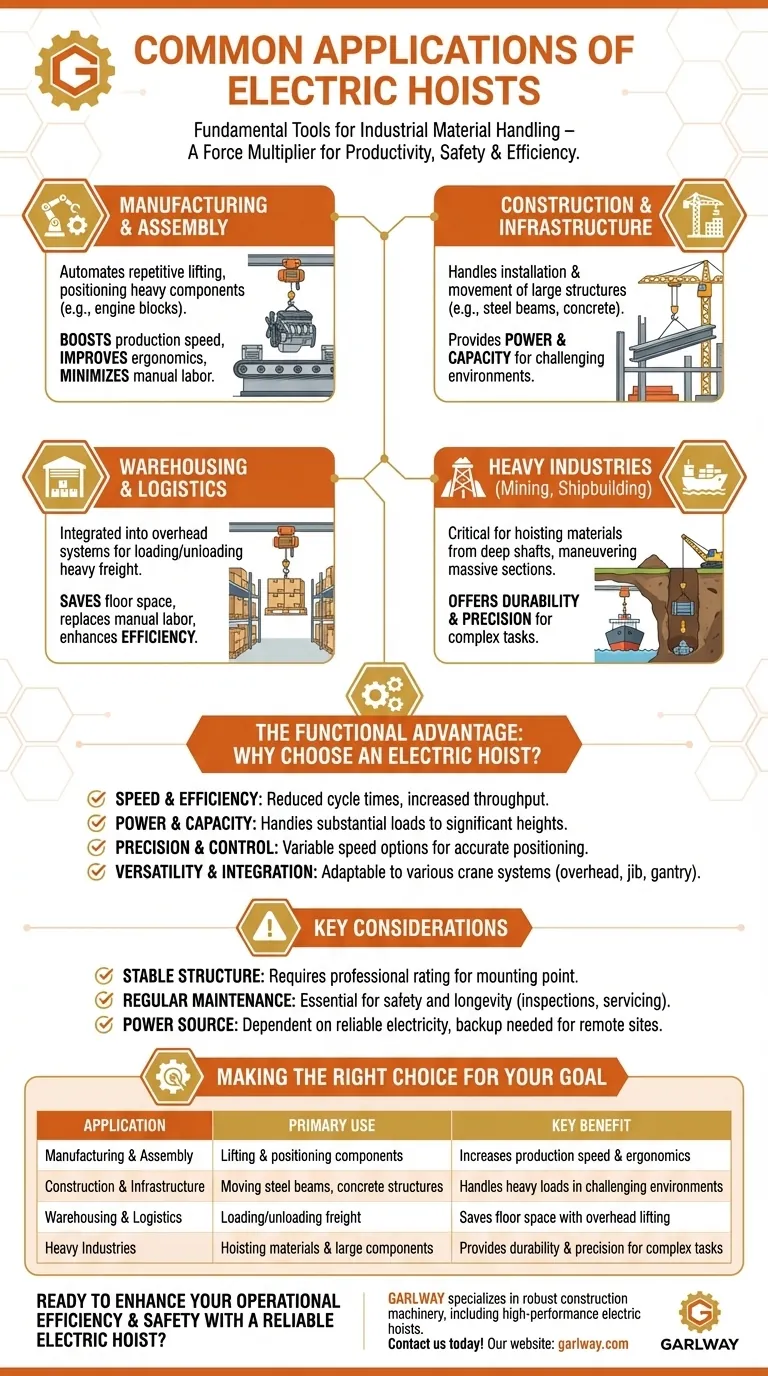
Summary Table:
| Application | Primary Use | Key Benefit |
|---|---|---|
| Manufacturing & Assembly | Lifting & positioning components | Increases production speed & ergonomics |
| Construction & Infrastructure | Moving steel beams, concrete structures | Handles heavy loads in challenging environments |
| Warehousing & Logistics | Loading/unloading freight | Saves floor space with overhead lifting |
| Heavy Industries (Mining, Shipbuilding) | Hoisting materials & large components | Provides durability & precision for complex tasks |
Ready to enhance your operational efficiency and safety with a reliable electric hoist? GARLWAY specializes in providing robust construction machinery, including high-performance electric hoists, winches, concrete mixers, and batching plants. Our solutions are designed for construction companies and contractors worldwide who demand precision, power, and durability. Contact us today to discuss how our equipment can be a strategic asset for your projects!
Visual Guide
Related Products
- Electric Hoist Winch Boat Anchor Windlass for Marine Applications
- Electric and Hydraulic Winch for Heavy Duty Applications
- Hydraulic Winding Engine Harbor Freight Winch
- Heavy Duty Electric Boat Winch Windlass Anchor
- 12000 lb Electric Boat Trailer Winch with Windlass Anchor Warn
People Also Ask
- How does an electric anchor winch work? Power, Safety, and Reliable Operation Explained
- What are the advantages of installing an electric anchor winch on a boat? Boost Safety & Ease for Boaters
- What are the operational differences between electric hoists and winches? A Guide to Safe Lifting vs. Pulling
- What are the main benefits of a boat anchor winch? Boost Safety & Efficiency for Your Vessel
- How does a boat anchor winch work? A Guide to Reliable Anchor Handling