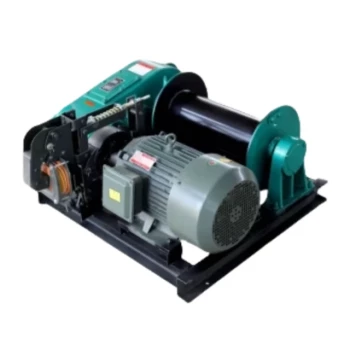
At its core, winding is the vertical transportation system of an underground mine. It is the fundamental process used to hoist mined minerals from deep underground to the surface. Crucially, this same system is also used to lower and raise miners, materials, and equipment, serving as the mine's primary lifeline.
Winding is more than just a mining elevator; it is the critical artery connecting the underground workings to the surface. Its efficiency and safety directly determine the mine's overall productivity and the well-being of its workforce.
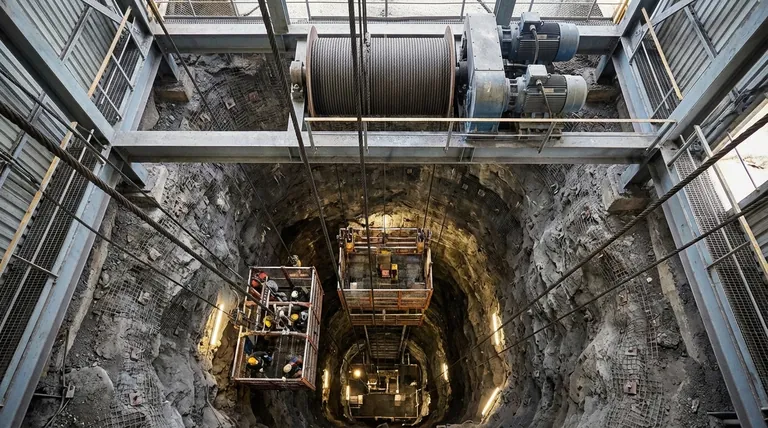
The Dual Purpose of a Winding System
A winding system is not a single-task operation. It performs two co-dependent functions that are essential for the mine's viability.
Hoisting for Production
The primary economic purpose of winding is to lift the mined ore or minerals to the surface. This is often referred to as hoisting.
The speed, capacity, and reliability of the hoist directly limit the mine's maximum production output.
Access for Personnel and Materials
For a mine to function, people and supplies must be able to get in and out safely and efficiently.
Winding systems are used to transport miners to and from their working levels. They are also used to lower all necessary equipment, from tools and explosives to structural supports.
The Evolution to Modern Winding
Early winding systems were simple mechanical affairs. Modern systems, however, are highly sophisticated and engineered for safety and performance.
Automation and Control
In today's mines, winding is largely an automated process. It is controlled by a network of electrical contacts, sensors, and signaling systems.
This automation allows for precise control over speed, acceleration, and positioning, which is vital for both safety and efficiency.
An Unwavering Focus on Safety
Because winding systems transport personnel, safety is the absolute highest priority.
Modern systems are equipped with numerous safety devices, including over-speed protectors, emergency braking systems, and redundant controls to prevent accidents when raising or lowering people.
Understanding the Inherent Risks
Despite modern technology, the winding system remains one of the most critical and potentially hazardous parts of a mine.
The Single Point of Failure
The mine shaft is often the only way in or out. Any failure in the winding system can halt production and, more critically, trap miners underground.
This makes the system's maintenance and inspection protocols extremely important.
The Human Element
While automated, the system still requires human oversight. Proper training for operators and strict adherence to safety procedures are essential to mitigate risk.
How Winding Defines Your Operational Focus
The design and operation of a winding system reflect the mine's core priorities.
- If your primary focus is high production: The system must be optimized for rapid, high-capacity hoisting of minerals, often using dedicated conveyances called "skips."
- If your primary focus is deep-level access: The engineering must account for the immense rope lengths and power required to move people and materials safely over great vertical distances.
- If your primary focus is safety: The system will feature advanced braking, multiple redundancies, and rigorous inspection schedules, especially for conveyances ("cages") used for personnel.
Ultimately, a reliable and safe winding system is the foundation upon which every successful underground mining operation is built.
Summary Table:
| Purpose | Key Function | Impact |
|---|---|---|
| Hoisting for Production | Lifts mined ore to the surface | Determines maximum production output |
| Access for Personnel & Materials | Transports miners, equipment, and supplies | Ensures operational continuity and workforce safety |
| Safety & Automation | Employs sensors, braking systems, and controls | Mitigates risks and enhances reliability |
Maximize the safety and efficiency of your mining operations with GARLWAY's robust winding solutions. As a specialist in construction and mining machinery, GARLWAY provides durable winches, concrete mixers, and batching plants trusted by construction companies and contractors globally. Let our expertise in heavy-duty equipment support your project's foundation—contact us today to discuss your specific needs!
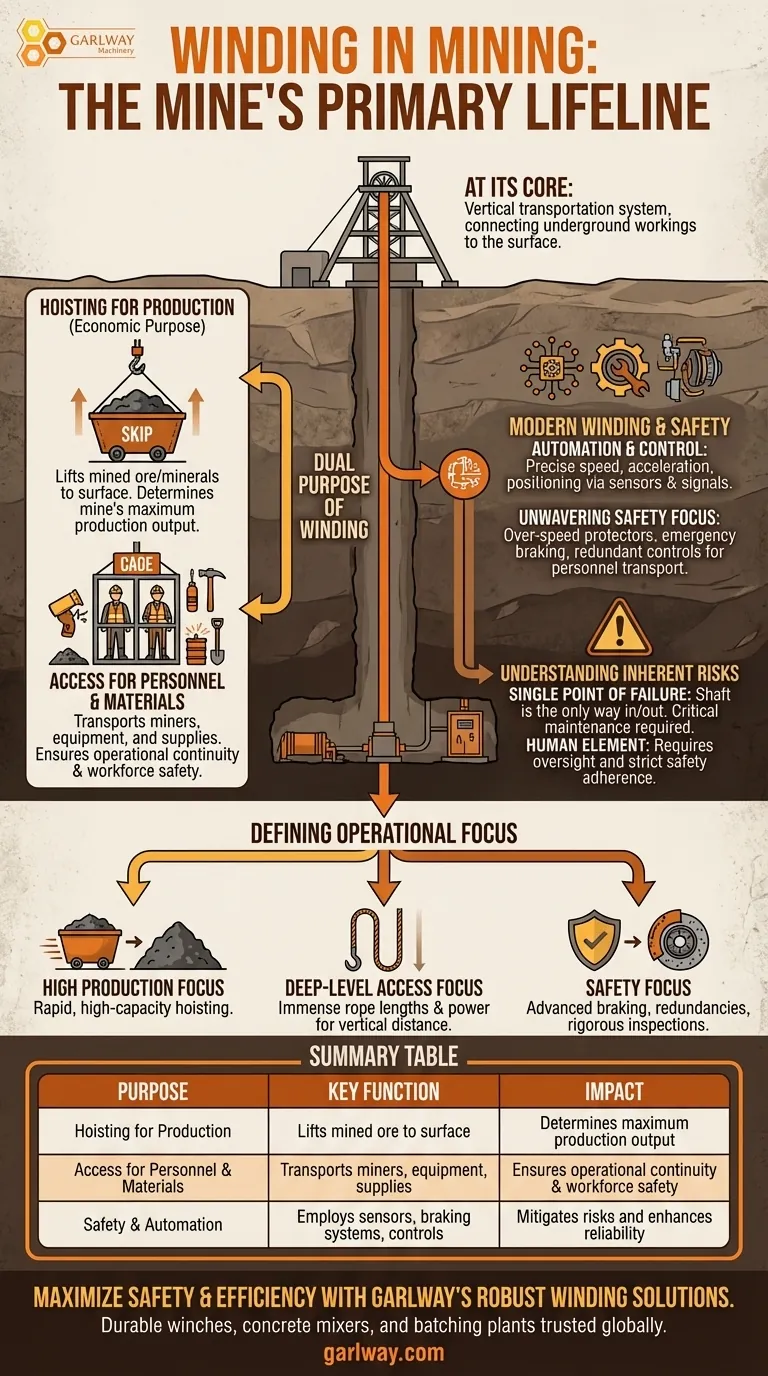
Visual Guide
Related Products
- Hydraulic Winding Engine Harbor Freight Winch
- Small Electric Winch 120V and 240V for Compact Applications
People Also Ask
- What role does hydraulic fluid play in hydraulic winches? It's the Lifeblood of Your Heavy-Duty Pulling Power
- What vehicles commonly use hydraulic winches? For Industrial Trucks Needing Unmatched Power
- What are the features of hydraulic winches? Unmatched Power and Continuous Duty for Heavy Loads
- What preventive measures can be taken to avoid oil leakage in hydraulic winches? Ensure Long-Term Reliability
- What does 'power out' mean in a hydraulic winch? Achieve Absolute Control When Lowering Heavy Loads