
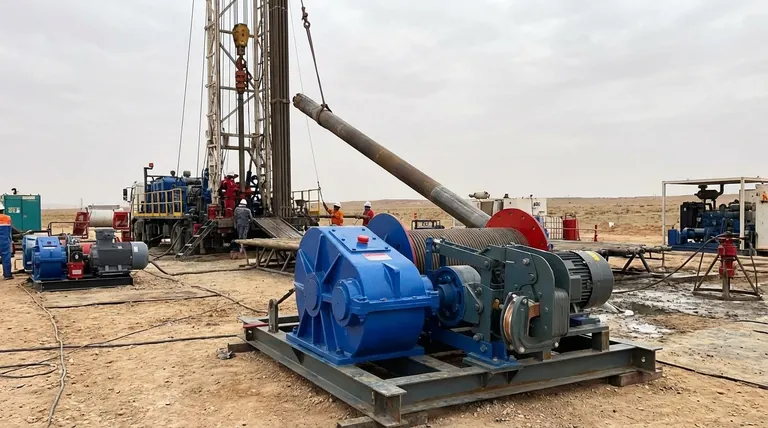
In the demanding environments of drilling and water well industries, winches are not merely auxiliary tools; they are fundamental components that provide the immense power and precise control required for nearly every phase of operations. They are the mechanical muscle used for lifting, lowering, and positioning the heavy strings of drill pipe, well casings, and other critical downhole equipment.
The true value of a winch in drilling is not just its raw lifting power, but its ability to ensure operational efficiency, enhance crew safety, and provide the delicate control needed to manage components weighing several tons.
The Core Functions of Winches in Drilling
Winches serve as the primary hoisting mechanism on a drilling rig, performing a series of distinct, critical tasks that would otherwise be impossible.
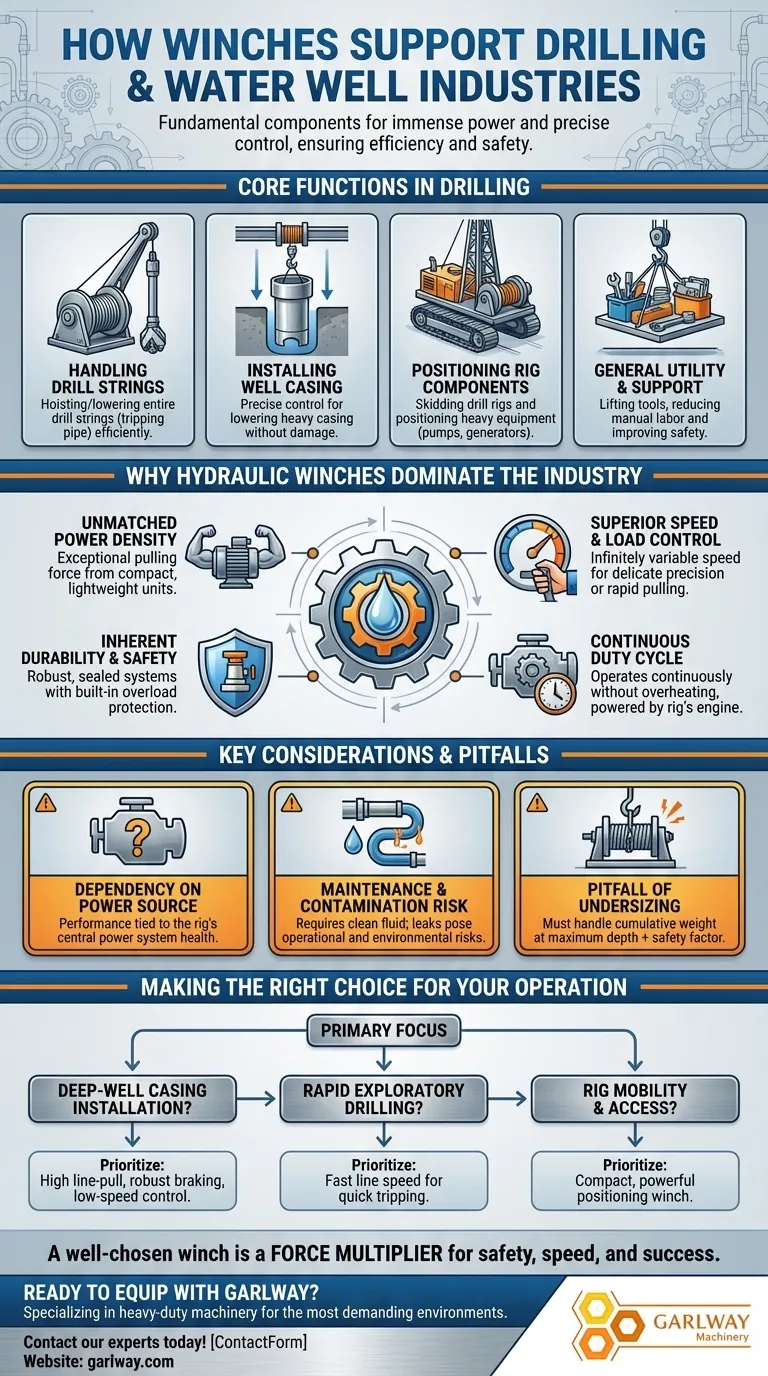
Handling Drill Strings and Tooling
The most frequent job for a rig winch is "tripping" pipe. This involves hoisting and lowering the entire drill string—composed of dozens of sections of drill pipe, collars, and the drill bit—into and out of the borehole.
Installing Well Casing and Screens
Once the well is drilled to the target depth, the winch is used to carefully lower heavy steel or PVC well casing into the open hole. This operation demands immense strength combined with slow, precise control to avoid damaging the casing or the borehole wall.
Positioning Rig Components
On many sites, winches are used for more than just vertical lifting. They provide the pulling force needed to skid the entire drill rig into its precise location over the wellhead or to position heavy support equipment like mud pumps and generators.
General Utility and Support
Beyond the main drilling tasks, winches act as utility hoists. They lift tools, supplies, and other materials onto the rig floor, reducing manual labor and improving site safety.
Why Hydraulic Winches Dominate the Industry
While other types of winches exist, hydraulic systems are the standard in modern drilling and water well applications for several key reasons.
Unmatched Power Density
Hydraulic systems deliver exceptional pulling force from a relatively compact and lightweight unit. This is critical for mobile drilling rigs where space and weight are significant constraints.
Superior Speed and Load Control
Hydraulics offer infinitely variable speed control. An operator can smoothly and slowly lower a heavy casing with millimeter precision or rapidly pull an empty drill string, a level of control that is difficult to achieve with other systems.
Inherent Durability and Safety
Hydraulic winches are robust, sealed systems well-suited for the dirty and demanding environment of a drill site. They also feature built-in overload protection through pressure relief valves, which prevent catastrophic failure if the load exceeds the winch's capacity.
Continuous Duty Cycle
Unlike many electric winches that can overheat under constant use, hydraulic systems can operate continuously for long periods. They are powered by the rig's main diesel engine, allowing for a sustained high-power output without risk of thermal damage.
Understanding the Key Considerations
While highly effective, the reliance on hydraulic winches comes with specific operational realities and potential pitfalls that must be managed.
Dependency on a Hydraulic Power Source
A hydraulic winch is useless without a running engine and a functioning hydraulic pump. The winch's performance is directly tied to the health of the rig's central power system.
Maintenance and Contamination Risk
Hydraulic systems require clean fluid and intact hoses to function properly. A single hydraulic leak can sideline an entire operation and poses an environmental risk. Regular inspection and preventative maintenance are non-negotiable.
The Pitfall of Undersizing
A common mistake is selecting a winch based only on the heaviest single load. The winch must be sized to handle the cumulative weight of the drill string at maximum depth, with a significant safety factor built in to account for friction, shock loads, and emergencies.
Making the Right Choice for Your Operation
Selecting the correct winch is about matching its specifications to the primary demands of your drilling project.
- If your primary focus is deep-well casing installation: Prioritize winches with a high line-pull capacity, a robust multi-stage braking system, and excellent low-speed control.
- If your primary focus is rapid exploratory or geotechnical drilling: A winch with a fast line speed for quick tripping of lightweight tooling is often more critical than maximum lifting capacity.
- If your primary focus is rig mobility and difficult site access: A compact, powerful positioning winch for skidding the rig is the most crucial choice, even if a separate winch handles hoisting.
Ultimately, a well-chosen winch is not just a piece of equipment; it is a force multiplier that directly impacts the safety, speed, and success of your entire drilling project.
Summary Table:
| Key Function | Why It's Critical |
|---|---|
| Handling Drill Strings | Hoists/lowers entire drill string for efficient "tripping" operations. |
| Installing Well Casing | Provides precise control to lower heavy casing without damage. |
| Positioning Rig Components | Skids drill rigs and positions heavy support equipment on site. |
| Superior Hydraulic Control | Offers variable speed for delicate maneuvers and continuous duty cycles. |
Ready to equip your drilling operation with a winch built for power, precision, and reliability?
At GARLWAY, we specialize in heavy-duty construction machinery engineered for the most demanding environments. Our robust hydraulic winches are designed to meet the specific challenges of the drilling and water well industry, providing the unmatched power density and superior control your projects demand.
We help construction companies and contractors globally achieve:
- Enhanced Efficiency: Reduce tripping time and improve operational workflow.
- Maximum Safety: Rely on built-in overload protection and durable, sealed systems.
- Project Success: Get the right winch specification for your primary focus, from deep-well casing to rapid exploratory drilling.
Let's discuss how a GARLWAY winch can be the force multiplier for your next project. Contact our experts today for a personalized consultation!
Visual Guide
Related Products
- Hydraulic Winding Engine Harbor Freight Winch
- Electric and Hydraulic Winch for Heavy Duty Applications
- Small Electric Winch 120V and 240V for Compact Applications
- Electric 120V Boat Winch by Badlands
- 12000 lb Electric Boat Trailer Winch with Windlass Anchor Warn
People Also Ask
- What role does hydraulic fluid play in hydraulic winches? It's the Lifeblood of Your Heavy-Duty Pulling Power
- What vehicles commonly use hydraulic winches? For Industrial Trucks Needing Unmatched Power
- What are the features of hydraulic winches? Unmatched Power and Continuous Duty for Heavy Loads
- What preventive measures can be taken to avoid oil leakage in hydraulic winches? Ensure Long-Term Reliability
- What does 'power out' mean in a hydraulic winch? Achieve Absolute Control When Lowering Heavy Loads



