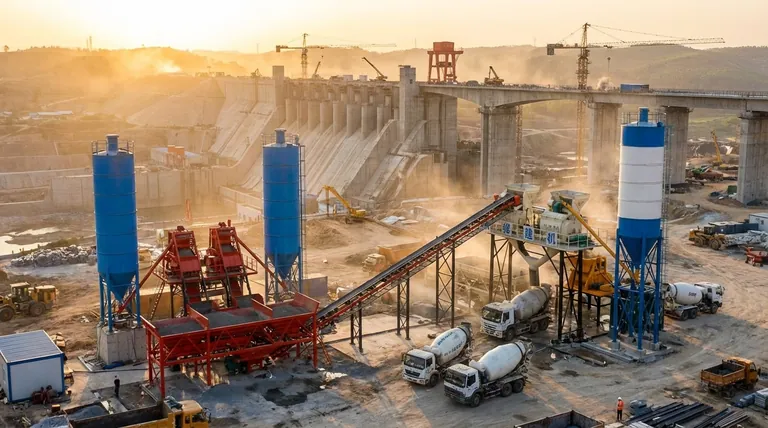
At their core, large and medium-sized concrete mixing stations are the industrial backbone for major construction projects that demand significant volumes of high-quality concrete over extended periods. They are specifically chosen for large-scale infrastructure like bridges, dams, and power plants, as well as for the commercial production of concrete supplied to various municipal and building projects.
The decision to use a large or medium mixing station is not just about producing concrete; it's a strategic choice for projects where consistency, speed, and the integration of mechanized construction processes are critical to success.
The Profile of a Project Demanding a Large-Scale Station
Not every construction site requires an industrial-scale mixing station. These systems are engineered for a specific class of project defined by its scale, duration, and logistical setup.
High and Continuous Concrete Demand
Large infrastructure projects require a massive, uninterrupted flow of concrete. A dam, for instance, cannot be poured in small, inconsistent batches.
Large and medium stations are designed for high productivity, ensuring a steady supply that manual or smaller-scale mixing simply cannot match.
Long Construction Timelines
These stations are built for endurance. Their robust, all-steel construction is designed to operate reliably for the months or years a major project takes to complete.
This durability justifies the significant initial setup for projects with a long-term horizon.
Centralized Work Sites
The ideal scenario for these stations is a large, consolidated construction site. They act as a central hub, efficiently supplying concrete to various points of the project via pumps and transport vehicles.
This centralized model streamlines logistics and ensures every part of the project receives concrete of the same consistent quality.
Key Applications and Industries
The value of these stations becomes clear when you look at the sectors that rely on them. Their primary function is to enable construction on a scale that would otherwise be impractical.
Major Infrastructure Development
The most common application is in foundational infrastructure. This includes projects like water conservancy (dams, reservoirs), power generation (nuclear or thermal power plants), and transportation networks (major bridges and highways).
Commercial Concrete Production
Many large and medium stations are not dedicated to a single project. Instead, they operate as commercial plants, producing ready-mix concrete for a wide range of customers in a metropolitan area.
These commercial hubs support overall municipal development, from office buildings to residential complexes.
Enabling Mechanized Construction
A key benefit is the role these stations play in modernizing the construction process. Their high, consistent output is a prerequisite for using advanced concrete pumping and other mechanized pouring techniques.
This integration of mixing, transportation, and pouring creates a highly efficient, joint operation that dramatically accelerates construction timelines.
Understanding the Trade-offs
While powerful, these stations are not a universal solution. An objective assessment requires acknowledging their limitations and specific requirements.
Significant Initial Investment
The primary barrier is cost. Compared to smaller, mobile mixing solutions, establishing a large or medium-sized station requires a substantial upfront investment in equipment, land, and setup.
The references note that smaller stations are chosen for their lower initial investment, highlighting the clear difference in scale.
Substantial Site Footprint
These are not compact machines. They consist of multiple large systems for material storage, conveying, weighing, and mixing, which demand a significant amount of space.
While their design can be adapted to various terrains, they are fundamentally unsuitable for small, constrained, or dense urban sites.
Operational Complexity
Though highly automated, these are complex industrial plants. They require skilled personnel for operation, quality control, and routine maintenance to ensure they function safely and efficiently.
Making the Right Choice for Your Goal
Selecting the appropriate concrete production method is a foundational decision for any project manager or engineer. Your primary objective will dictate the best path forward.
- If your primary focus is a landmark infrastructure project: A dedicated large or medium-sized station is essential for meeting the massive volume demands and ensuring non-negotiable quality consistency.
- If your primary focus is supplying a metropolitan area with commercial concrete: A stationary medium-to-large plant provides the high output and operational efficiency required to serve multiple clients and projects profitably.
- If your primary focus is a smaller-scale or budget-conscious project: A smaller mobile batching plant or on-site mixing offers a more practical and economical solution without the overhead of a large station.
Ultimately, matching the scale of your concrete production to the ambition of your project is the first step toward building efficiently and successfully.
Summary Table:
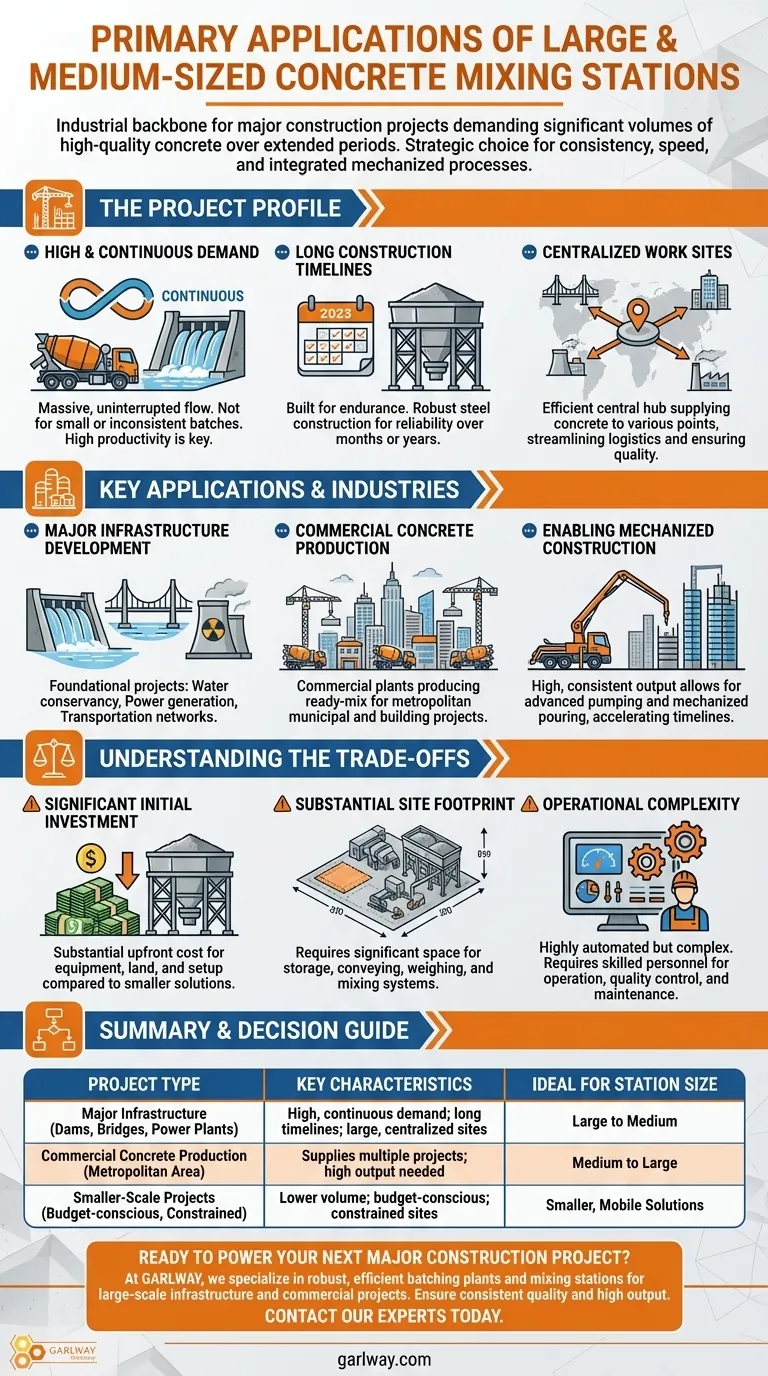
| Project Type | Key Characteristics | Ideal for Station Size |
|---|---|---|
| Major Infrastructure (Dams, Bridges, Power Plants) | High, continuous demand; long timelines; large, centralized sites | Large to Medium |
| Commercial Concrete Production | Supplies multiple projects in a metropolitan area; high output needed | Medium to Large |
| Smaller-Scale Projects | Lower volume; budget-conscious; constrained sites | Smaller, mobile solutions |
Ready to power your next major construction project with reliable, high-volume concrete production?
At GARLWAY, we specialize in providing robust and efficient concrete batching plants and mixing stations tailored for construction companies and contractors working on large-scale infrastructure and commercial projects. Our solutions ensure the consistent quality and high output your projects demand.
Contact our experts today to discuss how a GARLWAY concrete mixing station can be the backbone of your success.
Visual Guide
Related Products
- HZS90 Large Multiquip Concrete Mixers for Construction
- HZS75 Concrete Batching Plant Cement Mixer Price Concrete Mixer Bunnings Mixing Plant
- Portable Concrete Mixer Machine Equipment for Mixing Concrete
- Commercial Electric Concrete Mixer Machine HZS 50 Small Batch Plant for Sale
- HZS35 Small Cement Concrete Mixing Batch Plant
People Also Ask
- What are the types of concrete mixers used in batching plants? Choose the Right Mixer for Your Project
- What is the core component of a concrete batching plant? The Mixer Unit Defines Your Concrete Quality
- What are the different power sources for concrete mixers? Choose the Right Power for Your Project
- What are the main types of concrete mixers? A Guide to Batch, Continuous & More
- What are the main types of concrete mixers mentioned? Find the Perfect Mixer for Your Project