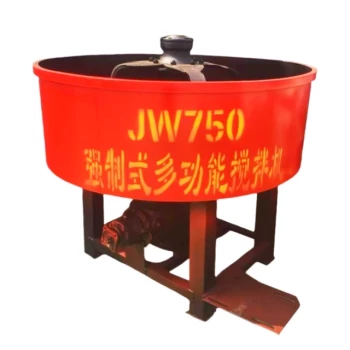
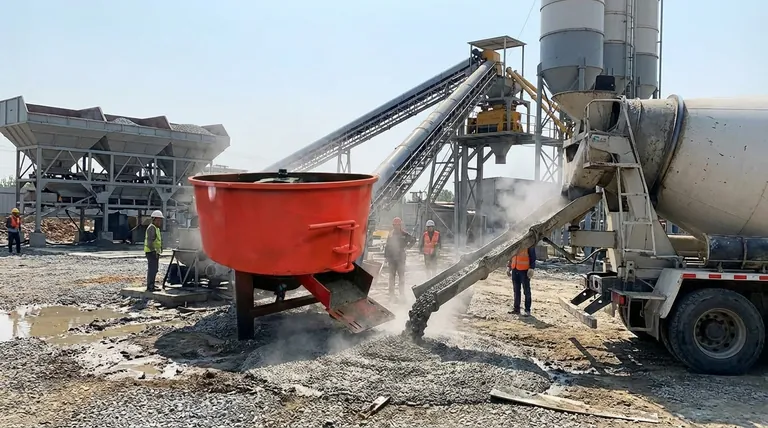
The final process in a concrete batching plant's workflow is the discharge of the finished, uniformly mixed concrete into a transport vehicle. This is typically a transit mixer or concrete truck, which then delivers the ready-mix concrete to the construction site for placement.
The entire batching plant workflow is a highly controlled sequence designed for precision and consistency. While discharging the concrete is the final action performed at the plant, the success of this step is entirely dependent on the accuracy of every preceding stage, from weighing materials to the mixing time.
The Core Workflow: From Raw Material to Ready-Mix
Understanding the final step requires seeing it as the culmination of a carefully orchestrated process. Each stage builds upon the last to produce concrete that meets specific engineering requirements.
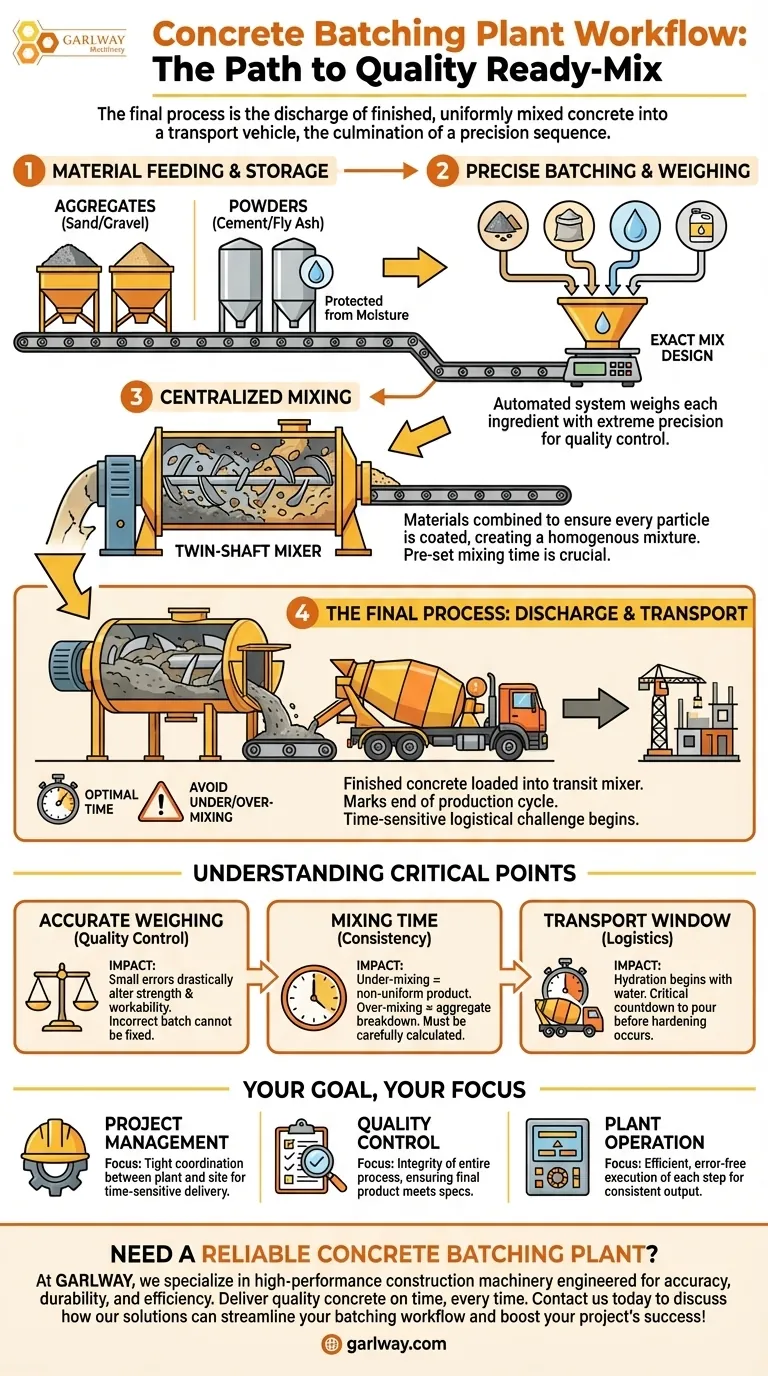
Step 1: Material Feeding and Storage
The process begins with loading the raw ingredients into the plant. Aggregates like sand and gravel are fed into separate storage bins, while powders like cement and fly ash are stored in dedicated silos to protect them from moisture.
Step 2: Precise Batching and Weighing
This is the most critical stage for quality control. The plant's automated control system executes a specific "mix design," weighing each ingredient—aggregates, cement, water, and any additives—with extreme precision using weigh conveyors and hoppers.
Step 3: Centralized Mixing
Once weighed, all the individual components are transferred into a central mixing unit. Most modern plants use a powerful twin-shaft mixer that tumbles and combines the materials to ensure every particle is coated in cement paste, creating a homogenous and consistent mixture.
Step 4: Discharge and Transport
After the pre-set mixing time is complete, the final step occurs. The mixer's discharge gate opens, and the fresh, ready-mix concrete is loaded directly into a waiting transit mixer truck. This marks the end of the batching plant's production cycle for that batch.
Understanding the Trade-offs and Critical Points
The workflow is not merely a sequence of actions; it's a series of control points where quality can be either assured or compromised.
The Impact of Inaccurate Weighing
Even small errors in the weight of cement or water can drastically alter the concrete's strength and workability. The control system's accuracy is paramount, as an incorrect batch cannot be fixed once it's mixed.
The Importance of Mixing Time
Under-mixing results in a non-uniform product with inconsistent strength. Conversely, over-mixing can begin to break down aggregates and negatively affect the final properties of the hardened concrete. The mixing time is carefully calculated for each specific design.
The Critical Transport Window
The moment water is added to the mix, the hydration process begins, and the concrete starts to set. Discharging the concrete into the truck starts a critical countdown. The time it takes to transport and pour the concrete on-site must be carefully managed to prevent it from hardening prematurely.
Making the Right Choice for Your Goal
Understanding this workflow allows different professionals to focus on what matters most for their specific role.
- If your primary focus is project management: Recognize that the plant's discharge step marks the start of a time-sensitive logistical challenge that requires tight coordination between the plant and the construction site.
- If your primary focus is quality control: Your attention must be on the integrity of the entire process, ensuring the accuracy of the batching and weighing systems to guarantee the final product meets design specifications.
- If your primary focus is plant operation: The goal is to ensure each step, from loading materials to discharging the final mix, is executed efficiently and without error to maintain consistent output.
Ultimately, the concrete batching plant transforms simple raw materials into a high-performance construction product through a chain of precise, interconnected steps.
Summary Table:
| Process Step | Key Action | Critical Factor |
|---|---|---|
| 1. Material Feeding & Storage | Loading raw materials (aggregates, cement) into bins/silos. | Material quality and protection from moisture. |
| 2. Precise Batching & Weighing | Automated weighing of each ingredient per mix design. | Accuracy of the control system for consistent quality. |
| 3. Centralized Mixing | Combining materials in a twin-shaft mixer for uniformity. | Pre-set mixing time to ensure homogeneity without over/under-mixing. |
| 4. Discharge & Transport (Final Step) | Loading finished concrete into a transit mixer truck. | Timing and coordination for delivery before concrete sets. |
Need a reliable concrete batching plant to ensure your project's concrete is mixed and discharged with precision?
At GARLWAY, we specialize in high-performance construction machinery for contractors and construction companies worldwide. Our concrete batching plants, mixers, and winches are engineered for accuracy, durability, and efficiency—helping you deliver quality concrete on time, every time.
Contact us today to discuss how our solutions can streamline your batching workflow and boost your project's success!
Visual Guide
Related Products
- HZS35 Small Cement Concrete Mixing Batch Plant
- HZS120 Ready Mix Concrete Batching Plant Commercial Mud Cement Mixer
- HZS75 Concrete Batching Plant Cement Mixer Price Concrete Mixer Bunnings Mixing Plant
- HZS180 Ready Mix Concrete Plant for Foundations with Sand and Cement
- Commercial Electric Concrete Mixer Machine HZS 50 Small Batch Plant for Sale
People Also Ask
- Why buy concrete batch plant parts only from the manufacturer? Protect Your Investment and Maximize Uptime
- Why is proper maintenance important for a concrete batch mix plant? Maximize Uptime & Profitability
- What is the advantage of a mobile concrete batching plant? Achieve On-Site Production & Total Control
- What are the advantages and disadvantages of concrete batching plants? Maximize Quality & Efficiency
- What are the two methods of material charging in a concrete mixing station? Single vs. Multiple Charging Explained