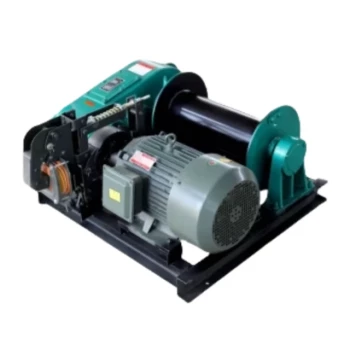
At its core, a winch is a surprisingly simple machine. It consists of a power source (like a motor or a hand crank), a gear train to multiply force, a drum to spool a line, and the winch line (cable or rope) itself. These fundamental components work together to trade speed for immense pulling power.
A winch is not just a collection of parts; it is a system designed for one purpose: to multiply a small input force into a massive output force. Understanding how the motor, gears, and drum interact is the key to appreciating its power and using it safely.

The Core System: How a Winch Generates Force
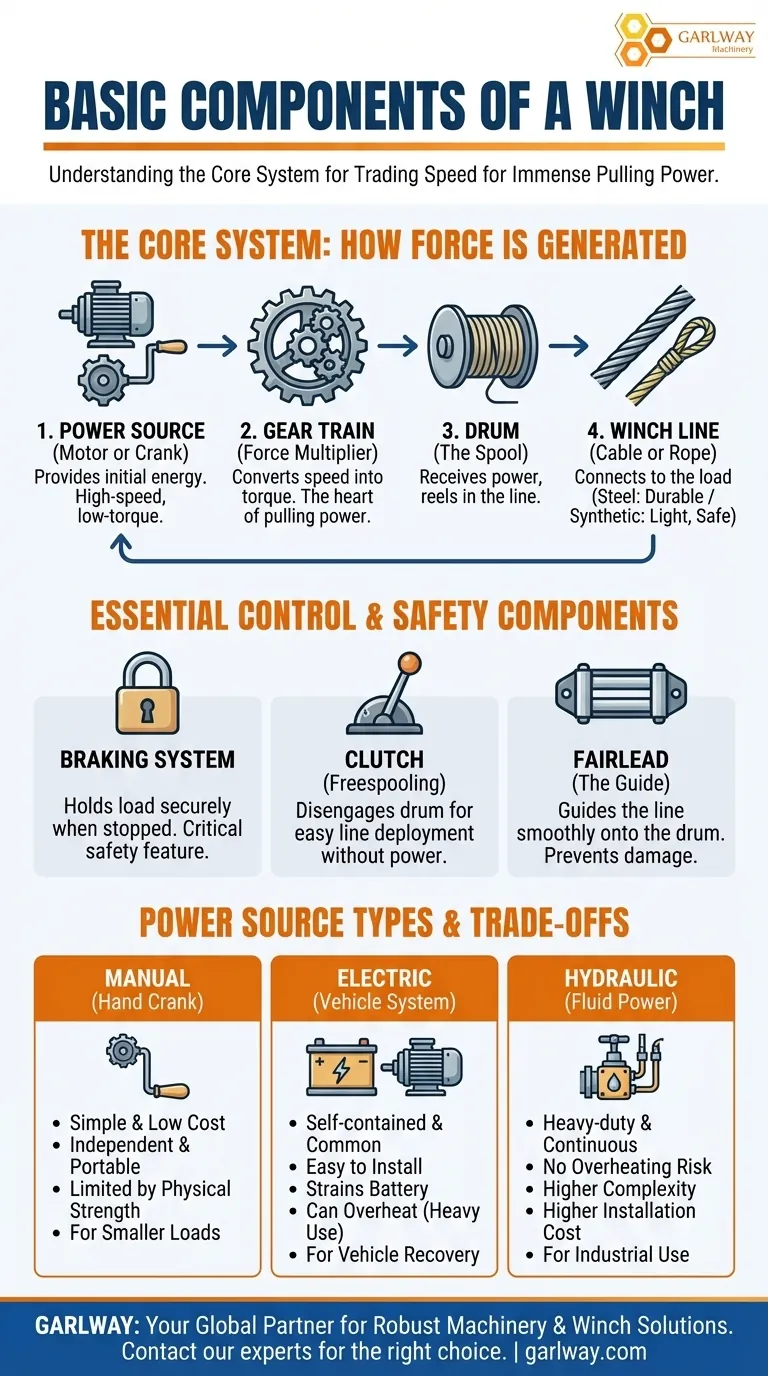
Every winch, regardless of its type, is built around a central system that creates pulling power. This system has four indispensable parts that work in sequence.
The Power Source (Motor or Crank)
The entire process begins with the power source. This is what provides the initial energy.
In powered winches, this is typically an electric or hydraulic motor that generates high-speed, low-torque rotation. In manual winches, your own physical effort turning a crank serves the same function.
The Gear Train (The Force Multiplier)
The gear train, or reducer, is the heart of the winch's power. It takes the high-speed output from the motor and converts it into low-speed, high-torque power.
Think of it like the gears on a bicycle. A low gear makes it easy to pedal up a steep hill by trading your speed for climbing power. A winch's gear train does the same thing, allowing a small motor to pull thousands of pounds.
The Drum (The Spool)
The drum is the cylinder that the winch line wraps around. It receives the slow, powerful rotation from the gear train and uses it to reel in the line under load. The drum is also often where other components, like the braking system, are housed.
The Winch Line (Cable or Rope)
This is the component that connects the winch to the object you need to pull. It can be made of steel cable, which is extremely durable and abrasion-resistant, or synthetic rope, which is lighter, safer, and easier to handle.
Essential Control and Safety Components
Beyond the core power system, several other components are critical for controlling the winch safely and efficiently.
The Braking System
The brake is arguably the most important safety feature. When the motor stops, the brake automatically engages to prevent the drum from unspooling and releasing the load. This is essential for holding a heavy object securely in place.
The Clutch (Freespooling)
The clutch allows you to disengage the drum from the gear train. This enables "freespooling," where you can quickly and easily pull the line out by hand without running the motor. To begin pulling, you simply re-engage the clutch.
The Fairlead (The Guide)
The fairlead is a guide mounted to the winch or vehicle bumper that feeds the winch line onto the drum smoothly. It prevents the line from piling up on one side of the drum and protects it from rubbing against sharp edges, which would cause damage and wear.
Understanding the Trade-offs: Power Source Implications
The choice of power source fundamentally changes a winch's characteristics, complexity, and ideal use case. Each type represents a different set of trade-offs.
Manual (Hand Crank) Winches
These are the simplest winches. Their power is limited by your physical strength, making them suitable for smaller loads. Their key advantages are their low cost, portability, and independence from any power source.
Electric Winches
This is the most common type for vehicles like trucks and ATVs. They are powered by the vehicle's electrical system, making them self-contained and relatively easy to install. However, they can put a significant strain on the battery and can overheat during prolonged, heavy use.
Hydraulic Winches
Hydraulic winches are powered by a vehicle's power steering pump or a separate hydraulic pump. They are designed for heavy-duty, commercial applications because they can run continuously without overheating. Their main trade-off is higher complexity and installation cost.
Making the Right Choice for Your Application
Understanding these components allows you to select the right tool for the job. Your decision should be based on your primary need.
- If your primary focus is occasional light-duty pulling: A manual winch offers a simple, reliable, and cost-effective solution.
- If your primary focus is vehicle recovery and versatile use: An electric winch provides the best balance of power, convenience, and self-sufficiency.
- If your primary focus is heavy industrial or continuous operation: A hydraulic winch is the only choice for sustained, high-demand work without risk of overheating.
By seeing a winch as a system of interconnected components, you gain the clarity needed to operate it effectively and safely.
Summary Table:
| Component | Primary Function | Key Consideration |
|---|---|---|
| Power Source | Provides initial energy (motor or crank) | Electric for convenience, hydraulic for heavy-duty, manual for simplicity |
| Gear Train | Multiplies force (converts speed to torque) | The heart of the winch's pulling power |
| Drum | Spools the winch line under load | Houses the braking system for safety |
| Winch Line | Connects to the load (cable or rope) | Steel for durability, synthetic for safety and handling |
| Brake | Holds the load securely when stopped | Critical safety feature |
| Clutch | Enables freespooling (disengages drum) | Allows for easy line deployment |
| Fairlead | Guides the line onto the drum smoothly | Prevents damage and uneven spooling |
Ready to Select the Perfect Winch for Your Project?
Understanding the components is the first step. Choosing the right winch for your specific needs—whether for vehicle recovery, construction, or industrial use—is what ensures success and safety.
GARLWAY specializes in providing robust and reliable construction machinery, including a full range of winches, concrete mixers, and batching plants. We help construction companies and contractors globally enhance their operational efficiency and tackle demanding jobs with confidence.
Contact our experts today for a personalized consultation. Let us help you identify the ideal winch solution based on your load requirements, power source preferences, and application demands.
Visual Guide
Related Products
- Warn Winch Windlass Boat Trailer Winch
- Electric and Hydraulic Winch for Heavy Duty Applications
- Small Electric Winch 120V and 240V for Compact Applications
- 12000 lb Electric Boat Trailer Winch with Windlass Anchor Warn
- Quick Windlass Portable Winch for Truck and Boat Best Boat Winch
People Also Ask
- What are the main components of a boat trailer winch? A Guide to Safe & Efficient Boat Loading
- What factors should be considered when choosing a boat trailer winch? Ensure Safe and Effortless Boat Loading
- What is the purpose of boat trailer winches? Safely and Efficiently Load Your Boat
- What are the two main types of boat trailer winches? Manual vs. Electric Explained
- How often should a boat trailer winch be replaced? Your Guide to Safety and Longevity