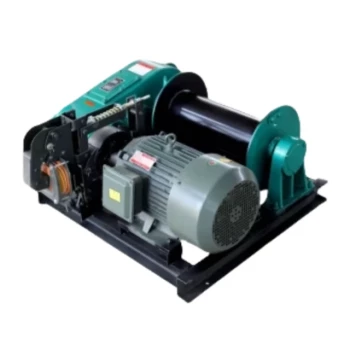
A winch is considered a lifeline because it provides a powerful and reliable means of self-recovery in unpredictable off-road environments. When you are stuck in mud, snow, or a ditch far from help, a winch offers a direct way to pull your vehicle—or another's—to safety, transforming a potentially trip-ending disaster into a manageable delay.
The true value of a winch isn't just convenience; it's about self-reliance. It serves as a mechanical safety net, ensuring that you have the capability to resolve a difficult situation independently and safely when no other help is available.
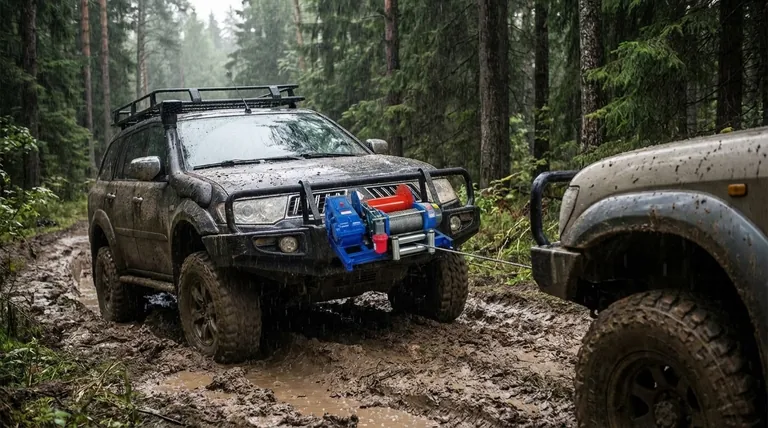
The Core Function: Self-Recovery
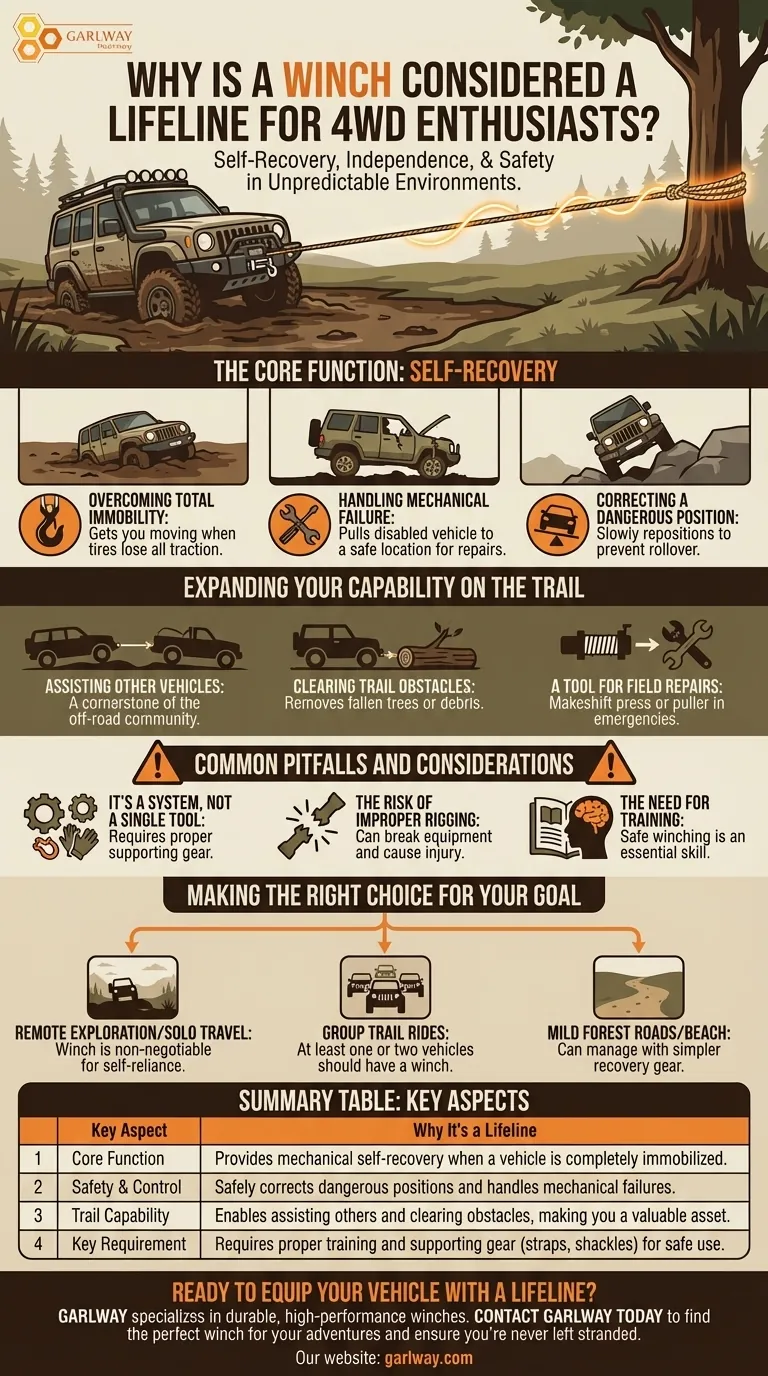
A winch's primary job is to get you moving when you're completely immobilized. This capability is critical in off-roading where the terrain itself is the main obstacle.
Overcoming Total Immobility
When your tires lose all traction in deep mud, soft sand, or snow, no amount of driving skill can help. A winch allows you to attach to a solid anchor point—like a tree or another vehicle—and pull yourself out with mechanical force.
Handling Mechanical Failure
Sometimes, getting stuck isn't about the terrain. A failed part, like a broken axle or driveshaft, can leave you stranded. A winch can be used to pull the disabled vehicle to a safer, more accessible location for repairs or towing.
Correcting a Dangerous Position
A vehicle can become dangerously tilted or high-centered on rocks or ruts. A winch provides the controlled pulling power needed to slowly and safely reposition the vehicle back onto a stable line without risking a rollover.
Expanding Your Capability on the Trail
Beyond saving yourself, a winch makes you a more capable and helpful member of any off-road group. It extends your ability to manage the environment around you.
Assisting Other Vehicles
One of the most common uses for a winch is recovering another vehicle. Being able to assist a fellow enthusiast who is stuck is a cornerstone of the off-road community.
Clearing Trail Obstacles
Fallen trees, large boulders, or other debris can make a trail impassable. A winch can be used to drag these obstacles out of the way, clearing the path for everyone.
A Tool for Field Repairs
In rare emergencies, a winch can serve as a makeshift press or puller. For instance, it can be carefully used to help straighten a bent steering component like a tie rod enough to limp back to civilization.
Common Pitfalls and Considerations
While invaluable, a winch is a powerful tool that demands knowledge and respect. Misunderstanding its operation can lead to dangerous outcomes.
It's a System, Not a Single Tool
A winch is useless without proper supporting gear. This includes tree-saver straps to protect your anchor, shackles to make secure connections, a snatch block to redirect force, and heavy-duty gloves for safety.
The Risk of Improper Rigging
Using a winch incorrectly can cause immense damage. Attaching the line to a weak anchor point or directly to a vehicle's axle or bumper can break equipment and turn components into dangerous projectiles.
The Need for Training
Safe winching is a skill. Understanding concepts like line pull, cable spooling, and hand signals is not optional; it is essential for preventing injury to people and damage to vehicles.
Making the Right Choice for Your Goal
Deciding if you need a winch depends entirely on where and how you drive.
- If your primary focus is remote exploration or solo travel: A winch is a non-negotiable piece of safety equipment for self-reliance.
- If your primary focus is group trail rides in challenging terrain: At least one or two vehicles in the group should have a winch to ensure the entire party can get through obstacles.
- If your primary focus is mild forest roads or beach driving: You can often manage with simpler recovery gear like traction boards and a kinetic recovery rope.
Ultimately, installing a winch is an investment in capability, safety, and the peace of mind that comes from knowing you can get yourself home.
Summary Table:
| Key Aspect | Why It's a Lifeline |
|---|---|
| Core Function | Provides mechanical self-recovery when a vehicle is completely immobilized. |
| Safety & Control | Safely corrects dangerous positions and handles mechanical failures. |
| Trail Capability | Enables assisting others and clearing obstacles, making you a valuable asset. |
| Key Requirement | Requires proper training and supporting gear (straps, shackles) for safe use. |
Ready to equip your vehicle with a lifeline? GARLWAY specializes in durable, high-performance winches and construction machinery for contractors and off-road enthusiasts globally. Our winches provide the reliable power you need for safe self-recovery. Contact GARLWAY today to find the perfect winch for your adventures and ensure you're never left stranded.
Visual Guide
Related Products
- Warn Winch Windlass Boat Trailer Winch
- Electric and Hydraulic Winch for Heavy Duty Applications
- Small Electric Winch 120V and 240V for Compact Applications
- Quick Windlass Portable Winch for Truck and Boat Best Boat Winch
- Hydraulic Winding Engine Harbor Freight Winch
People Also Ask
- What are the main components of a boat trailer winch? A Guide to Safe & Efficient Boat Loading
- What factors should be considered when choosing a boat trailer winch? Ensure Safe and Effortless Boat Loading
- What is the purpose of boat trailer winches? Safely and Efficiently Load Your Boat
- What are the two main types of boat trailer winches? Manual vs. Electric Explained
- How often should a boat trailer winch be replaced? Your Guide to Safety and Longevity