
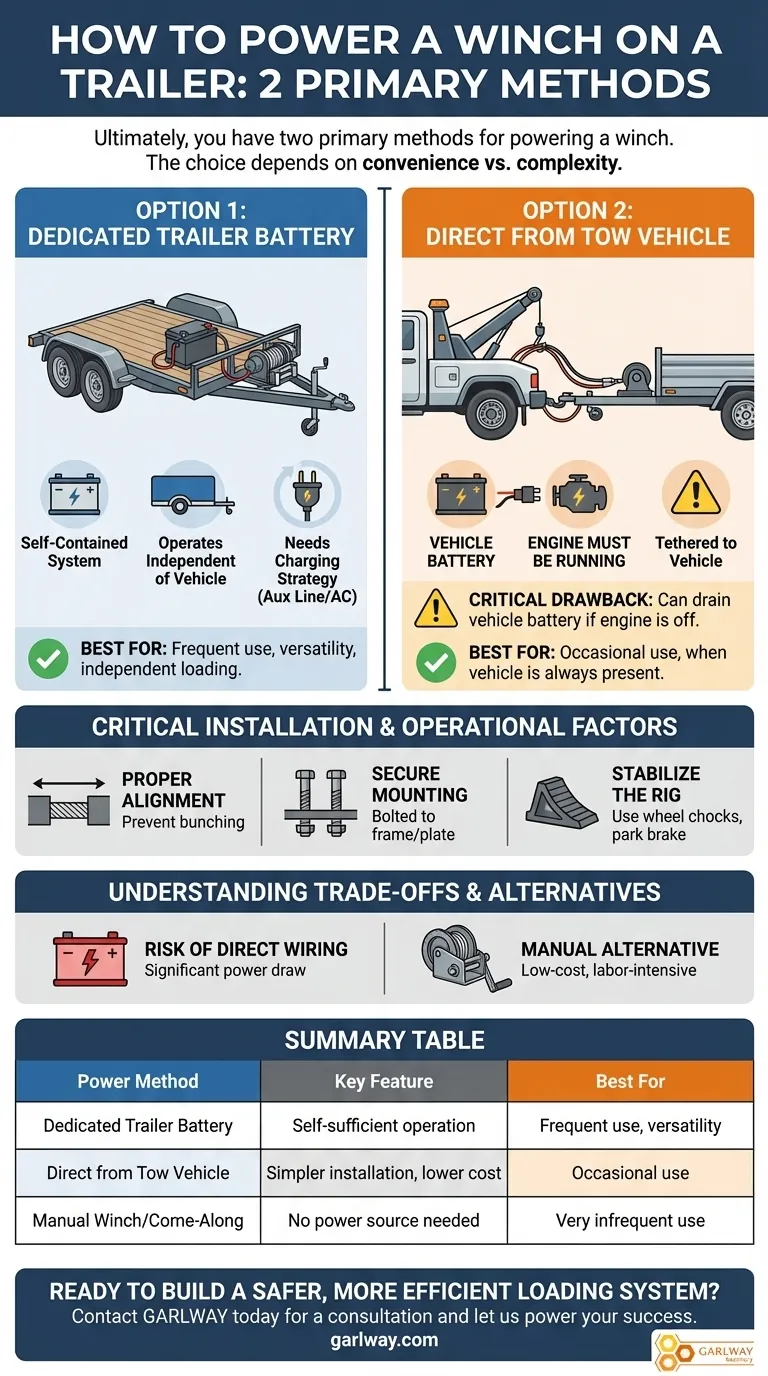
Ultimately, you have two primary methods for powering a winch on a trailer. You can either install a dedicated, self-contained battery directly on the trailer, or you can run wiring to draw power from your tow vehicle's main battery. The best choice depends entirely on how you plan to use the winch.
The core decision is between convenience and complexity. A dedicated trailer battery offers the freedom to operate the winch anytime, while wiring to the tow vehicle is simpler but tethers the winch's function to the vehicle.
Two Primary Powering Methods Explained
Understanding the mechanics of each power source is the first step. Each has distinct advantages and is suited for different patterns of use.
Option 1: The Dedicated Trailer Battery
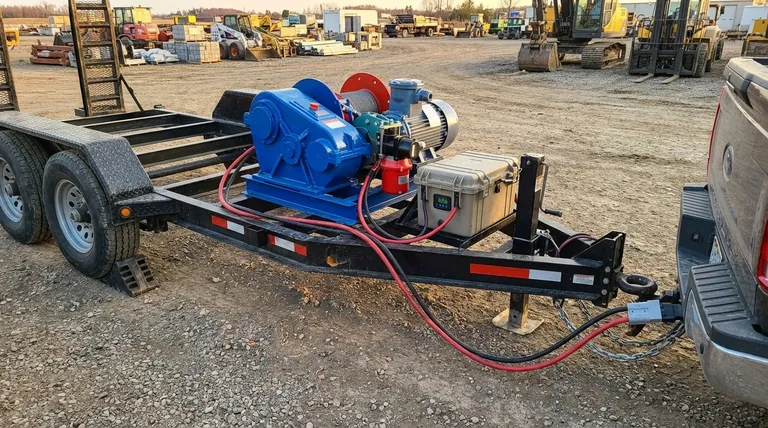
This method involves mounting a separate deep-cycle battery on the trailer, often in a protective box. The winch connects directly to this battery.
This setup creates a self-sufficient system. You can operate the winch even when the trailer is not hitched to a vehicle, which is a significant advantage for staging or pre-loading.
However, this battery needs a way to be charged. This is typically done by running an auxiliary power line from the tow vehicle's alternator or by using a separate AC charger when the trailer is parked.
Option 2: Direct Power from the Tow Vehicle
This is a more direct approach where you run heavy-gauge cables from the tow vehicle's battery to a connector at the rear bumper, which then connects to the winch on the trailer.
The primary benefit is simplicity. You do not have an extra battery to purchase, mount, or maintain.
The critical drawback is that the winch will only function when the trailer is electrically connected to the tow vehicle. More importantly, you must have the tow vehicle's engine running during winch operation to prevent completely draining its starting battery.
Critical Installation and Operational Factors
Power is only one part of the equation. A poorly mounted or improperly used winch is ineffective and dangerous, regardless of its power source.
Ensuring Proper Alignment
The winch must be mounted so the cable or strap pulls in a perfectly straight line from the winch drum to the load's attachment point (like a car's tow hook or a boat's bow eye).
Any misalignment will cause the cable to "bunch up" on one side of the drum, which can damage the cable and the winch itself.
Securely Mounting the Winch
The winch must be bolted directly to the trailer's frame or to a dedicated, heavy-duty winch stand or mounting plate that is securely attached to the frame.
Use high-grade bolts, nuts, and washers. Mark and drill bolt holes slightly larger than your bolts to allow for minor adjustments before tightening everything down securely.
Stabilizing the Rig
Before operating the winch, your entire rig must be stabilized. Set the tow vehicle's parking brake and place its transmission in neutral or park.
Most importantly, place wheel chocks securely behind the trailer's tires to prevent any movement during the loading process.
Understanding the Trade-offs
An electric winch is a powerful tool, but its benefits come with responsibilities and potential downsides if configured improperly.
The Clear Benefit of a Winch
A winch transforms loading from a physically demanding task into a controlled, manageable process. It provides precise control, enhances safety with heavy loads, and often allows for one-person operation.
This is especially true for loading disabled vehicles, cars with locked drivetrains, or working on slick, wet surfaces where traction is a problem.
The Risk of Direct Wiring
The main pitfall of wiring directly to the tow vehicle is the significant power draw. Attempting to operate the winch without the vehicle's engine running can drain a healthy battery in minutes, leaving you stranded.
This method also limits the winch's utility, as it is completely non-functional without the tow vehicle present and running.
Manual Alternatives
For very infrequent use, you can bypass an electric setup entirely. A manual hand-crank winch or a "come-along" offers a low-cost alternative.
These tools are more labor-intensive and slower, but they are simple, reliable, and require no electrical system to function.
Making the Right Choice for Your Needs
Selecting the correct power system is about aligning the solution with your specific loading tasks and frequency of use.
- If your primary focus is versatility and frequent use: A dedicated trailer battery is the superior choice, allowing operation independent of the tow vehicle.
- If your primary focus is simplicity and occasional use: Wiring directly to the tow vehicle is a cost-effective and straightforward solution, provided you always run the engine during operation.
- If your primary focus is budget and very rare use: Consider a manual alternative like a hand crank come-along before investing in an electric setup.
By matching your power source to your specific needs, you ensure your trailer winch is a reliable tool for safe and efficient loading.
Summary Table:
| Power Method | Key Feature | Best For |
|---|---|---|
| Dedicated Trailer Battery | Self-sufficient operation | Frequent use, versatility, independent loading |
| Direct from Tow Vehicle | Simpler installation, lower cost | Occasional use, when vehicle is always present |
| Manual Winch/Come-Along | No power source needed | Very infrequent use, budget-conscious users |
Ready to build a safer, more efficient loading system?
GARLWAY specializes in robust construction machinery, including winches designed for demanding applications. Whether you're a contractor managing equipment or a company needing reliable loading solutions, our experts can help you select the right winch and power configuration for your trailer.
Contact GARLWAY today for a consultation and let us power your success.
Visual Guide
Related Products
- Portable Small Trailer Winch
- 12000 lb Electric Boat Trailer Winch with Windlass Anchor Warn
- Warn Winch Windlass Boat Trailer Winch
- Best 18000 Pound Drum Anchor Trailer Winch
- Quick Windlass Portable Winch for Truck and Boat Best Boat Winch
People Also Ask
- What features were incorporated into the upgraded portable winch system? Boost Your Recovery Power & Safety
- What are some uses mentioned for portable winches beyond vehicle recovery? Essential Versatility for Property & Work
- How could the twisting issue with a portable winch be mitigated? Achieve Safe, Centered Pulls with Proper Rigging
- What is the significance of trailer winches in the boating industry? Ensure Safe and Efficient Boat Recovery
- What should be considered when mounting a winch on a trailer? Ensure a Safe, Aligned Installation





