
At its core, a wire rope electric hoist is a high-performance lifting machine defined by its compact structure, operational speed, and capacity for heavy loads. Its main features are a powerful motor and transmission system, a durable wire rope on a grooved drum, and advanced control systems that allow for precise and safe handling of materials.
A wire rope hoist is not just a collection of parts, but an integrated system designed for speed, power, and precision in demanding industrial environments. Understanding how its mechanical design and control features interact is the key to selecting the right tool for heavy-duty lifting tasks.
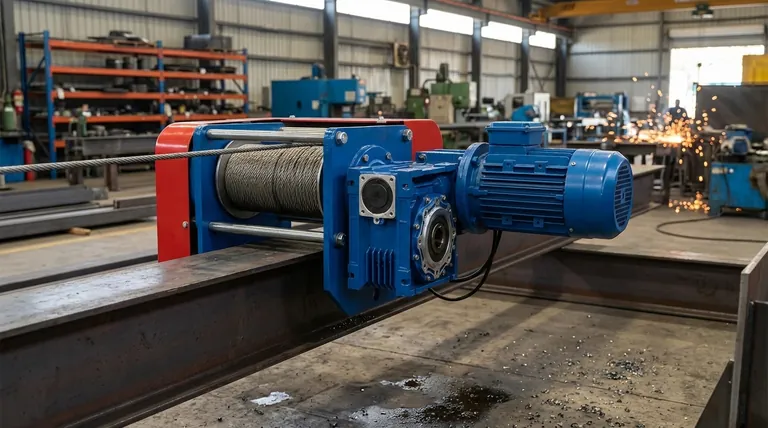
The Core Mechanical System: How It Achieves Power and Speed
The fundamental design of a wire rope hoist is what enables its signature performance characteristics. Each component plays a critical role in converting electrical energy into controlled lifting power.
The Lifting Motor
The motor is the heart of the hoist. It provides the initial torque required to begin the lift, and its design dictates the hoist's overall power and duty cycle capabilities.
The Transmission and Drum
The motor's power is amplified through a gearbox. This transmission drives a shaft that rotates the winding drum, which is the component the wire rope wraps around. This mechanism efficiently converts high-speed motor rotation into high-torque, lower-speed lifting force.
The Wire Rope and Guide
The wire rope, typically made from high-strength carbon or stainless steel, is the medium that carries the load. A crucial complementary part is the rope guide, which ensures the rope winds evenly onto the grooved drum, preventing tangles and premature wear.
Advanced Features for Precision and Control
Modern wire rope hoists are more than just brute force lifters. They incorporate sophisticated controls that give operators a high degree of accuracy and safety.
Variable Speed Control
This feature allows the operator to adjust the lifting and lowering speed. It is essential for carefully positioning heavy or delicate equipment and for slowing down as a load approaches its destination.
Soft Start/Stop Functionality
Soft start and stop technology smooths out the acceleration and deceleration of the hoist. This drastically reduces load swing and mechanical shock, protecting both the load and the hoist components from stress.
Smooth Acceleration and Deceleration
Building on soft start/stop, this feature ensures a fluid transition between speeds. It gives the operator superior control, which is vital for complex lifts or when working in tight spaces.
Understanding the Trade-offs and Design Choices
While powerful and versatile, wire rope hoists are not the perfect solution for every scenario. Acknowledging their trade-offs is crucial for making an informed decision.
Cost vs. Chain Hoists
Wire rope hoists are generally more expensive than their electric chain hoist counterparts. This higher initial cost is justified by their superior lifting speed, longer lift heights, and suitability for high-frequency, heavy-duty applications.
Wire Rope Durability
While strong, the wire rope can be less durable than a load chain in harsh environments with abrasive particles or chemical exposure. Regular inspection for fraying and wear is a critical maintenance task.
The Compact "In-Drum" Motor Design
Some designs place the motor inside the winding drum to create a more compact unit, which is ideal for tight headroom applications. However, this comes with drawbacks: the motor has poorer heat dissipation and is significantly more difficult to access for maintenance.
The Role of Safety Systems
Integrated safety features are non-negotiable. These include limit switches to prevent over-travel, overload protection to stop lifts that exceed capacity, and emergency braking systems. These are essential for protecting personnel, the load, and the equipment.
Making the Right Choice for Your Application
Selecting the appropriate hoist requires matching its features to the demands of your work.
- If your primary focus is high-speed, heavy-duty cycles: The speed and robust design of a wire rope hoist make it the superior choice for manufacturing and production lines.
- If your primary focus is precision handling of valuable loads: Prioritize a model with advanced controls like variable speed and soft start/stop to ensure maximum safety and accuracy.
- If your primary focus is operation in a tight space: An in-drum motor design may be necessary, but you must account for its more demanding maintenance and cooling requirements.
- If your primary focus is a lower-capacity, less frequent lift: A more cost-effective electric chain hoist may be a better-suited alternative to evaluate.
Ultimately, selecting the right hoist depends on a clear understanding of how these core features align with the specific demands of your lifting operations.
Summary Table:
| Feature | Key Components | Benefit |
|---|---|---|
| Power & Speed | Lifting Motor, Transmission, Drum | High-speed, heavy-duty lifting cycles |
| Durability & Safety | Steel Wire Rope, Rope Guide | Reliable load handling and reduced wear |
| Precision Control | Variable Speed, Soft Start/Stop | Accurate positioning and minimal load swing |
| Compact Design | In-Drum Motor (on some models) | Ideal for tight headroom applications |
Need a reliable hoist for your heavy-duty projects?
GARLWAY specializes in construction machinery, offering robust wire rope electric hoists for construction companies and contractors globally. Our hoists are engineered for high performance, safety, and durability to maximize your operational efficiency.
Contact GARLWAY today to discuss your specific lifting requirements and find the perfect solution!
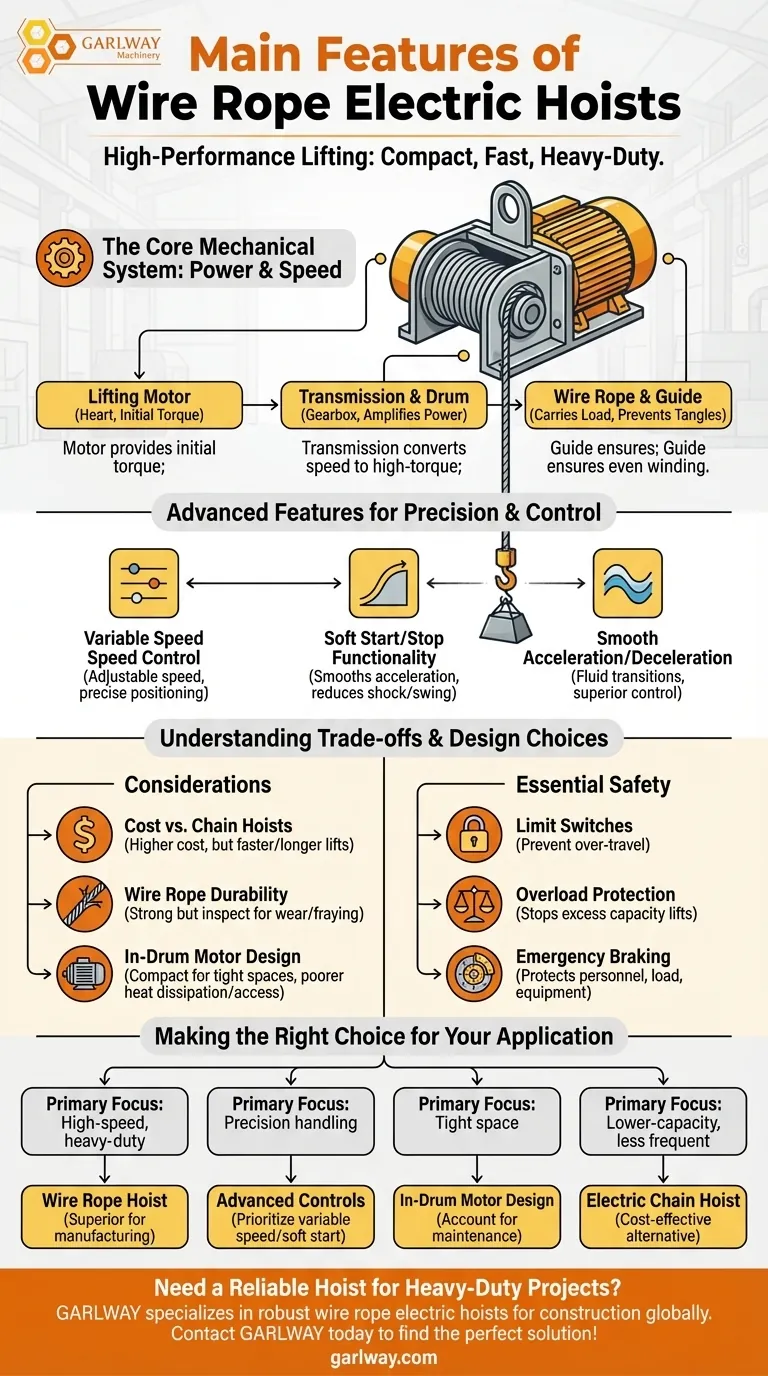
Visual Guide
Related Products
- Electric Hoist Winch Boat Anchor Windlass for Marine Applications
- Electric and Hydraulic Winch for Heavy Duty Applications
People Also Ask
- How does an electric anchor winch work? Power, Safety, and Reliable Operation Explained
- What are the advantages of installing an electric anchor winch on a boat? Boost Safety & Ease for Boaters
- What are the operational differences between electric hoists and winches? A Guide to Safe Lifting vs. Pulling
- What are the main benefits of a boat anchor winch? Boost Safety & Efficiency for Your Vessel
- How does a boat anchor winch work? A Guide to Reliable Anchor Handling

