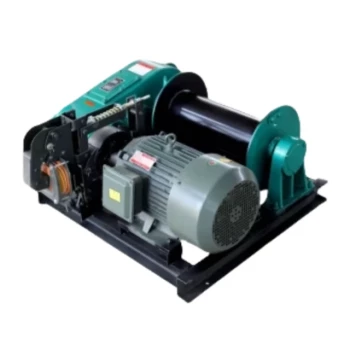
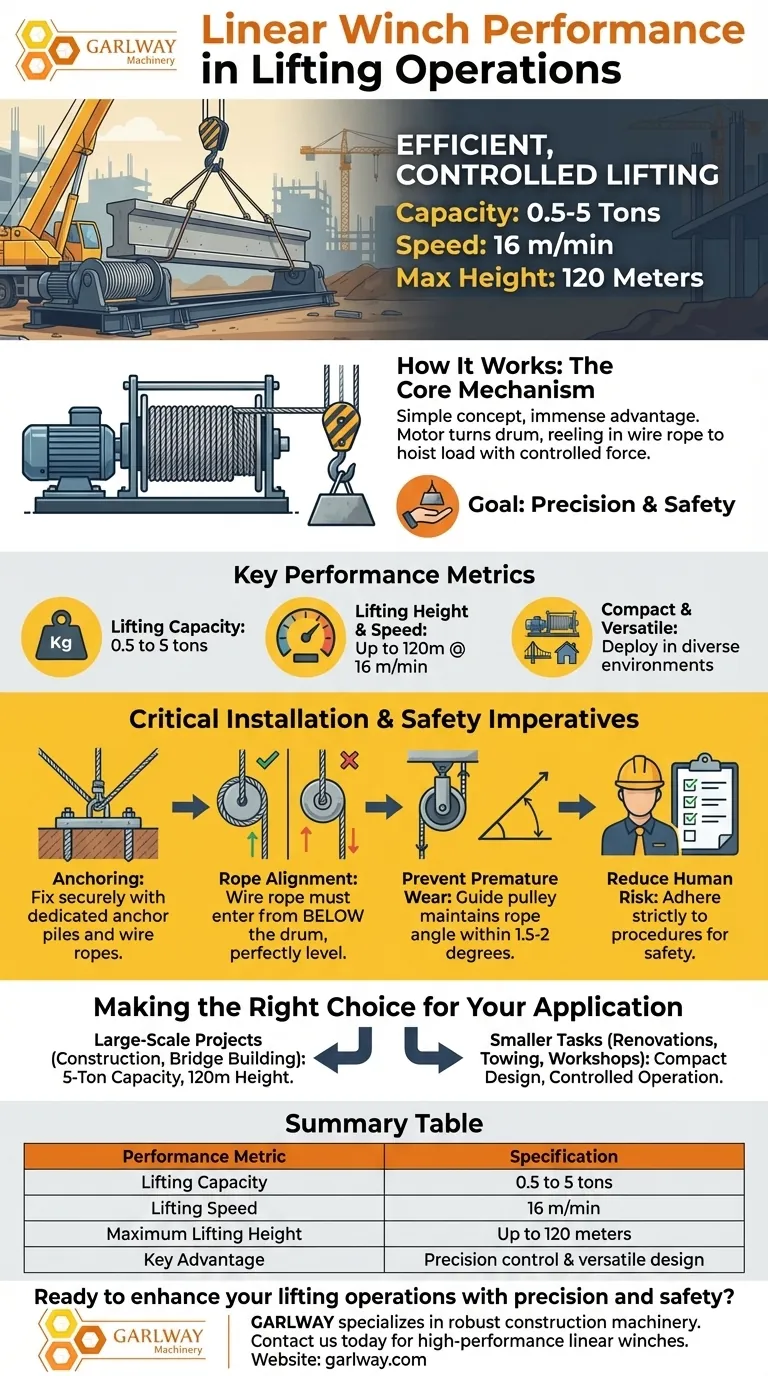
In lifting operations, a linear winch performs with notable efficiency and control. It is specifically engineered to handle heavy loads, ranging from 0.5 to 5 tons, with a consistent lifting speed of 16 meters per minute. This capability allows it to manage objects across a significant vertical distance, from 1 up to 120 meters, making it a versatile tool for a wide array of tasks.
The true performance of a linear winch isn't just about its lifting power; it's about achieving that power with precision and safety, which is entirely dependent on correct installation and operational discipline.
How a Winch Fundamentally Works
To understand the linear winch's performance, we must first grasp its core operational principle. It is a simple concept that provides immense mechanical advantage.
The Core Mechanism
At its heart, a winch operates much like a fishing reel. A strong wire rope is wound around a central drum or spool. When the winch is activated, a motor turns the drum, reeling in the rope and pulling the attached load with controlled force.
The Goal of Precision
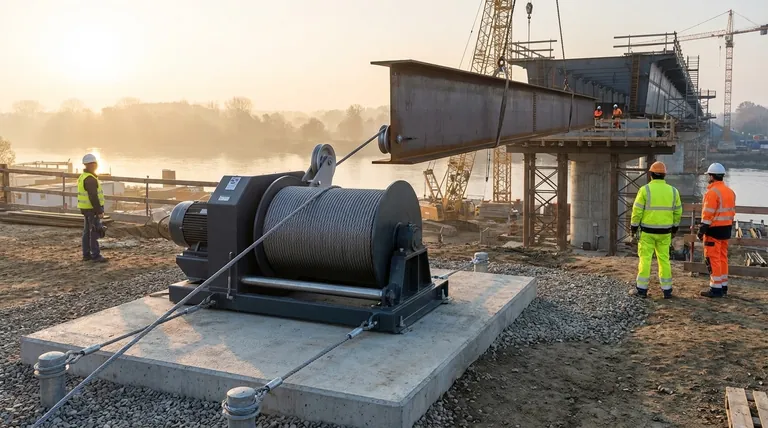
Industrial winches are the backbone of heavy lifting because they translate raw power into precise, manageable movement. This allows for the careful hoisting of massive loads, such as steel beams on a construction site or heavy equipment within a factory.
Key Performance Metrics of a Linear Winch
The specific capabilities of a linear winch define its suitability for different lifting operations. These metrics highlight its blend of power and adaptability.
Lifting Capacity
The linear winch is designed to handle lifting needs from 0.5 to 5 tons. This range makes it suitable for both large-scale industrial applications and smaller, demanding tasks.
Lifting Height and Speed
With a maximum lifting height of 120 meters and a steady speed of 16 meters per minute, the winch provides a predictable and controlled ascent. This balance is crucial for maintaining safety and accuracy over long vertical distances.
Compact and Versatile Design
Despite its power, the linear winch maintains a compact size. This design allows it to be deployed in diverse environments, from sprawling construction sites and bridge building projects to smaller-scale jobs like home renovations.
Critical Installation and Safety Imperatives
A winch's performance is directly tied to its setup. Flaws in installation will compromise both its effectiveness and, more importantly, its safety.
The Foundation of Safety: Anchoring
The winch must be fixed securely using dedicated anchor piles. Wire ropes should be used to secure both sides of the machine, preventing any lateral movement or tipping under load. It must be installed on a flat, stable surface outside the direct lifting area.
Wire Rope Alignment is Non-Negotiable
For the winch to function correctly, the wire rope must be wound onto the drum perfectly. The rope should be level, enter from below the drum, and be as perpendicular as possible to the drum's axis. This prevents the rope from overlapping or crushing itself.
Preventing Premature Wear
To ensure longevity, a guide pulley should be placed in front of the winch. This pulley maintains the maximum deviation angle of the wire rope to within 1.5 to 2 degrees, drastically reducing wear on both the rope and the pulley groove.
Reducing Human Risk
When properly installed and operated, a winch significantly reduces the risk of accidents and injuries associated with manual heavy lifting. However, this safety advantage is only realized when all procedural and mechanical safeguards are strictly followed.
Making the Right Choice for Your Application
To leverage the linear winch effectively, match its capabilities to the specific demands of your project.
- If your primary focus is large-scale industrial projects: The winch's 5-ton capacity and 120-meter height make it ideal for construction, road repairs, and bridge building.
- If your primary focus is smaller, versatile tasks: Its compact design and controlled operation are perfectly suited for home renovations, vehicle towing, and workshop lifting.
Ultimately, understanding the linear winch's capabilities and operational requirements is the key to executing lifting operations with safety and precision.
Summary Table:
| Performance Metric | Specification |
|---|---|
| Lifting Capacity | 0.5 to 5 tons |
| Lifting Speed | 16 meters per minute |
| Maximum Lifting Height | Up to 120 meters |
| Key Advantage | Precision control & versatile design |
Ready to enhance your lifting operations with precision and safety?
GARLWAY specializes in providing robust construction machinery, including high-performance linear winches, concrete mixers, and batching plants for construction companies and contractors globally. Our equipment is engineered for reliability and efficiency, helping you complete projects on time and within budget.
Contact us today to discuss how our linear winches can meet your specific project needs and deliver superior performance.
Get a Free Consultation & Quote
Visual Guide
Related Products
- Portable Small Trailer Winch
- Small Electric Winch 120V and 240V for Compact Applications
- Hydraulic Winding Engine Harbor Freight Winch
- Quick Windlass Portable Winch for Truck and Boat Best Boat Winch
- Electric and Hydraulic Winch for Heavy Duty Applications
People Also Ask
- What features were incorporated into the upgraded portable winch system? Boost Your Recovery Power & Safety
- What are some uses mentioned for portable winches beyond vehicle recovery? Essential Versatility for Property & Work
- How could the twisting issue with a portable winch be mitigated? Achieve Safe, Centered Pulls with Proper Rigging
- What is the significance of trailer winches in the boating industry? Ensure Safe and Efficient Boat Recovery
- What should be considered when mounting a winch on a trailer? Ensure a Safe, Aligned Installation