
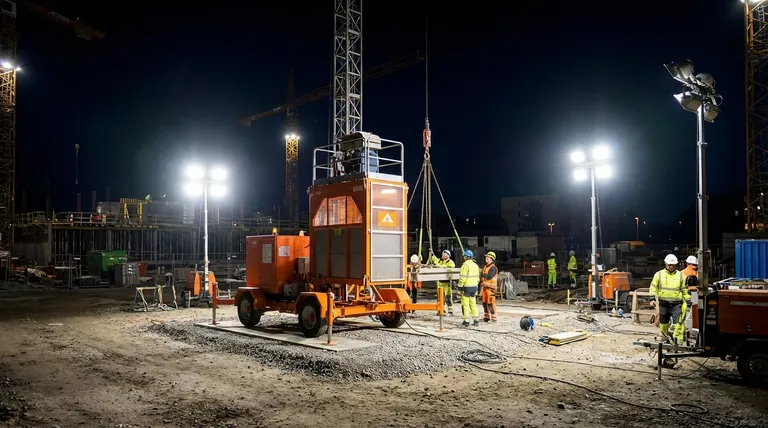
At its core, the single most critical requirement for night operations with a hoist is providing sufficient lighting. This fundamental need for illumination is layered on top of the comprehensive safety, inspection, and operator competency protocols that are mandatory for any hoist operation, regardless of the time of day.
Operating a hoist at night is not a separate discipline; it is the standard, rigorous process of safe hoisting performed in a higher-risk environment. The key is to use adequate lighting to mitigate the specific risks introduced by darkness.
The Foundation: Standard Hoist Readiness
Before considering the unique challenges of night work, you must ensure the fundamentals are flawlessly executed. These requirements are the bedrock of any safe hoisting operation.
Operator Competency
The operator is the most critical component. They must be thoroughly familiar with the hoist's structure, performance, and operational methods.
This includes having some mechanical knowledge to identify potential issues and being trained on pre-arranged signals and gestures for clear communication.
Daily Pre-Operation Inspection
Before any work begins, a meticulous inspection is mandatory. This is a non-negotiable safety step.
Check the hoist, wire rope, anchor points, ground wheel, clutch, brake, and ratchet mechanisms. A no-load test run should be performed to confirm everything is in proper working order.
Mechanical and Electrical Integrity
The equipment must be in peak condition. Ensure all lubrication points are serviced and that the screw is kept clean and freshly greased to prevent rust and ensure smooth operation.
Inspect for loose bolts and confirm the integrity of the power line connection and switches. During operation, no one should be standing around the hoist.
The Critical Variable: Night Illumination
Sufficient lighting is the primary factor that makes a night operation possible. Without it, the risks become unacceptable.
Defining "Sufficient" Light
"Sufficient" means the entire operational area is clearly and evenly lit. This includes the hoist itself, the load's entire travel path from start to finish, and the operator's position.
The goal is to eliminate shadows and dark spots that could hide a hazard, such as a snagged rope or an unstable ground condition.
Ensuring Reliability
The lighting source must be as reliable as the hoist itself. It requires a stable power source that is not prone to failure.
Consider having a backup lighting source available in case the primary system fails unexpectedly during a critical lift.
Understanding the Heightened Risks of Darkness
Failing to properly account for night conditions introduces significant dangers that are less prevalent during the day.
Reduced Situational Awareness
Darkness inherently limits what the operator and ground crew can see. Peripheral hazards, subtle shifts in the load, or personnel moving into the area can be easily missed.
Increased Potential for Miscommunication
Hand signals become difficult or impossible to see clearly over a distance. This places a much greater emphasis on clear, pre-arranged verbal or radio communication protocols.
Delayed Problem Recognition
An equipment issue, such as a fraying wire rope or a shifting anchor point, is much harder to detect in low light. This can delay the operator's reaction time and turn a minor issue into a major failure.
A Checklist for Safe Night Hoist Operations
Use these points to structure your approach to any night-time hoisting task.
- If your primary focus is safety and compliance: Your lighting plan must be documented and proven to illuminate the hoist, the load, the full travel path, and all personnel areas without creating dangerous glare.
- If your primary focus is operational readiness: Conduct a "dry run" in the dark without a load to identify and eliminate blind spots, communication gaps, or unexpected shadows before the real work begins.
- If your primary focus is team preparedness: Ensure every crew member knows the specific communication plan for night work and can execute emergency shutdown procedures instantly.
Proper preparation transforms a high-risk night operation into a controlled and professional task.
Summary Table:
| Requirement | Key Focus for Night Operations |
|---|---|
| Illumination | Provide sufficient, reliable lighting for the hoist, load path, and operator area. |
| Operator Competency | Ensure familiarity with equipment and clear communication protocols (verbal/radio). |
| Pre-Operation Inspection | Conduct meticulous checks of mechanical/electrical components and perform a no-load test. |
| Risk Mitigation | Address reduced visibility, miscommunication risks, and delayed problem recognition. |
Ensure your construction projects run safely and efficiently, day or night. GARLWAY specializes in providing robust construction machinery, including reliable hoists, winches, concrete mixers, and batching plants, designed for demanding environments. Our equipment helps construction companies and contractors maintain operational readiness and safety compliance. Contact us today to learn how our solutions can support your night operations and enhance your project's success.
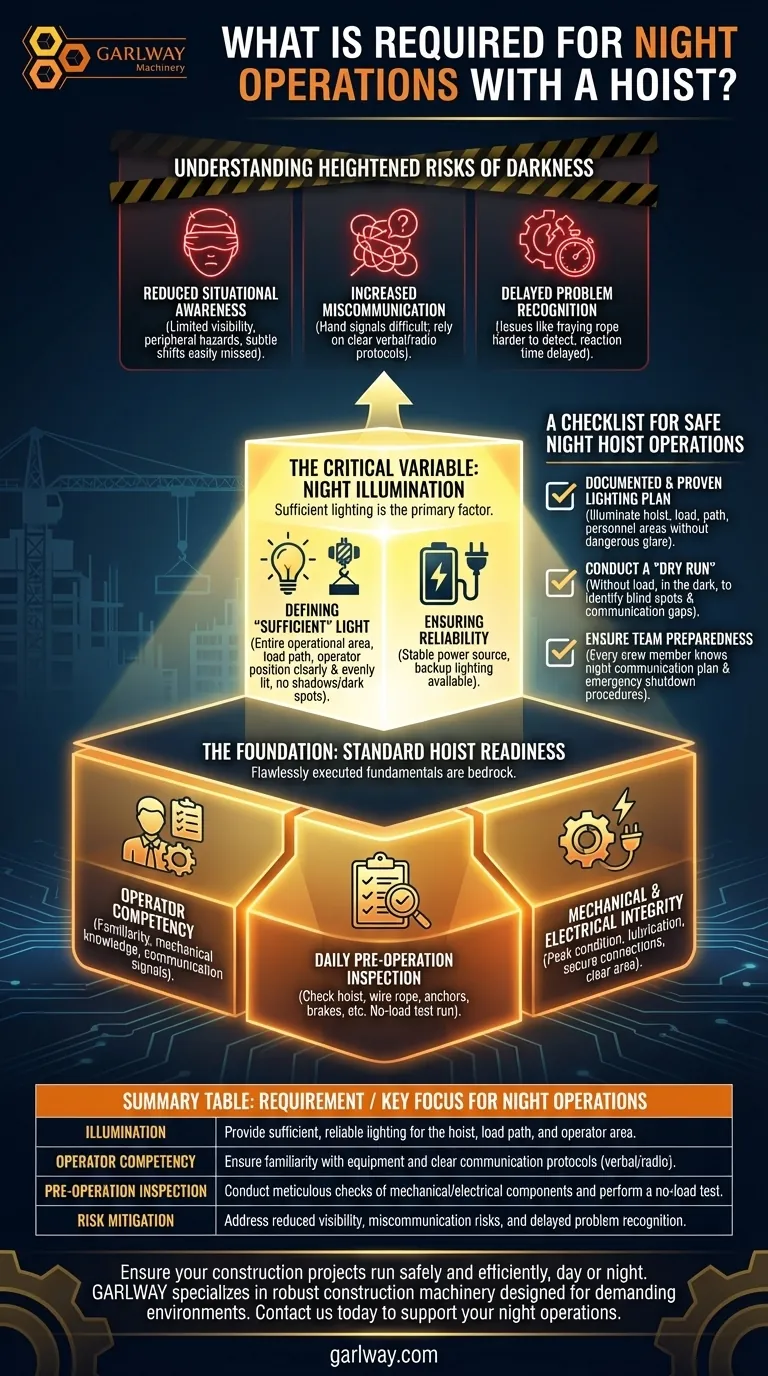
Visual Guide
Related Products
- Electric Hoist Winch Boat Anchor Windlass for Marine Applications
- Electric and Hydraulic Winch for Heavy Duty Applications
- Hydraulic Winding Engine Harbor Freight Winch
People Also Ask
- How does an electric anchor winch work? Power, Safety, and Reliable Operation Explained
- What are the advantages of installing an electric anchor winch on a boat? Boost Safety & Ease for Boaters
- What are the operational differences between electric hoists and winches? A Guide to Safe Lifting vs. Pulling
- What are the main benefits of a boat anchor winch? Boost Safety & Efficiency for Your Vessel
- How does a boat anchor winch work? A Guide to Reliable Anchor Handling


