
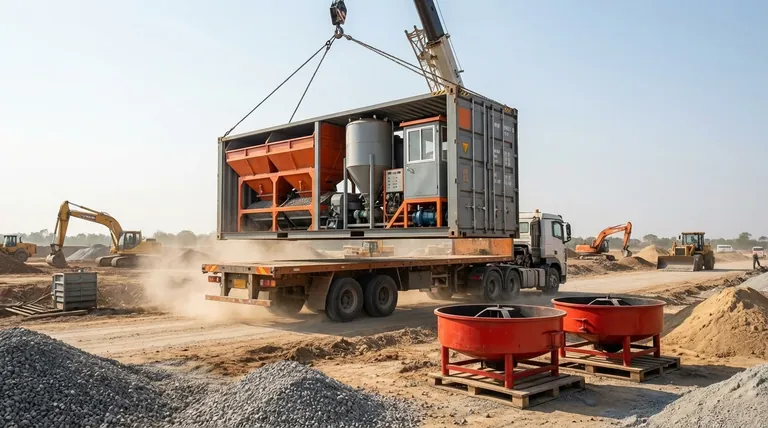
At its core, a concrete mixing plant container improves mobility by integrating the entire batching facility—storage, weighing, mixing, and controls—into a standardized, self-contained unit. This design allows the entire plant to be transported as a single piece of equipment using standard trailers or skids, eliminating the complex disassembly and reassembly required for traditional plants.
The true advantage isn't just movement; it's the radical reduction in deployment time and logistical complexity. By treating the entire concrete plant as a single, transportable module, projects gain the flexibility to produce high-quality concrete on-demand, anywhere a truck can go.
The Core Design Principle: Self-Contained Integration
A concrete mixing plant container fundamentally changes the equation for on-site concrete production. It shifts the paradigm from building a temporary factory to simply positioning a piece of equipment.
What is a Containerized Plant?
This is a complete, mobile concrete mixing facility engineered to fit within the structural frame of a standard shipping container.
It is a fully functional plant, not just a mixer. All necessary components are pre-installed and calibrated within the unit.
The Power of Standardization
The container-based design leverages global logistics infrastructure. It is built to be easily loaded, secured, and transported on standard flatbed trucks or trailers.
This eliminates the need for specialized transport or complex crating, drastically simplifying the process of moving between job sites.
All-in-One Functionality
These units contain aggregate bins, cement silos, water and admixture systems, weighing scales, a mixer, and a control room.
Because everything is integrated, setup on a new site primarily involves connecting power and water, a process that is significantly faster than assembling a traditional plant from individual components.
Translating Design into On-Site Advantages
The self-contained, mobile design delivers tangible benefits that directly impact project timelines and budgets.
Rapid Deployment and Installation
The most significant advantage is the speed of setup and teardown. A containerized plant can often be operational within hours of arriving on-site.
This is ideal for projects with tight schedules or those that require concrete production to begin almost immediately.
Improved Quality Control
By producing concrete directly at the point of use, you eliminate variables associated with long transit times from an off-site supplier.
This ensures consistent quality, slump, and temperature, giving you direct control over the final product for every pour.
Cost Savings Beyond Transportation
While direct transport costs are lower, the primary savings come from reduced labor for setup, minimal need for extensive foundations, and eliminating the expense and delays of relying on third-party concrete suppliers.
Understanding the Trade-offs
While highly effective, containerized plants are a specific tool for a specific job. Understanding their limitations is crucial for making an informed decision.
Production Capacity
Mobile container plants are generally designed for small to medium-volume projects. Their output capacity is typically lower than that of large, permanent stationary plants.
For massive, single-site projects like dam construction, a traditional plant may be more efficient.
Site Requirements and Logistics
While mobile, the plant still requires a stable, level area for operation. You must also plan for the logistics of raw material delivery, including cement, aggregate, and water.
Access for delivery trucks is a critical consideration for site selection.
Initial Investment
The upfront capital cost for a mobile plant can be significant. This investment must be weighed against the long-term savings in logistics, labor, and supplier costs over the course of multiple projects.
Making the Right Choice for Your Project
Selecting the right equipment depends entirely on your operational needs and project types.
- If your primary focus is rapid deployment for short-term or remote projects: The containerized plant is the most efficient solution available.
- If your primary focus is serving multiple, geographically separate job sites in succession: The "plug-and-play" nature of a mobile plant minimizes downtime between projects.
- If your primary focus is extremely high-volume, continuous production at a single location: A larger, stationary batching plant will likely offer a lower cost per cubic meter of concrete.
Ultimately, a concrete mixing plant container empowers you to take direct control over your concrete supply chain.
Summary Table:
| Feature | Benefit |
|---|---|
| Self-Contained Design | Eliminates complex disassembly; transport as a single unit |
| Standardized Container Frame | Easy transport via standard trucks and trailers |
| All-in-One Integration | Faster setup with pre-installed components |
| Rapid Deployment | Operational within hours, ideal for tight schedules |
| On-Site Quality Control | Consistent concrete quality by reducing transit variables |
Ready to take control of your concrete supply chain? GARLWAY specializes in high-performance construction machinery, including containerized concrete batching plants, winches, and mixers designed for contractors and construction companies. Our mobile plants deliver rapid deployment, cost savings, and reliable on-site production. Contact us today to discuss how our solutions can optimize your project's efficiency and mobility!
Visual Guide

Related Products
- HZS35 Small Cement Concrete Mixing Batch Plant
- Construction Products Concrete Plant Machine Mixing Concrete Mixer
- HZS120 Ready Mix Concrete Batching Plant Commercial Mud Cement Mixer
- HZS75 Concrete Batching Plant Cement Mixer Price Concrete Mixer Bunnings Mixing Plant
- Commercial Electric Concrete Mixer Machine HZS 50 Small Batch Plant for Sale
People Also Ask
- Why buy concrete batch plant parts only from the manufacturer? Protect Your Investment and Maximize Uptime
- Why is proper maintenance important for a concrete batch mix plant? Maximize Uptime & Profitability
- What is the advantage of a mobile concrete batching plant? Achieve On-Site Production & Total Control
- What are the advantages and disadvantages of concrete batching plants? Maximize Quality & Efficiency
- What are the two methods of material charging in a concrete mixing station? Single vs. Multiple Charging Explained




