While history books often point to a Kansas-based inventor, the individual most frequently credited with inventing the first motorized, truck-mounted concrete mixer is Stephen Stepanian. He filed for a patent for his "Apparatus for Concrete Work" in 1916, which was eventually granted in 1933, laying the groundwork for the modern ready-mix concrete industry.
The invention of the concrete mixer truck wasn't a single event but an evolution. The key distinction lies between the invention of the first practical mixer and the later innovation of mounting that mixer onto a truck.
The Two Key Innovations: Mixer vs. Truck
Understanding the history requires separating two distinct but related breakthroughs that occurred over a decade apart. Each solved a different fundamental problem in construction.
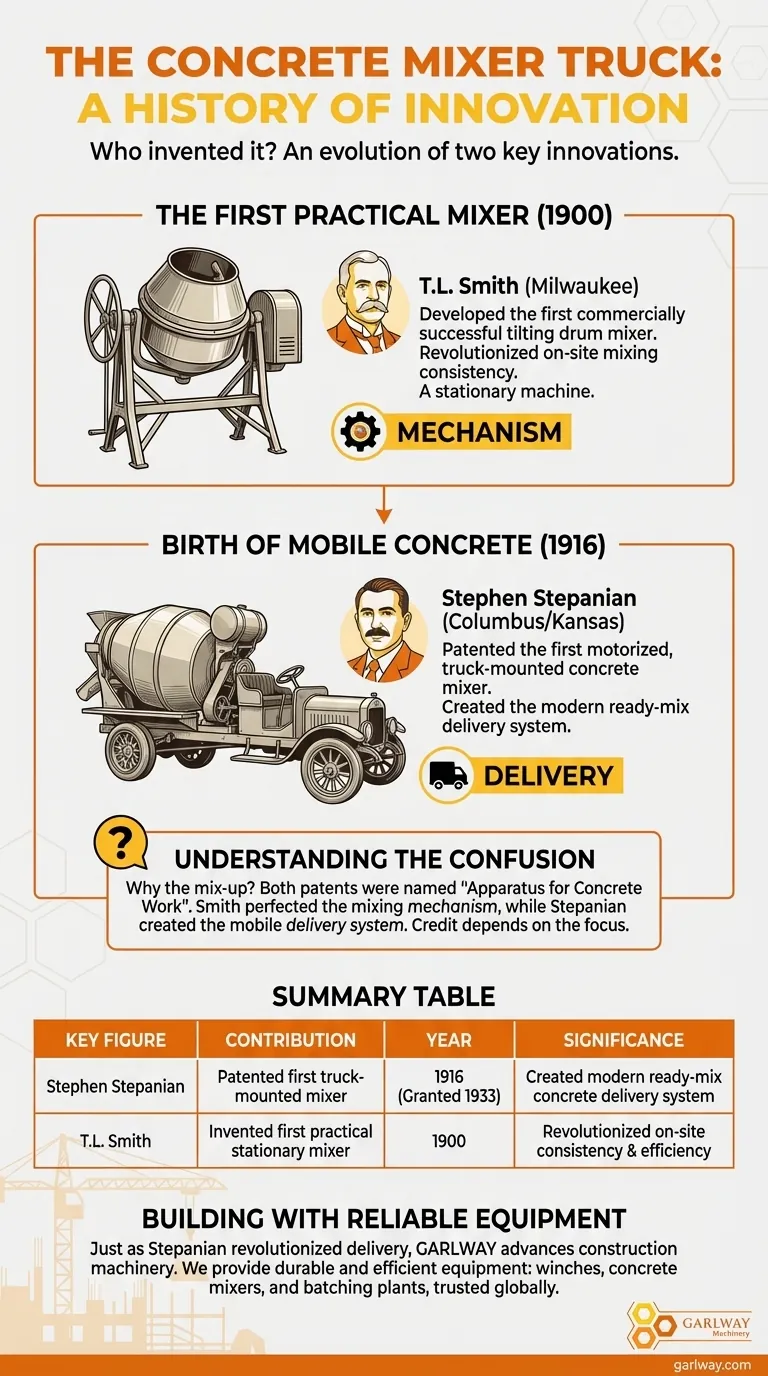
T.L. Smith and the First Practical Mixer (1900)
Before the turn of the 20th century, concrete was mixed by hand on-site, a labor-intensive and inconsistent process.
Thomas L. Smith, an industrialist from Milwaukee, addressed this by developing the first commercially successful tilting drum mixer in 1900. His design featured a double-cone drum with internal blades that provided a uniform and efficient mix.
This invention was revolutionary, but it was a stationary machine. It standardized the quality of concrete but didn't solve the problem of transporting it from a central plant to a distant job site.
Stephen Stepanian and the Birth of Mobile Concrete (1916)
The next great leap was making this process mobile. Stephen Stepanian, an inventor from Columbus, Ohio (though often associated with Kansas), conceived of mounting a mixer onto a truck chassis.
This seemingly simple idea had profound implications. It allowed for the creation of central batching plants where concrete could be mixed to precise specifications and then delivered, still fresh, directly to a construction site.
Stepanian's patent application for this "truck mixer" established the core concept of the vehicle we recognize today, effectively bringing the concrete factory to the job site.
Understanding the Historical Confusion
The overlapping timelines and similar patent names often create confusion about who deserves the primary credit. This is common with major industrial innovations.
Why "First" Is Rarely Simple
The term "inventor" can be ambiguous. Credit can be assigned to the person with the first idea, the first patent, or the first commercially viable product.
T.L. Smith created the first viable mixing mechanism, while Stepanian created the first mobile delivery system. Both were critical steps.
The 'Apparatus for Concrete Work' Naming
The references note that both inventions were patented under a similar name, "Apparatus for Concrete Work."
This generic-sounding title was common for patents of that era and contributes to the difficulty in distinguishing between the stationary mixer and the later truck-mounted version in historical records.
How to View This Piece of History
To properly attribute credit, it's essential to define which part of the innovation you are focused on.
- If your primary focus is the mixing mechanism itself: T.L. Smith is the key figure for his foundational 1900 design of the double-cone tilting drum.
- If your primary focus is the mobile, truck-mounted mixer: Stephen Stepanian is the inventor credited with the 1916 patent that defined the modern concrete truck.
Ultimately, the concrete mixer truck exists because one inventor perfected the process and another had the vision to put it on wheels.
Summary Table:
| Key Figure | Contribution | Year | Significance |
|---|---|---|---|
| Stephen Stepanian | Patented the first motorized, truck-mounted concrete mixer | 1916 (Patent granted 1933) | Created the modern ready-mix concrete delivery system |
| T.L. Smith | Invented the first commercially successful stationary tilting drum mixer | 1900 | Revolutionized on-site mixing consistency and efficiency |
Ready to Build with Reliable Equipment?
Just as Stepanian's innovation revolutionized concrete delivery, GARLWAY is committed to advancing construction machinery today. We specialize in providing durable and efficient equipment, including winches, concrete mixers, and concrete batching plants, trusted by construction companies and contractors globally.
Let us help you build smarter and more efficiently. Contact GARLWAY today to discuss your project needs and discover the right machinery solutions for you.
Visual Guide
Related Products
- Ready Mixer Machine for Construction Ready Mix Machinery
- JW1000 Mobile Cement Mixer Concrete Mixer Truck and Batching Plant
- Mini Cement Mortar Mixer Truck for Construction
- Harbor Freight JS1500 On Site Concrete Mixing Volumetric Cement Mixer
- Portable Concrete Mixer Machine Equipment for Mixing Concrete
People Also Ask
- What are the purposes of low-speed agitation in truck mixers? Preserve Concrete Quality During Transit
- How is ready-mixed concrete transported from a commercial concrete batching plant? Ensuring Quality & Timely Delivery
- What are the main ingredients mixed in a concrete mixer truck? Master the Formula for Strong Concrete
- In what ways does a mobile concrete mixer improve quality control and consistency? Achieve Superior On-Site Concrete Quality
- What types of construction projects typically use concrete mixer trucks? From Highways to Home Foundations