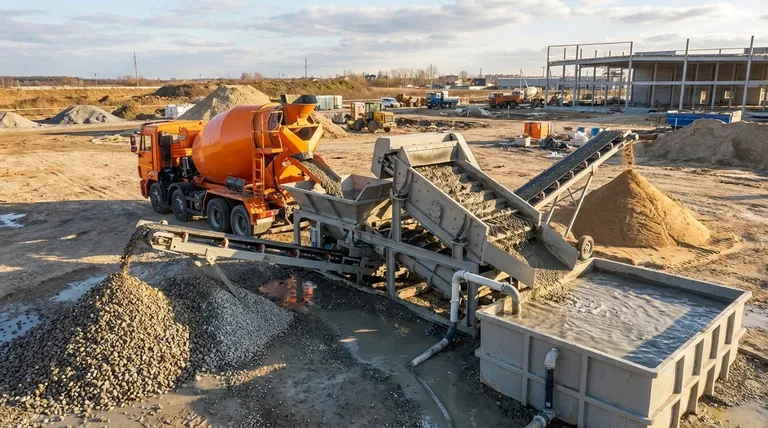
In essence, a concrete reclaimer is a sophisticated washing system. It takes unused wet concrete that would otherwise be discarded and mechanically separates it back into its core components—sand, stone, and water containing cement fines—allowing nearly all of it to be reused in new batches of concrete.
A concrete reclaimer transforms the challenge of returned concrete from a costly waste disposal problem into a closed-loop system that recovers valuable raw materials, significantly cutting both operational costs and environmental impact.
The Core Problem: The High Cost of Unused Concrete
Before understanding the solution, it's crucial to appreciate the problem. Leftover concrete from a job site, often called a "hot load" or returned concrete, represents a significant financial and environmental liability for any concrete producer.
The Logistical Challenge of "Hot" Loads
When a concrete mixer truck returns to the plant with unused product, it cannot simply be left in the drum to harden. This material must be dealt with immediately.
The Financial Drain of Disposal
The traditional method is to wash out the truck into a settlement pit or, worse, dispose of the concrete at a designated landfill. This incurs substantial disposal fees, transportation costs, and represents a complete loss of the valuable raw materials within the concrete.
The Environmental Footprint
Dumping concrete contributes to overflowing landfills. Furthermore, the wastewater from the washout process (slurry) is highly alkaline and can be harmful to the local environment if not managed properly.
How a Concrete Reclaimer Works: A Step-by-Step Process
A concrete reclaimer automates the process of breaking down this waste stream into usable parts. The process is remarkably straightforward and efficient.
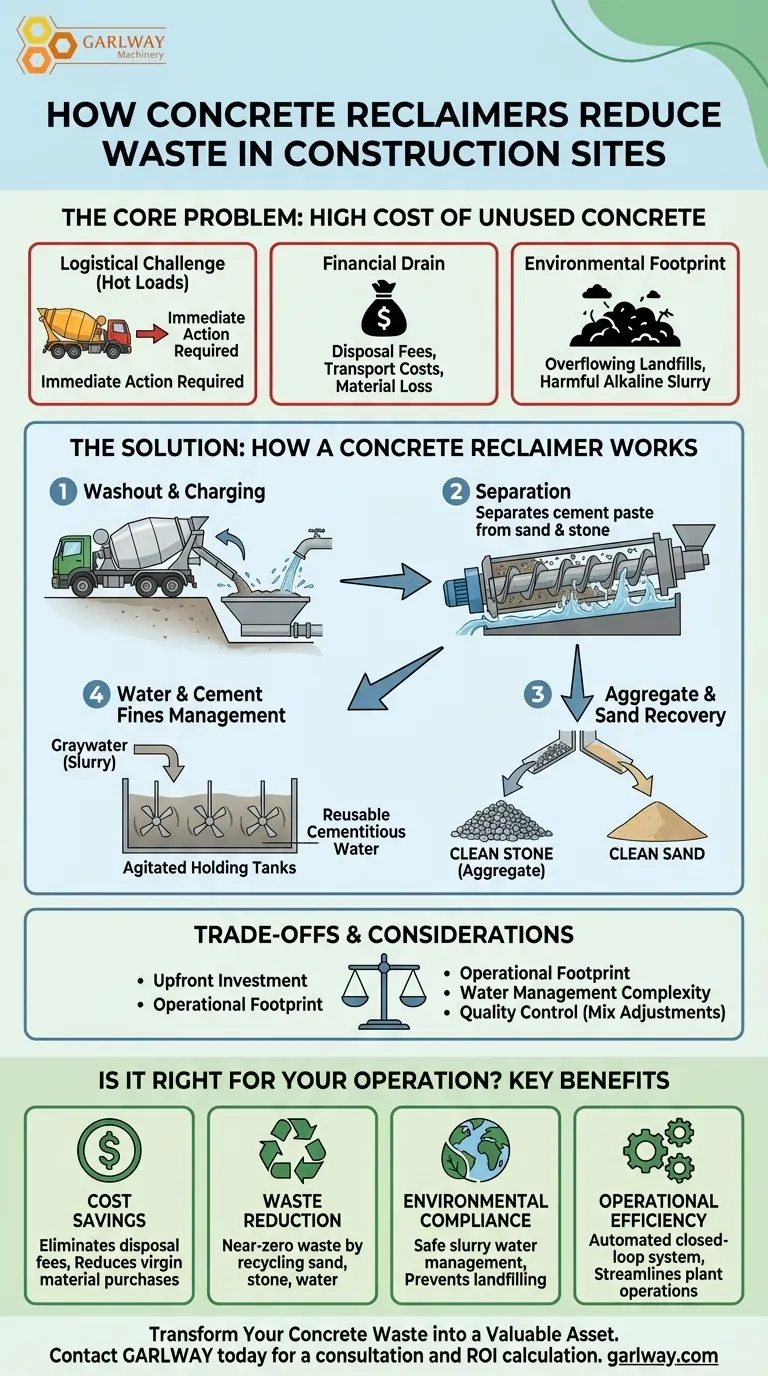
Step 1: Washout and Charging
A returning concrete truck backs up to the reclaimer's receiving hopper and discharges its leftover wet concrete. At the same time, water is injected into the system to begin the washing process.
Step 2: Separation
Inside the reclaimer, a large, rotating screw conveyor (an Archimedes screw) or a trommel screen churns the material. This mechanical action, combined with water, washes the cement paste off the surfaces of the sand and stone.
Step 3: Aggregate and Sand Recovery
The larger aggregates (stone) and sand are separated by size. As the screw turns, it carries the cleaned solids upward and out of the water bath, discharging them onto separate stockpiles. This recovered material is now clean and ready for immediate reuse.
Step 4: Water and Cement Fines Management
The water used in the washing process now contains the suspended cement and other fine particles. This "graywater" or slurry is channeled into a series of agitated holding tanks. Agitators keep the particles suspended, preventing them from settling and hardening.
Understanding the Trade-offs and Considerations
While reclaimers offer clear benefits, they are a significant investment and require careful integration into a plant's operations.
Upfront Capital Investment
Concrete reclaimers are a major piece of industrial equipment with a correspondingly high initial cost. The return on investment must be calculated based on the volume of returned concrete and current disposal costs.
Operational Footprint
These systems require a dedicated physical space at the plant for the machine itself, the aggregate storage piles, and the slurry water management pits or tanks.
Water Management Complexity
Properly managing the slurry water is critical. An effective system of agitated tanks is necessary to keep the cementitious water viable for reuse. Without this, the system's benefits are severely diminished.
Quality Control Is Essential
Reusing the recovered materials requires adjustments to your mix designs. The slurry water's specific gravity must be regularly tested to ensure consistent and predictable strength in the new concrete batches produced with it.
Is a Concrete Reclaimer Right for Your Operation?
Making the right decision depends entirely on your operational goals, scale, and commitment to sustainability.
- If your primary focus is cost reduction: A reclaimer offers a clear ROI by nearly eliminating concrete disposal fees and drastically reducing your need to purchase virgin sand, stone, and cement.
- If your primary focus is environmental sustainability: This technology is the most effective way to achieve a near-zero waste operation, conserve massive amounts of water, and prevent landfilling of concrete.
- If your primary focus is operational efficiency: A reclaimer streamlines the handling of returned trucks, creating a reliable, closed-loop system for material recovery that makes your entire plant more self-sufficient.
By turning a daily liability into a valuable asset, a concrete reclaimer fundamentally improves the financial and ecological performance of a concrete production facility.
Summary Table:
| Benefit | Description |
|---|---|
| Cost Savings | Eliminates disposal fees and reduces need for virgin materials. |
| Waste Reduction | Achieves near-zero waste by recycling sand, stone, and water. |
| Environmental Compliance | Manages alkaline slurry water safely, preventing landfill overflow. |
| Operational Efficiency | Automates handling of returned concrete, streamlining plant operations. |
Ready to transform your concrete waste into a valuable asset?
At GARLWAY, we specialize in construction machinery that drives profitability and sustainability for concrete producers and contractors worldwide. Our concrete reclaimers are engineered to:
- Slash your disposal costs by recovering up to 99% of returned concrete materials.
- Boost your operational efficiency with a reliable, automated closed-loop system.
- Strengthen your environmental credentials by significantly reducing your site's waste and water consumption.
Let our experts help you calculate your potential ROI and design a reclaimer system tailored to your plant's specific needs. Contact GARLWAY today to schedule a free consultation and see how we can help you build a more profitable, sustainable future.
Visual Guide
Related Products
- Portable Cement Mixer with Lift Concrete Machine
- Portable Electric Small Cement Mixer Concrete Machine
- Portable Concrete Mixer Machine Equipment for Mixing Concrete
- Commercial Electric Concrete Mixer Machine HZS 50 Small Batch Plant for Sale
- Construction Products Concrete Plant Machine Mixing Concrete Mixer
People Also Ask
- What are the size and portability options for portable cement mixers? Find Your Perfect Match for Any Job
- Why is it necessary to use a portable concrete mixer? Gain Total Control & Efficiency
- How much concrete can you pour with a portable mixer? Find the Perfect Fit for Your Project
- What is a portable cement mixer? Achieve Consistent, On-Demand Concrete Mixing
- What are the power sources for portable cement mixers? Choose the Right Power for Your Job Site