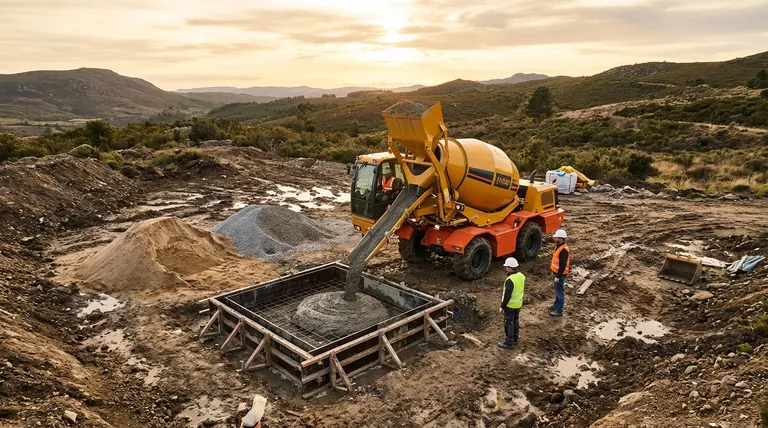
The core versatility of a self-loading mobile concrete mixer is its ability to function as an entire mobile batching plant. Unlike a traditional mixer truck that merely transports pre-mixed concrete, a self-loading unit sources raw materials, precisely measures them, mixes them to specification, and delivers the fresh concrete exactly where it's needed, regardless of terrain.
This transforms the equipment from a simple delivery vehicle into a complete, on-demand concrete production system. The fundamental advantage is gaining control over your entire concrete supply chain, breaking free from the logistical constraints and dependencies of a fixed batching plant.
Beyond Transport: An All-in-One Production System
Traditional concrete work involves a complex chain of logistics: a loader, a batching plant, and a transit mixer. The self-loading mixer consolidates all these functions into a single, efficient machine.
Control Over the Concrete Mix
A self-loading mixer gives you complete authority over the concrete recipe. You can combine cement, sand, aggregate, and water in customizable ratios directly on-site.
This allows for immediate adjustments to achieve the perfect consistency for different applications, a level of flexibility impossible with pre-mixed concrete delivered from a distant plant.
Eliminating Auxiliary Equipment
By integrating a loading bucket, digital weigh-batching system, and mixing drum, the machine performs the work of multiple vehicles. This eliminates the need for a separate wheel loader to handle raw materials and removes dependency on a central batching plant.
This consolidation directly reduces fuel consumption, labor requirements, and the number of machines needed on-site.
Unlocking Difficult and Remote Sites
A primary advantage is the ability to produce high-quality concrete in locations that are inaccessible or uneconomical for traditional methods.
All-Terrain Mobility
Engineered with four-wheel drive, rugged, low-pressure tires, and high ground clearance, these mixers excel on rough and uneven surfaces.
They can confidently navigate muddy sites, undeveloped rural areas, and steep inclines of up to 30 degrees, ensuring project continuity in challenging conditions.
Maneuverability in Confined Spaces
Their relatively compact design and excellent maneuverability make them ideal for urban construction, infrastructure repair, and sites with tight access.
Where a large transit mixer cannot go, a self-loading mixer can often navigate directly to the point of pour, saving significant time and labor.
Understanding the Trade-offs
While incredibly versatile, this equipment is not a universal solution. An objective assessment requires acknowledging its operational boundaries.
Initial Capital Outlay
As an all-in-one system, the upfront investment for a self-loading mixer is typically higher than for a single-function machine like a standard transit mixer. The return on investment is calculated through long-term savings on labor, fuel, and wasted material.
Lower Volume Throughput
A self-loading mixer is designed for on-demand, precision work. It cannot compete with the sheer cubic meters per hour output of a large, dedicated stationary batching plant. It is a tool for versatility, not mass production.
Increased Maintenance Complexity
Combining loading, weighing, and mixing systems into one chassis means more components to service. Proper maintenance is critical to ensure the reliability of the hydraulic, mechanical, and electronic systems.
Making the Right Choice for Your Project
Selecting the right equipment depends entirely on the logistical challenges you aim to solve.
- If your primary focus is working on remote or varied terrain projects: The off-road capability is the defining advantage, allowing you to produce quality concrete anywhere.
- If your primary focus is maximizing on-site efficiency and reducing labor: The all-in-one design is a force multiplier, significantly cutting down on machinery and personnel costs.
- If your primary focus is projects requiring custom or small-batch concrete: The on-demand mixing provides unparalleled quality control and flexibility, eliminating waste from over-ordered batches.
Ultimately, adopting a self-loading mixer is about taking direct control over your concrete production, turning a major logistical dependency into a strategic on-site asset.
Summary Table:
| Advantage | Key Feature | Ideal For |
|---|---|---|
| All-in-One Production | Integrated loading, batching, mixing | Reducing equipment & labor needs |
| On-Site Mix Control | Customizable ratios, immediate adjustments | Projects requiring precise concrete specs |
| Remote & Rough Terrain Access | 4WD, high clearance, rugged tires | Inaccessible or off-grid sites |
| Urban & Confined Spaces | Compact design, excellent maneuverability | Tight urban construction or repairs |
Ready to take control of your concrete supply chain?
GARLWAY specializes in robust construction machinery, including self-loading mobile concrete mixers designed for contractors and construction companies globally. Our machines empower you to produce high-quality concrete on-demand, directly at your project site—eliminating logistical delays and reducing costs.
Contact GARLWAY today to discuss how our solutions can enhance your project's efficiency and versatility.
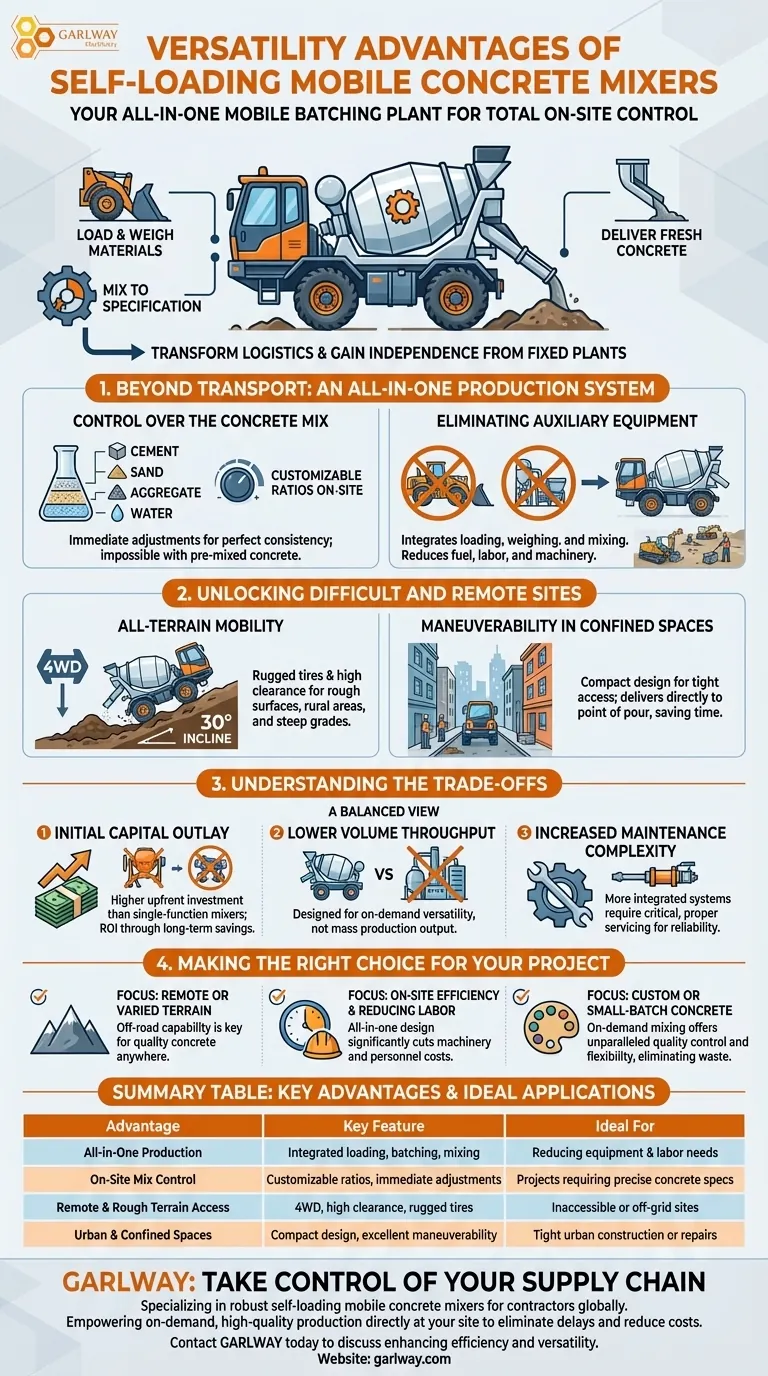
Visual Guide
Related Products
- Skid Steer Self Loading Concrete Mixers for Construction
- Belle Mixer Drum Self Loading Mortar Mixers JS3000
- Portable Cement Mixer with Lift Concrete Machine
- Portable Concrete Mixer Machine Equipment for Mixing Concrete
- Portable Ready Mix Concrete Mixer Equipment
People Also Ask
- How does the control system improve production efficiency in a self loading concrete mixer? Automate Mixing for Speed & Quality
- What is the purpose of keeping the drum rotating during transportation in a self loading concrete mixer? Ensure Quality & Consistency
- How does the weighing process work in a self loading concrete mixer? Achieve Precise, On-Site Concrete Batching
- What components are involved in the loading process of a self loading concrete mixer? A Guide to the Key Systems
- How should materials be loaded into a self-loading concrete mixer? Master the Step-by-Step Process