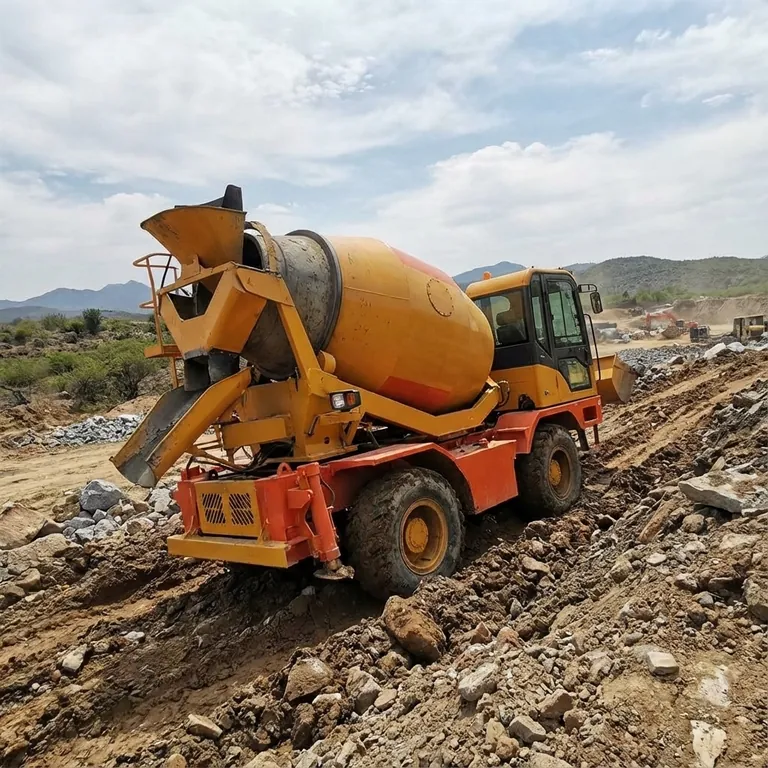
Ultimately, self-loading mobile concrete mixers are engineered as true all-terrain vehicles. They are purpose-built to operate effectively on rough terrain, steep inclines up to 30 degrees, and uneven surfaces. This capability is achieved through a combination of four-wheel drive systems, high ground clearance, and an optimized weight distribution that ensures stability.
The core value of a self-loading mixer isn't just its ability to mix concrete; it's the power to bring the entire batching plant directly to difficult and previously inaccessible points on a job site, overcoming logistical barriers that would stop a traditional mixer truck.
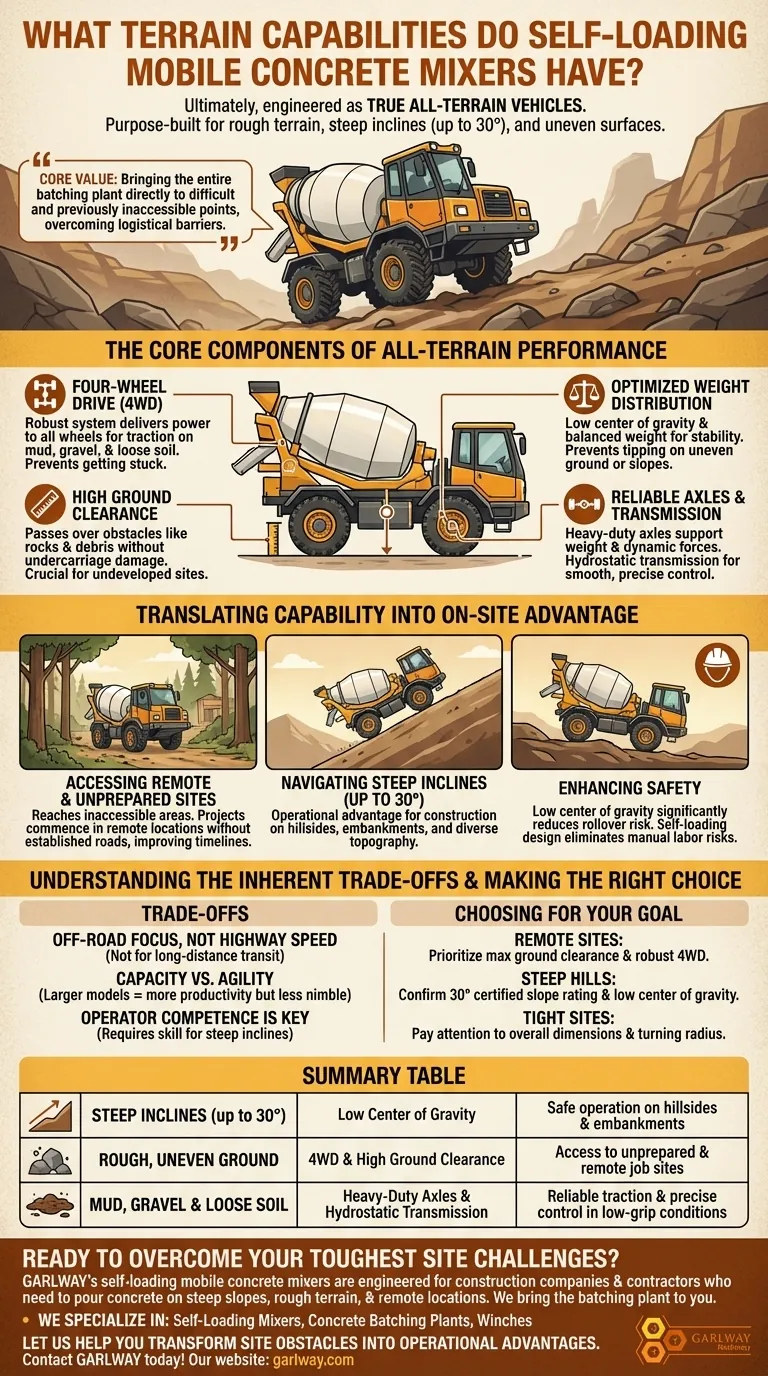
The Core Components of All-Terrain Performance
A self-loading mixer's off-road capability is not a single feature but the result of several integrated engineering choices. Understanding these components clarifies how the machine functions in challenging environments.
Four-Wheel Drive (4WD)
A robust four-wheel drive system is the foundation of its terrain handling. It ensures that power is delivered to all wheels, providing the necessary traction to move across mud, gravel, loose soil, and other low-grip surfaces without getting stuck.
High Ground Clearance
Sufficient ground clearance allows the machine to pass over obstacles like rocks, debris, and uneven ground without damaging the undercarriage. This is critical for operating on undeveloped sites or in the early stages of construction before the ground has been graded.
Optimized Weight Distribution
These mixers are designed with a low center of gravity and balanced weight distribution. This engineering is vital for maintaining stability and preventing tipping, especially when carrying a full load of concrete on uneven ground or traversing a slope.
Reliable Axles & Transmission
Heavy-duty axles are essential for supporting the machine's weight and the dynamic forces exerted when moving over rough terrain. A hydrostatic transmission provides smooth, reliable power delivery, which is crucial for precise control in difficult conditions.
Translating Capability into On-Site Advantage
These engineering features are not just specifications on a data sheet; they provide tangible benefits that solve real-world construction problems.
Accessing Remote and Unprepared Sites
The primary advantage is the ability to reach work areas that are inaccessible to standard vehicles. This allows projects to commence in remote locations or on sites without established roads, dramatically improving project timelines.
Navigating Steep Inclines
The certified ability to operate on slopes up to 30 degrees is a significant operational advantage. It unlocks the potential for construction on hillsides, embankments, and in geographically diverse regions without requiring extensive preliminary earthworks.
Enhancing Safety
The combination of a low center of gravity and a stable platform directly enhances operator safety. It significantly reduces the risk of rollovers on uneven surfaces, which is a major concern with heavy machinery. The self-loading design also eliminates manual labor risks associated with traditional mixing methods.
Understanding the Inherent Trade-offs
While exceptionally capable, it is important to understand the operational context and limitations of these machines. True expertise comes from knowing not just what a tool can do, but what it is not designed for.
Off-Road Focus, Not Highway Speed
A self-loading mixer is an off-road specialist. While it can travel on paved roads, it is not designed for high-speed, long-distance transit like a conventional concrete truck. Its strengths are maneuverability and stability at the job site, not cross-country logistics.
Capacity vs. Agility
There is a direct trade-off between the mixer's batch capacity and its agility. Larger models offer greater productivity per batch but may struggle to navigate extremely tight or confined spaces. Smaller models are more nimble but require more trips to pour the same volume.
Operator Competence is Key
Although designed with user-friendly controls, safely operating a fully loaded, multi-ton machine on a steep incline requires skill and situational awareness. Proper training is essential to leverage the machine's capabilities without compromising safety protocols.
Making the Right Choice for Your Goal
Selecting the right machine depends entirely on the primary challenges of your project environment.
- If your primary focus is working on remote, undeveloped sites: Prioritize a model with the highest available ground clearance and a robust four-wheel-drive system to handle unpredictable obstacles.
- If your primary focus is projects with steep hills or varied topography: Confirm the machine has a certified slope rating of 30 degrees and a demonstrably low center of gravity for maximum stability.
- If your primary focus is navigating tight, complex job sites: Pay close attention to the machine's overall dimensions and turning radius, as maneuverability will be your most critical asset.
By matching the machine's specific terrain capabilities to your project's unique demands, you can transform logistical challenges into a distinct operational advantage.
Summary Table:
| Terrain Capability | Key Feature | Operational Benefit |
|---|---|---|
| Steep Inclines (up to 30°) | Low Center of Gravity | Safe operation on hillsides & embankments |
| Rough, Uneven Ground | 4WD & High Ground Clearance | Access to unprepared & remote job sites |
| Mud, Gravel & Loose Soil | Heavy-Duty Axles & Hydrostatic Transmission | Reliable traction & precise control in low-grip conditions |
Ready to overcome your toughest site challenges?
GARLWAY's self-loading mobile concrete mixers are engineered for construction companies and contractors who need to pour concrete on steep slopes, rough terrain, and remote locations. Our machines bring the batching plant directly to your site, eliminating logistical barriers and saving you time and money.
We specialize in:
- Self-Loading Mixers for all-terrain mobility
- Concrete Batching Plants for high-volume production
- Winches for heavy lifting operations
Let us help you transform site obstacles into operational advantages. Contact GARLWAY today for a personalized solution and see how our construction machinery can power your projects!
Visual Guide
Related Products
- Skid Steer Self Loading Concrete Mixers for Construction
- Belle Mixer Drum Self Loading Mortar Mixers JS3000
- Portable Cement Mixer with Lift Concrete Machine
- Portable Concrete Mixer Machine Equipment for Mixing Concrete
- Portable Ready Mix Concrete Mixer Equipment
People Also Ask
- How does the control system improve production efficiency in a self loading concrete mixer? Automate Mixing for Speed & Quality
- What is the purpose of keeping the drum rotating during transportation in a self loading concrete mixer? Ensure Quality & Consistency
- How does the weighing process work in a self loading concrete mixer? Achieve Precise, On-Site Concrete Batching
- What components are involved in the loading process of a self loading concrete mixer? A Guide to the Key Systems
- How should materials be loaded into a self-loading concrete mixer? Master the Step-by-Step Process