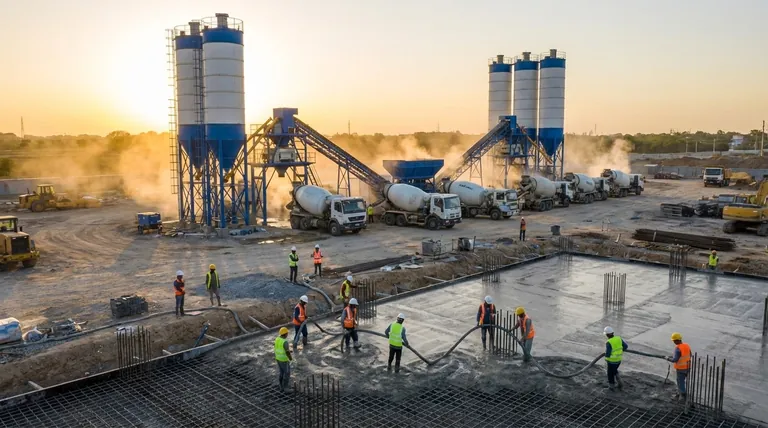
At its core, a consistent concrete mixture is the single most critical factor for ensuring the structural integrity, durability, and safety of any construction project. An inconsistent mix introduces unpredictable variables and weak points, turning a precisely engineered material into a liability.
Inconsistency in concrete is not a minor flaw; it is a fundamental risk. It creates a hidden network of vulnerabilities within a structure, jeopardizing everything from project budgets to the physical safety of its future occupants.
The Core Principle: From Uniformity to Strength
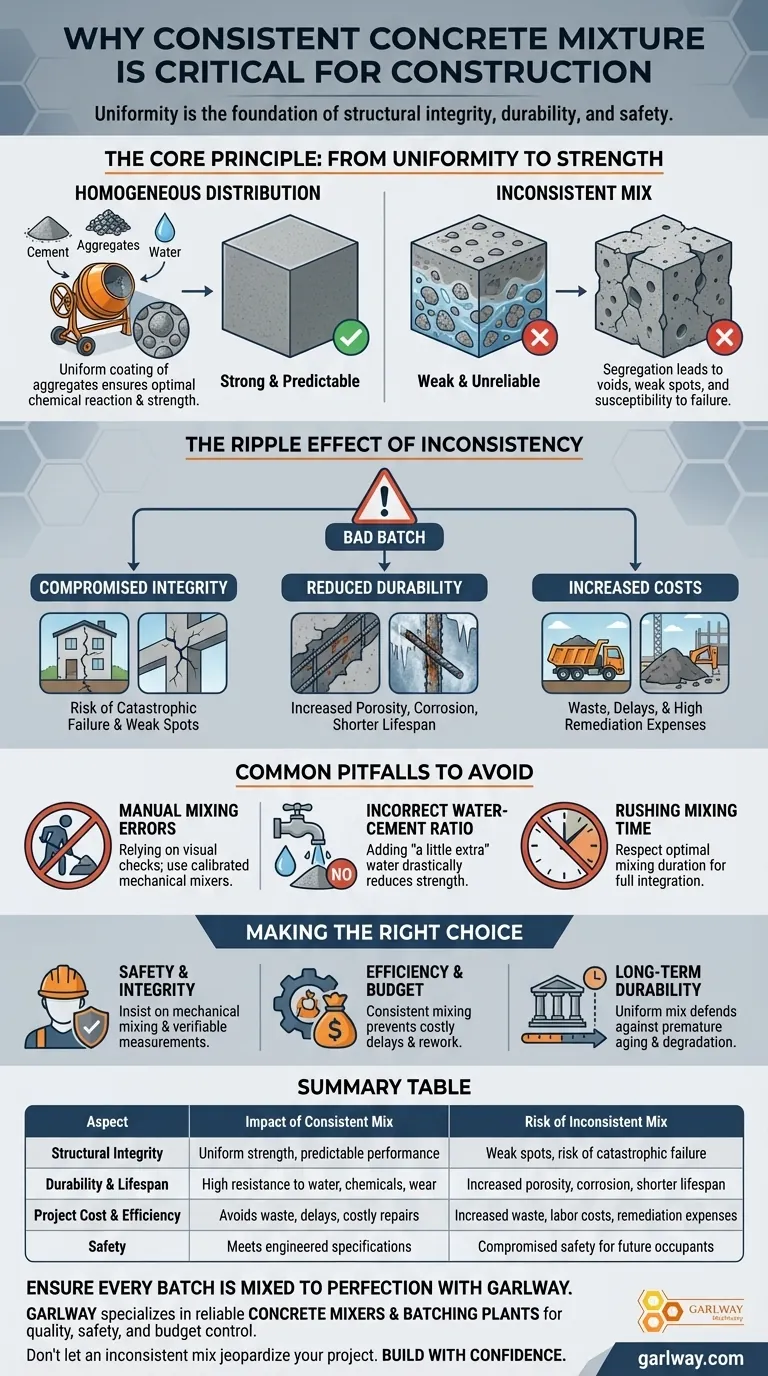
A well-mixed batch of concrete is a homogeneous suspension of materials. This uniformity is not just for appearance; it is essential for the chemical and physical processes that give concrete its strength.
The Role of Homogeneous Distribution
Proper mixing ensures that cement, aggregates (sand and gravel), and water are distributed evenly. This allows the cement particles to coat the surface of every aggregate, which is crucial for the chemical reaction of hydration to occur uniformly.
Preventing Structural Voids and Weak Spots
When a mix is inconsistent, it can lead to segregation. This results in pockets with too much aggregate and not enough cement paste, or areas that are overly wet and weak. These spots become the path of least resistance for cracks and structural failure.
Ensuring Predictable Performance
Engineers specify concrete mixes to achieve a certain compressive strength (measured in PSI or MPa). Only a consistent, properly mixed batch can be relied upon to meet these engineering specifications and perform as designed under load.
The Ripple Effect of Inconsistency
A single bad batch of concrete can have consequences that extend far beyond its initial placement, impacting safety, cost, and the building's entire lifespan.
Compromised Structural Integrity
The most immediate danger of inconsistent concrete is structural weakness. Columns, beams, and foundations with weak spots cannot support their designed loads, increasing the risk of catastrophic failure over time.
Reduced Durability and Lifespan
Inconsistent concrete is often more porous. This allows water and chemicals to penetrate the structure, leading to corrosion of steel reinforcement (rebar), damage from freeze-thaw cycles, and a significantly shorter service life.
Increased Waste and Labor Costs
A batch of concrete that fails quality control must be rejected and disposed of. This wastes materials and causes significant project delays, leading to increased labor costs and potential penalties. The cost of remediating a weak section after it has cured is exponentially higher than getting it right the first time.
Common Pitfalls to Avoid
Achieving a consistent mix requires vigilance against common shortcuts and errors that can undermine the quality of the final product.
The Myth of "Good Enough"
On-site, manual mixing is highly susceptible to human error. Relying on visual checks instead of calibrated equipment, like a concrete mixer, is a gamble that rarely pays off. Mechanical mixers are essential for guaranteeing uniformity.
Ignoring the Water-Cement Ratio
The water-to-cement ratio is the most critical factor for concrete strength. Adding "a little extra" water to make the concrete easier to pour is a common mistake that drastically reduces its final strength and durability.
Rushing the Mixing Time
Even with a machine, insufficient mixing time will fail to produce a homogeneous mixture. Each mix design has an optimal mixing duration that must be respected to allow all components to be fully integrated.
Making the Right Choice for Your Project
Ensuring consistency is not an added expense; it is a foundational requirement for any successful construction project.
- If your primary focus is maximum safety and structural integrity: Insist on using properly maintained mechanical mixers and verifiable measurements for every component, especially the water-cement ratio.
- If your primary focus is project efficiency and budget control: Recognize that consistent mixing prevents the significant costs associated with rejected batches, project delays, and future structural repairs.
- If your primary focus is long-term durability: A uniform concrete mix is your best defense against premature aging and environmental degradation, ensuring the structure lasts for its intended lifespan.
Ultimately, a commitment to a consistent concrete mixture is a commitment to quality, safety, and performance.
Summary Table:
| Aspect | Impact of Consistent Mix | Risk of Inconsistent Mix |
|---|---|---|
| Structural Integrity | Uniform strength, predictable performance | Weak spots, risk of catastrophic failure |
| Durability & Lifespan | High resistance to water, chemicals, and wear | Increased porosity, corrosion, shorter lifespan |
| Project Cost & Efficiency | Avoids waste, delays, and costly future repairs | Increased waste, labor costs, and remediation expenses |
| Safety | Meets engineered specifications for load-bearing | Compromised safety for future occupants |
Ensure every batch of concrete on your project is mixed to perfection.
GARLWAY specializes in construction machinery, offering reliable and efficient concrete mixers and batching plants designed for contractors and construction companies who prioritize quality, safety, and budget control. Our equipment helps you achieve the consistent, homogeneous mixtures essential for structural integrity and long-term durability.
Don't let an inconsistent mix jeopardize your project. Contact GARLWAY today to find the right mixing solution for your needs and build with confidence.
Visual Guide
Related Products
- Portable Concrete Mixer Machine Equipment for Mixing Concrete
- Construction Products Concrete Plant Machine Mixing Concrete Mixer
- Portable Electric Concrete Mixer Machine for Cement Mixing
- JZC400 Mobile Small Concrete Mixer Cement Mixer Machine
- Hydraulic Concrete Mixer Machine Cement Mixing Equipment for Mixture Concrete
People Also Ask
- Why is it necessary to use a portable concrete mixer? Gain Total Control & Efficiency
- How much concrete can you pour with a portable mixer? Find the Perfect Fit for Your Project
- What types of projects are portable concrete mixers suitable for? Ideal for DIY & Small-Scale Construction
- How much does a portable concrete mixer hold? A Guide to Choosing the Right Capacity
- What types of portable concrete mixers exist? Find the Perfect Mixer for Your Project