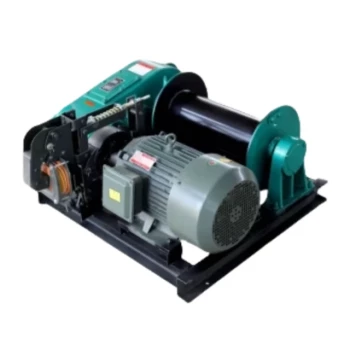
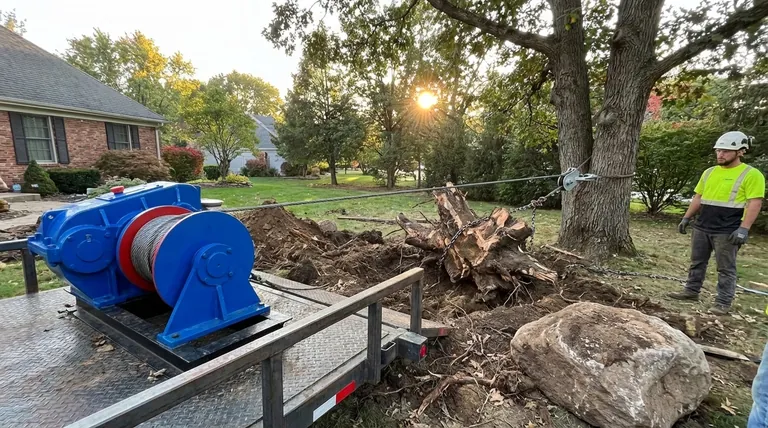
In landscaping, a winch is a force multiplier. It transforms seemingly impossible tasks, like moving multi-ton boulders or extracting stubborn tree stumps, into manageable operations. By providing immense and controlled pulling power, a winch allows a single person to accomplish what would otherwise require heavy machinery or a team of laborers.
The core value of a winch in landscaping is not just raw power, but controlled, precise force. It enables you to overcome immense resistance—like a deep root system or the inertia of a large stone—and position heavy objects with accuracy, even in areas inaccessible to larger equipment.
The Core Landscaping Applications
A winch's utility goes far beyond vehicle recovery. When applied to a landscape, it becomes a tool for fundamental reshaping and clearing.
Removing Tree Stumps and Roots
A winch provides the sustained, powerful pulling force necessary to break a stump free from the ground. This method is often more thorough than grinding, as it can extract a significant portion of the main root system along with the stump itself.
For particularly stubborn stumps, advanced techniques like a quadruple line pull using snatch blocks can multiply the winch's effective power, allowing it to handle even the most deeply rooted obstacles.
Precisely Felling Trees
When a tree needs to be removed from an area near a house, fence, or other valuable landscape features, controlling its fall is critical.
A winch cable attached to the tree allows you to apply directional force. This ensures the tree falls precisely where you intend, dramatically increasing safety and preventing collateral damage.
Moving Boulders and Heavy Objects
Placing large decorative rocks or moving heavy materials is a common landscaping challenge. A winch makes this far more efficient than using pry bars and manual labor.
By using natural anchors like a strong tree and snatch blocks, you can redirect the winch cable. This allows you to pull a boulder around corners, through gates, or into tight positions that a vehicle could never reach.
How to Approach a Landscaping Winch Project
Successful winch use is about planning, not just brute force. Understanding the principles of mechanical advantage and safety is essential before you begin any pull.
Choosing the Right Winch Capacity
The principle for sizing a winch is to ensure it is significantly stronger than the load. While the rule for vehicles is a winch with a capacity 1.5 times the vehicle's gross weight, applying this to landscaping requires estimation.
Because the force needed to uproot a stump can be unpredictable, it is always better to oversize your winch. A higher capacity provides a crucial margin of safety and ensures the equipment is not over-strained.
The Importance of Anchor Points
A winch is only as strong as its anchor. Whether you mount the winch to a vehicle or anchor your pull line to a tree, that point must be able to withstand the entire force of the pull.
A weak anchor point is the most common point of failure and represents a significant safety hazard. Always choose the thickest, healthiest tree available or ensure your vehicle is securely positioned.
Using Snatch Blocks for Advantage
A snatch block is a heavy-duty pulley that is a landscaper's best friend. It serves two primary functions.
First, it allows you to redirect the pulling angle. This is how you can pull an object sideways or around an obstacle. Second, it can be used to double the pulling power of your winch, giving you the mechanical advantage needed for the toughest jobs.
Understanding the Trade-offs and Risks
While incredibly effective, a winch is a professional tool that commands respect. The forces involved are immense and can be dangerous if not properly managed.
The Risk of Equipment Failure
A winch line, anchor strap, or shackle under thousands of pounds of tension stores an incredible amount of energy. If any component fails, it can become a dangerous projectile.
Always use high-quality, properly rated equipment and inspect every component before a pull. Never use a winch with a frayed cable or damaged straps.
The Inherent Learning Curve
Operating a winch safely requires more than just pushing a button. You must understand how pulling angles affect force, how to properly rig snatch blocks, and what safety precautions to take.
Treating this tool without the proper knowledge can lead to equipment damage or serious injury.
The Need for a Solid Base
A winch needs something to pull against. This typically means mounting it to a heavy vehicle, trailer, or another piece of substantial equipment.
This dependency can be a limitation. If you cannot get a vehicle into a position to act as a stable base, you may not be able to use a winch for that particular task.
Making the Right Choice for Your Goal
To use a winch effectively, match your equipment and technique to the specific landscaping challenge you are facing.
- If your primary focus is removing large, stubborn stumps: Invest in a high-capacity winch (12,000 lbs or more) and learn to use snatch blocks to create multi-line pulls for maximum force.
- If your primary focus is placing heavy landscape rocks: A standard winch (8,000-10,000 lbs) is often sufficient, but mastering the use of a snatch block to control positioning is key.
- If your primary focus is felling trees with precision: The winch is a tool for directional control, but this remains a high-risk task where professional expertise is strongly recommended.
With the right preparation and a deep respect for its power, a winch can be one of the most effective landscaping tools you can own.
Summary Table:
| Landscaping Task | Key Winch Application | Recommended Winch Capacity |
|---|---|---|
| Removing Tree Stumps | Sustained pulling to uproot stump and roots | 12,000 lbs+ (with snatch blocks) |
| Felling Trees Precisely | Directional control for safe fall | 8,000-10,000 lbs |
| Moving Boulders & Heavy Objects | Controlled positioning and redirection | 8,000-10,000 lbs (with snatch blocks) |
Ready to transform your landscaping projects with professional-grade power?
At GARLWAY, we specialize in robust construction machinery designed for demanding tasks. Our winches are engineered to provide the controlled, precise force you need to remove stubborn stumps, position heavy boulders, and tackle complex landscaping challenges safely and efficiently.
Whether you're a contractor managing large-scale projects or a landscaping professional seeking reliable equipment, GARLWAY winches offer the durability and performance to get the job done right.
Contact us today to discuss your specific needs and discover how a GARLWAY winch can become your most valuable landscaping tool.
Visual Guide
Related Products
- Warn Winch Windlass Boat Trailer Winch
- Electric and Hydraulic Winch for Heavy Duty Applications
- Small Electric Winch 120V and 240V for Compact Applications
- 12000 lb Electric Boat Trailer Winch with Windlass Anchor Warn
- Quick Windlass Portable Winch for Truck and Boat Best Boat Winch
People Also Ask
- What are the main components of a boat trailer winch? A Guide to Safe & Efficient Boat Loading
- What factors should be considered when choosing a boat trailer winch? Ensure Safe and Effortless Boat Loading
- What is the purpose of boat trailer winches? Safely and Efficiently Load Your Boat
- What are the two main types of boat trailer winches? Manual vs. Electric Explained
- How often should a boat trailer winch be replaced? Your Guide to Safety and Longevity