In concrete mixing plants, weighing devices are categorized by their construction into two primary types: electronic scales and lever scales. Electronic scales offer a high degree of automation and are simpler to integrate into modern control systems, while traditional lever scales are known for their straightforward mechanical design, which is easy to adjust and maintain.
The choice between electronic and lever scale construction is not merely a technical detail; it fundamentally dictates the plant's potential for automation, weighing precision, and the overall quality of the final concrete product.
The Two Core Designs: Electronic vs. Lever
The construction of the scale determines how weight is measured and processed. This choice has significant implications for the entire batching operation.
Electronic Scales: The Modern Standard
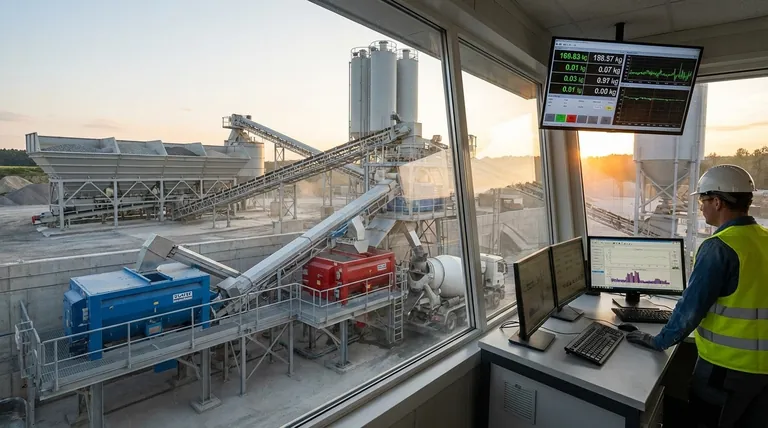
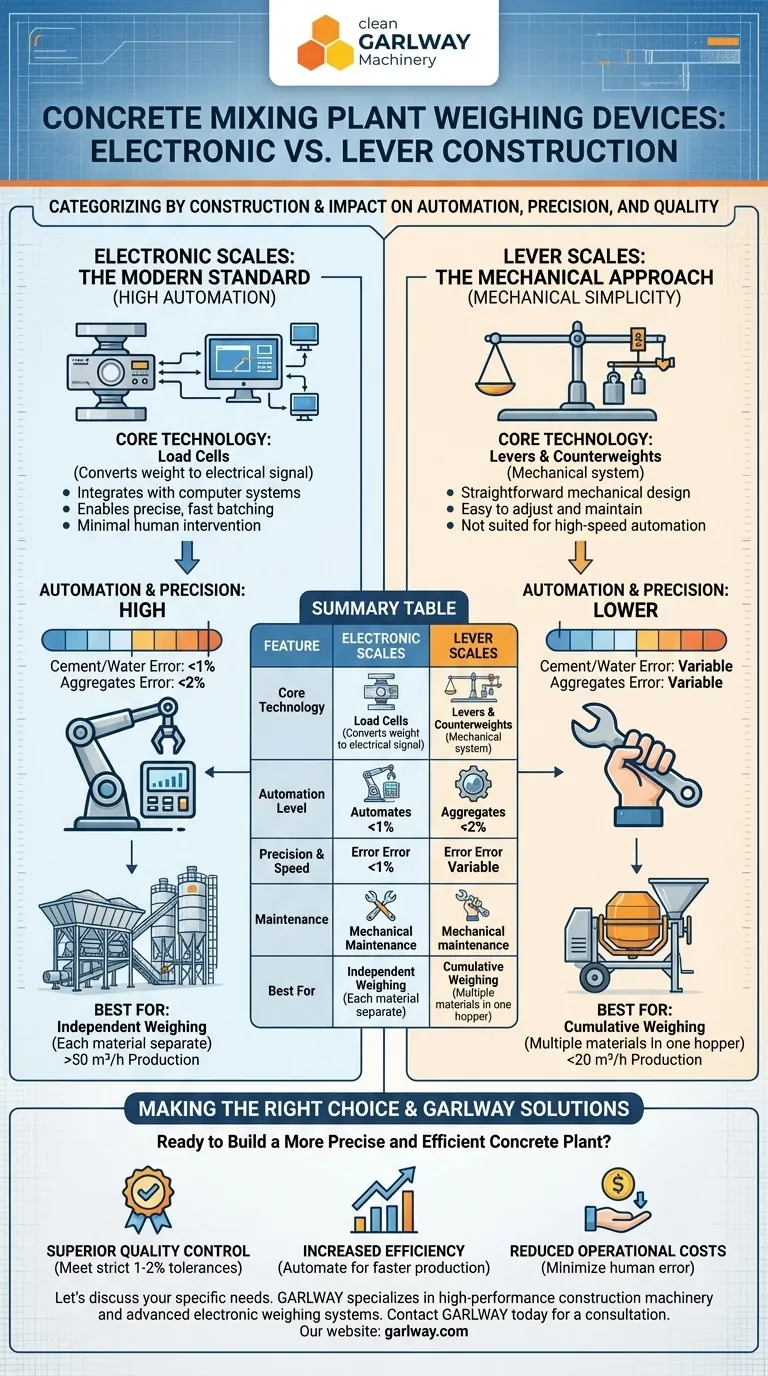
Electronic scales are the cornerstone of modern, high-capacity concrete plants. They use load cells to convert the force of the material's weight into an electrical signal.
This design is simpler and more convenient for automated control. The electrical output integrates seamlessly with computer systems, enabling precise, repeatable, and fast batching with minimal human intervention.
Lever Scales: The Mechanical Approach
Lever scales are a more traditional, mechanical system. They use a series of levers and counterweights to determine the mass of the materials.
Their design is straightforward and purely mechanical, making them relatively easy to adjust and maintain without specialized electronic expertise. However, they are less suited for the high-speed automation required in large-scale production.
How Construction Influences Weighing Methods
The type of scale used is directly linked to the weighing method a plant can effectively employ. This, in turn, is dictated by the plant's required output and precision.
Independent Weighing for High Precision
In larger plants (producing over 50 cubic meters per hour), an independent weighing method is standard. Each raw material—cement, water, sand, and each type of aggregate—is weighed in its own separate scale.
This method provides the highest level of precision and is almost exclusively accomplished using electronic scales managed by a central computer control system.
Cumulative Weighing for Smaller Operations
For smaller plants (producing less than 20 cubic meters per hour), a cumulative weighing method is often used to save space and cost.
In this approach, multiple materials, such as sand and stone, are weighed together in the same hopper, one after another. While this can be done with electronic scales, it's also common in simpler setups that may use lever scales.
Understanding the Trade-offs
Choosing a weighing system involves balancing precision, speed, and complexity. The right choice depends on the project's quality standards and production demands.
The Precision and Quality Imperative
Concrete construction standards demand tight tolerances, typically allowing only a 1% error for cement and water and a 2% error for aggregates.
Automated systems built with electronic scales are essential for consistently meeting these standards. Manual systems, which are more susceptible to human error, risk inaccurate measurements that directly compromise the quality and strength of the concrete.
Automation vs. Maintainability
Automated electronic systems vastly improve working conditions, save manpower, and ensure repeatable quality. They represent the clear direction of modern concrete production.
Lever scales offer simplicity. Their advantage lies in mechanical transparency and ease of maintenance, but this often comes at the cost of speed, precision, and the benefits of automation.
Making the Right Choice for Your Goal
The weighing system's construction is a direct indicator of the plant's capabilities. Your evaluation should be based on the specific requirements of the job.
- If your primary focus is high-volume production and consistent, verifiable quality: An automated plant using independent electronic scales is the only suitable choice.
- If your primary focus is a smaller-scale operation or a plant in a remote location: A simpler system using cumulative weighing or even robust lever scales may be adequate, provided there are strict operational controls.
Ultimately, understanding the construction of a plant's weighing system is the key to evaluating its capacity for precision, speed, and reliable quality control.
Summary Table:
| Feature | Electronic Scales | Lever Scales |
|---|---|---|
| Core Technology | Load cells (electronic signal) | Levers & counterweights (mechanical) |
| Automation Level | High (integrates with computer systems) | Low (manual operation) |
| Precision & Speed | High (ideal for high-volume production) | Lower (suited for smaller operations) |
| Maintenance | Requires electronic expertise | Simple, mechanical, easy to adjust |
| Best For | Independent weighing, >50 m³/h plants | Cumulative weighing, <20 m³/h plants |
Ready to Build a More Precise and Efficient Concrete Plant?
Choosing the right weighing system is critical to your project's success, productivity, and profitability. GARLWAY specializes in providing high-performance construction machinery, including advanced concrete batching plants with precise electronic weighing systems.
We help construction companies and contractors globally achieve:
- Superior Quality Control: Meet strict 1-2% tolerance standards consistently.
- Increased Efficiency: Automate batching for faster, more reliable production.
- Reduced Operational Costs: Minimize human error and save on manpower.
Let's discuss your specific needs. Whether you require a high-capacity plant or a robust solution for a smaller site, our experts are here to help.
Contact GARLWAY today for a consultation and discover how our concrete mixers and batching plants can elevate your operations.
Visual Guide
Related Products
- HZS90 Large Multiquip Concrete Mixers for Construction
- HZS180 Ready Mix Concrete Plant for Foundations with Sand and Cement
- Shaft Mixer Machine for Cement and Regular Concrete Mixing
- Belle Cement Mixer JS2000 Volumetric Concrete Mixer for Harbor Freight
- HZS120 Ready Mix Concrete Batching Plant Commercial Mud Cement Mixer
People Also Ask
- What are the types of concrete mixers used in batching plants? Choose the Right Mixer for Your Project
- What is the core component of a concrete batching plant? The Mixer Unit Defines Your Concrete Quality
- What are the different power sources for concrete mixers? Choose the Right Power for Your Project
- What are the main types of concrete mixers? A Guide to Batch, Continuous & More
- What are the main types of concrete mixers mentioned? Find the Perfect Mixer for Your Project