The Illusion of Unfailing Power
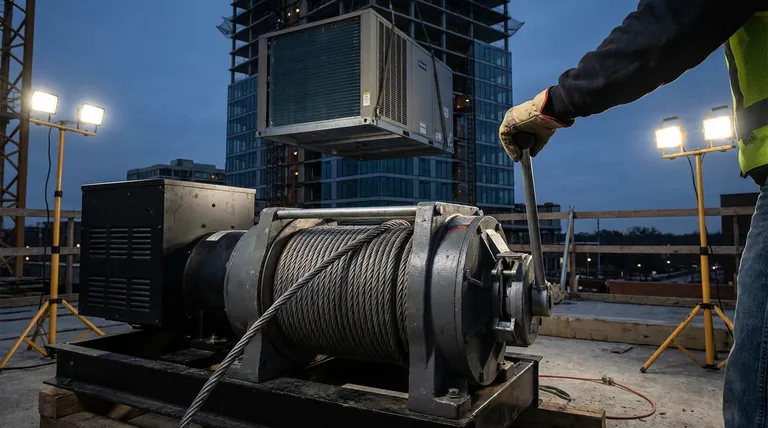
Picture a construction site. A crane, guided by an electric winch, is carefully hoisting a multi-ton HVAC unit into place on a skyscraper's roof. Below, the city hums along. Then, silence. The site's generator sputters and dies. The winch motor stops, leaving the massive load suspended thirty stories in the air.
This is the moment that separates good engineering from great engineering. We design systems for the 99% of the time they work perfectly. But true resilience—and safety—is defined by how a system behaves in that critical 1% when power is lost.
The electric winch, a symbol of effortless power, is no exception. Its greatest strength, its reliance on electricity, is also its most profound vulnerability.
The Mechanical Handshake: How Manual Override Works
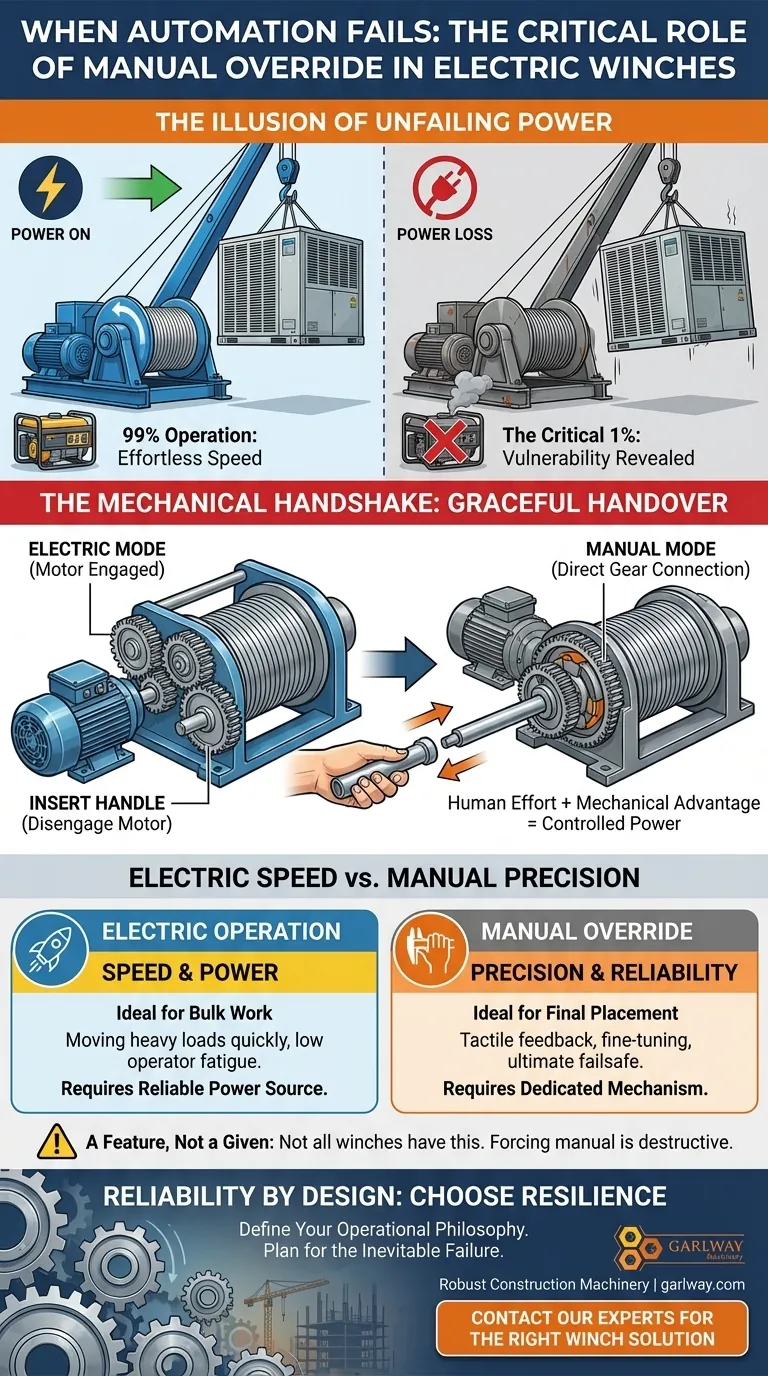
Some electric winches are designed with this failure in mind. They possess a feature that is less a "backup" and more of a "graceful handover": a manual override. This isn't a workaround; it's a deliberate, elegant piece of mechanical design.
A Deliberate Disengagement
The key is the winch handle socket. On a properly designed dual-function winch, inserting a standard winch handle does more than just give you a grip. It acts as a mechanical switch.
This action physically disengages the drivetrain from the electric motor. The motor is safely isolated, preventing any risk of damage from manual force. The system essentially transforms, shifting from an automated tool to a manually operated one.
Leveraging Mechanical Advantage
Once disengaged, you aren't fighting the motor's dead weight. You are now directly connected to the winch's internal gear train. The machine's own mechanical advantage is now yours to command, allowing your physical effort to be multiplied into serious pulling power.
It’s a perfect collaboration between human and machine—the machine provides the leverage, and the human provides the power and, most importantly, the control.
The Psychology of Control: Electric Speed vs. Manual Precision
The difference between electric and manual operation is not just about the power source. It's about two fundamentally different philosophies of control.
The Seduction of Speed
Electric mode is about velocity and efficiency. It’s for the bulk of the work, where the goal is to move a heavy load from point A to point B quickly and without operator fatigue. In the world of construction, where time is money, this speed is non-negotiable.
The Demand for Finesse
Manual mode is for the last millimeter. It’s for the delicate, final seating of a sensitive component or navigating a load through a tight clearance. The tactile feedback transmitted through the handle—the subtle shifts in tension, the slight groan of the cable—provides data a whirring motor cannot.
This is the shift from commanding a system to guiding it. It’s the ultimate failsafe when precision becomes more important than power.
A Feature, Not a Given: The Hard Reality of Winch Design
It is a dangerous assumption that all electric winches have this capability. Most, especially those designed for off-road vehicles, lack any manual override. Their engineering solves a different problem.
Forcing a standard electric winch to work manually is a direct path to destroying its internal gearing. The choice of equipment must be deliberate and informed by the specific risks of the job site.
| Characteristic | Electric Operation | Manual Override Operation |
|---|---|---|
| Core Philosophy | Speed & Power | Precision & Reliability |
| Ideal Scenario | Heavy, repetitive lifts with stable power | Power failure, fine-tuning, final placement |
| Operator Input | Push-button activation | Physical effort with tactile feedback |
| Critical Prerequisite | A reliable power source (grid, battery, generator) | A model with a dedicated handle socket & mechanism |
Choosing Your Philosophy: Reliability by Design
Ultimately, selecting a winch is about more than just its load rating. It's about defining your project's operational philosophy. Are you planning for uninterrupted efficiency, or are you building a system that can withstand the inevitability of failure?
For demanding environments like professional construction, where safety and project continuity are paramount, equipment must be chosen for its resilience. You need tools that not only perform under ideal conditions but also provide a clear, reliable path forward when those conditions change.
GARLWAY specializes in exactly this kind of robust construction machinery. Our range of powerful winches, concrete mixers, and concrete batching plants is built for contractors who understand that the best plan is one that anticipates and accounts for failure. Selecting the right winch—with the right features for your specific risk profile—is a critical decision.
Visual Guide
Related Products
- Electric 120V Boat Winch by Badlands
- Electric and Hydraulic Winch for Heavy Duty Applications
- Small Electric Winch 120V and 240V for Compact Applications
- 12000 lb Electric Boat Trailer Winch with Windlass Anchor Warn
- Electric Hoist Winch Boat Anchor Windlass for Marine Applications
Related Articles
- How to Choose Between Reversible and Friction Electric Winches: A Transmission Guide
- The Unseen System: How an Electric Winch Manages Force and Eliminates Fear
- How to Choose Between Manual and Electric Winches for Your Project
- Beyond Brute Force: The Calculated Power of the Electric Winch
- How Electric Winches’ Engineering Enhances Efficiency and Safety in Heavy-Duty Applications





