The Illusion of Simple Force
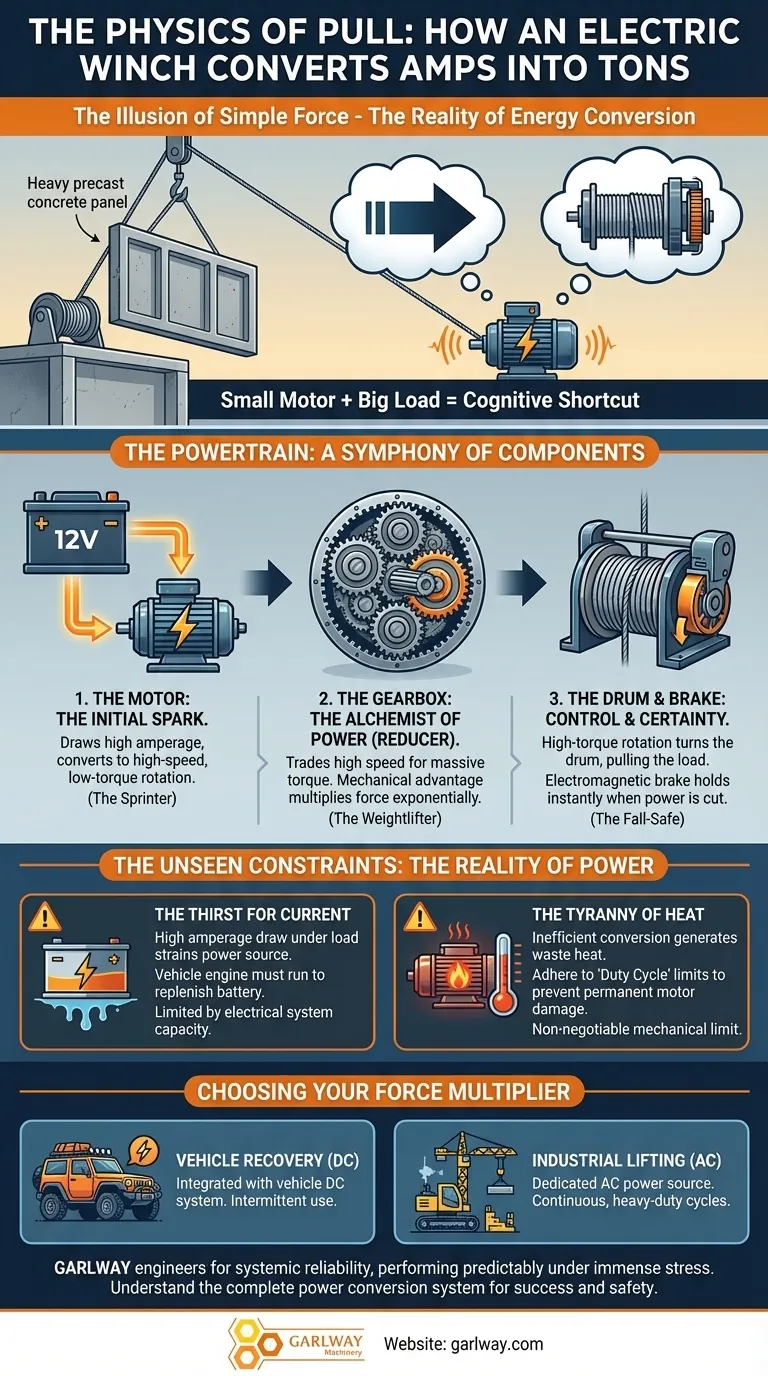
Picture a heavy precast concrete panel suspended five stories up, held by a single steel cable. Below, a small electric winch hums quietly, its drum turning with deliberate, unstoppable slowness. The scene feels calm, controlled.
We see the cable, the hook, and the load. But we don't see the physics. Our minds tend to connect the electric hum directly to the immense force being exerted.
This is a cognitive shortcut. The real story isn't the motor alone; it's the elegant, violent conversion of energy happening within the machine's powertrain. Understanding this system is the key to appreciating its power and its limits.
The Powertrain: A Symphony of Components
An electric winch isn't one thing. It's a series of components working in concert, each playing a critical role in transforming a whisper of electricity into a roar of mechanical force.
The Motor: The Initial Spark
The process begins with the electric motor. It draws current from a power source—like a vehicle's 12V battery—and converts it into high-speed rotation.
But this initial rotation is deceptive. It's fast, but it lacks the raw turning force, or torque, needed to move a multi-ton load. The motor is a sprinter, not a weightlifter. It provides the energy, but not yet the brute strength.
The Gearbox: The Alchemist of Power
This is the heart of the winch's strength. The motor's fast-spinning shaft feeds into a gearbox, a component often called a reducer. Its job is simple in principle but profound in effect: it trades speed for power.
Inside, a series of gears engage, with each stage drastically slowing the rotation. Through the laws of mechanical advantage, as speed plummets, torque multiplies exponentially.
This is the mechanical alchemy that allows a compact, humming motor to generate the force required to pull a vehicle from a ditch or lift tons of steel into the sky. It is the winch’s unsung hero.
The Drum and Brake: Control and Certainty
The slow, high-torque rotation from the gearbox finally turns the winch drum, spooling the cable and performing the work.
But power without control is chaos. Paired with the system is a critical brake, often electromagnetic. When electricity to the motor is cut, the brake engages automatically and instantly. It doesn't slow the load down; it holds it fast. This fail-safe is what turns a powerful tool into a safe one, preventing gravity from winning the moment you release the button.
The Unseen Constraints: The Reality of Power
A winch feels omnipotent, but it operates within strict physical and electrical boundaries. Ignoring them is the most common path to equipment failure.
The Thirst for Current
Under load, a winch draws an enormous amount of electrical current (amperage). This places an incredible strain on its power source.
This is why vehicle-mounted winches require the engine to be running during operation. The vehicle's alternator is needed to continuously replenish the battery, which would otherwise be drained in minutes. The winch's power is fundamentally limited by the health and capacity of the electrical system feeding it.
The Tyranny of Heat
Converting electricity into force is an inefficient process that generates tremendous waste heat within the motor. Every winch has a "duty cycle"—a specific limit on how long it can run before it must cool down.
Exceeding this is like forcing a marathon runner to sprint. The system will overheat, causing permanent damage to the motor windings. The duty cycle isn't a suggestion; it's a non-negotiable mechanical limit.
Choosing Your Force Multiplier
On a professional construction site, these aren't just theoretical trade-offs; they are daily operational realities. For construction companies and contractors, the winch isn't a recovery tool—it's a production machine.
The choice depends on the job's unique physics:
- Vehicle Recovery: Requires a winch integrated with a vehicle's DC electrical system.
- Industrial Lifting: Demands a winch powered by a dedicated AC source for continuous, heavy-duty cycles.
This is why GARLWAY engineers its winches, concrete mixers, and batching plants not just for raw power, but for systemic reliability. We understand that our clients depend on machinery that performs predictably under immense stress, day after day.
Understanding the winch as a complete power conversion system—from the battery terminals to the hook—is the difference between hoping for a good outcome and engineering one. To ensure success and safety, you need the right system for the job.
If your project demands machinery built on a deep understanding of these principles, Contact Our Experts.
Visual Guide
Related Products
- Electric 120V Boat Winch by Badlands
- Electric and Hydraulic Winch for Heavy Duty Applications
- Small Electric Winch 120V and 240V for Compact Applications
- 12000 lb Electric Boat Trailer Winch with Windlass Anchor Warn
- Electric Hoist Winch Boat Anchor Windlass for Marine Applications
Related Articles
- How to Choose Between Reversible and Friction Electric Winches: A Transmission Guide
- The Unseen System: How an Electric Winch Manages Force and Eliminates Fear
- How to Choose Between Manual and Electric Winches for Your Project
- When Automation Fails: The Critical Role of Manual Override in Electric Winches
- Beyond Brute Force: The Calculated Power of the Electric Winch