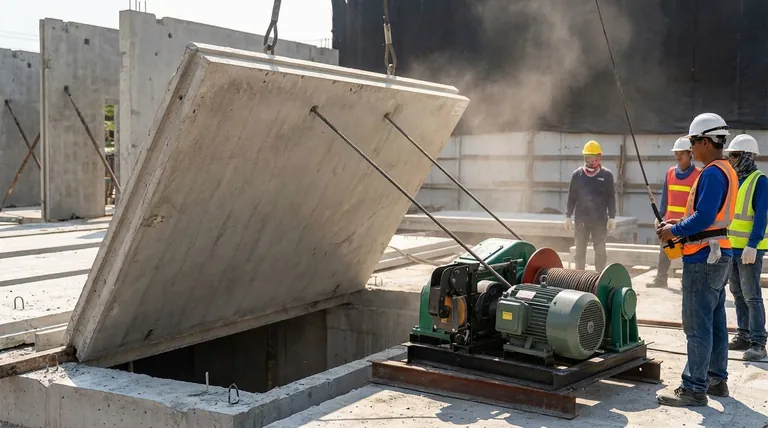
The Moment of Truth is Measured in Millimeters
Imagine a pre-cast concrete panel, weighing several tons, suspended mid-air over a foundation. The wind picks up slightly. Below, the crew waits. In this moment, the operator isn't just using a machine; they are placing their trust in it.
This trust isn't built on raw power alone. It's built on predictability. The crew needs to know the panel will lower smoothly, stop precisely, and hold steady without fail. This is the world where the reliability of an electric winch is not an abstract concept, but a critical component of safety and success.
True reliability is a product of deliberate engineering choices that prioritize control over chaos.
The Anatomy of Predictability
At its core, an electric winch is a beautifully simple system designed to convert electrical energy into immense, controlled mechanical force. Its dependability comes from three key pillars.
Consistent Power, Not Just Raw Strength
The human mind craves patterns and predictability. An electric motor delivers this in the form of a steady, non-fluctuating pulling force. There are no surges, no sputters—just a smooth application of power.
This consistency is what separates a professional tool from a blunt instrument. On advanced systems like those from GARLWAY, features like Variable Frequency Drives (VFDs) allow operators to program speeds and stop positions with surgical accuracy, turning a potentially chaotic operation into a choreographed procedure.
Mechanical Simplicity as a Virtue
Complexity is often the enemy of reliability. The genius of the electric winch lies in its robust, straightforward mechanics.
Power flows from the motor through a simple gear train, such as a three-stage enclosed gear reducer. This design doesn't invent new principles; it perfects old ones. It multiplies force with minimal moving parts, which means fewer potential points of failure.
Combined with an integrated electromagnetic brake that engages automatically, the system is designed to fail-safe. The simplicity is not a shortcut; it is a conscious engineering choice for dependability.
Control from a Distance: The Safety Imperative
Modern electric winches remove the operator from the immediate hazard zone. Using a push-button or remote control does more than just enhance convenience; it fundamentally changes the operator's psychology.
By stepping back, the operator gains a better vantage point. They shift from being a physical laborer to a strategic overseer. This cognitive distance reduces stress and improves decision-making, leading to safer and more precise maneuvers.
From Engineering Theory to Job Site Reality
These design principles translate directly into tangible advantages on a busy construction site.
- Automated Safety: An electric winch automates the most strenuous part of the job. This drastically reduces physical strain on workers and minimizes the risk of human error associated with manual lifting or pulling.
- Operational Efficiency: Motorized power is simply faster. Operations are completed in a fraction of the time compared to manual methods, keeping projects on schedule and on budget.
- Clean and Quiet Operation: Unlike hydraulic systems, electric winches run without fluids and with minimal noise. This makes them ideal for indoor applications, urban construction sites with noise restrictions, and environmentally sensitive areas.
GARLWAY's range of construction-grade electric winches is engineered specifically for these environments, offering a compact structure and light weight relative to their power, ensuring they can be deployed quickly wherever they are needed.
The Honest Limitations: Acknowledging the Boundaries of Trust
No tool is perfect. True dependability comes from understanding and respecting a tool's operational limits.
The Tether to Power
The electric winch's greatest strength is also its primary constraint: it needs a stable electrical source. A dead vehicle battery or a grid failure renders it inoperable. Planning for a reliable power source is as important as choosing the right winch.
The Physics of Heat and Patience
Electric motors generate heat under load. Every electric winch has a "duty cycle"—the amount of time it can run before it needs to cool down. Exceeding it is a recipe for motor failure. This isn't a design flaw; it's physics. Respecting the duty cycle is crucial for long-term reliability.
Matching the Tool to the Task
Is an electric winch right for your job? The answer depends on aligning its strengths with your primary goal.
| Application Focus | Key Consideration | Recommendation |
|---|---|---|
| Industrial Lifting | Precision, control, and a clean environment are paramount. | An electric winch is ideal due to its programmable controls and quiet operation. |
| Vehicle Recovery | High pulling power and control are needed in unpredictable situations. | An electric winch is the industry standard, but the vehicle's electrical system must be robust. |
| Continuous, Heavy Pulling | The system will be under constant, heavy load for extended periods. | Carefully evaluate the duty cycle. A hydraulic winch may offer better durability for non-stop use. |
Ultimately, reliability isn't an accident. It's the result of thoughtful engineering that prioritizes control, simplicity, and safety. The best tools don't just make us stronger; they make us more precise and more confident.
If your project demands this level of engineered trust, GARLWAY provides robust electric winches and other construction machinery designed for the world's most demanding job sites. Contact Our Experts
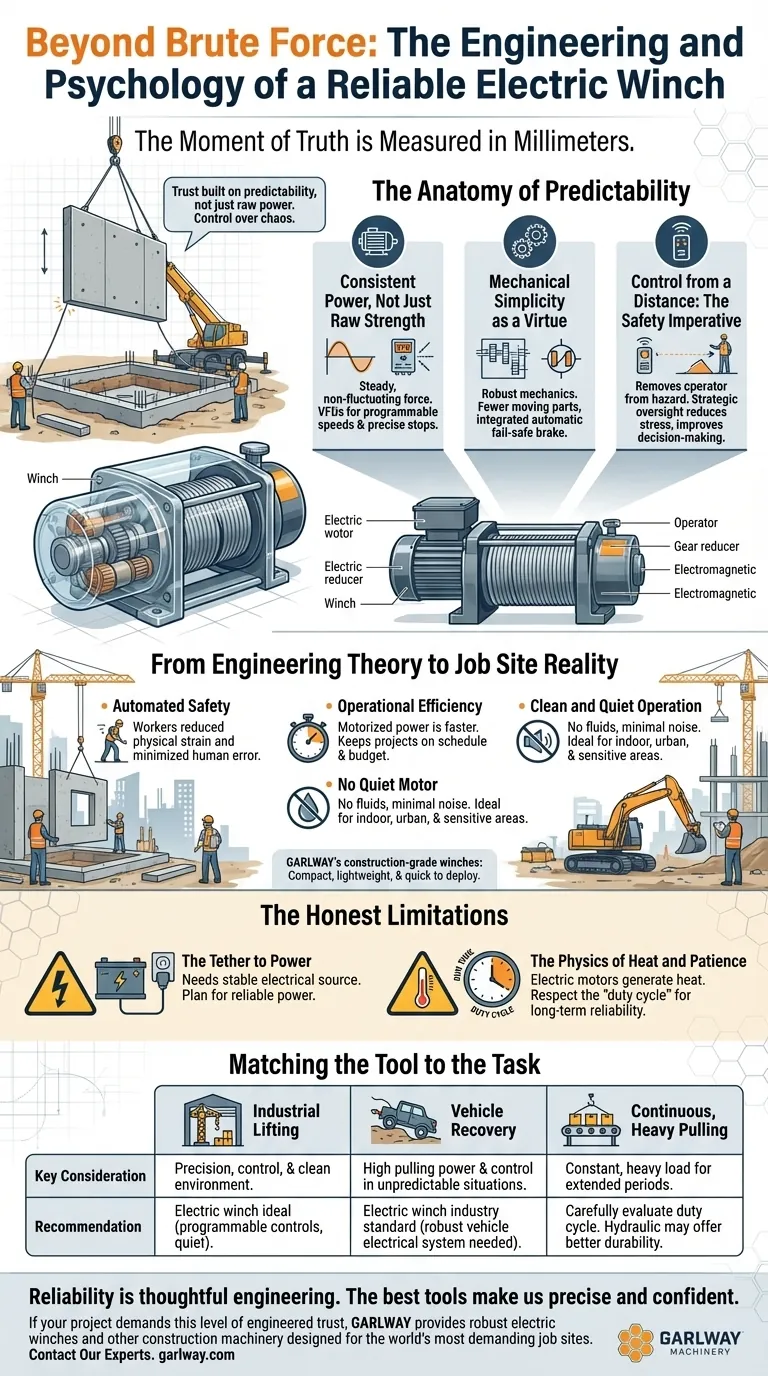
Visual Guide
Related Products
- Electric 120V Boat Winch by Badlands
- Electric and Hydraulic Winch for Heavy Duty Applications
- Small Electric Winch 120V and 240V for Compact Applications
- 12000 lb Electric Boat Trailer Winch with Windlass Anchor Warn
- Electric Hoist Winch Boat Anchor Windlass for Marine Applications
Related Articles
- How to Choose Between Reversible and Friction Electric Winches: A Transmission Guide
- The Unseen System: How an Electric Winch Manages Force and Eliminates Fear
- How to Choose Between Manual and Electric Winches for Your Project
- When Automation Fails: The Critical Role of Manual Override in Electric Winches
- Beyond Brute Force: The Calculated Power of the Electric Winch





