The Psychology of the Boat Ramp
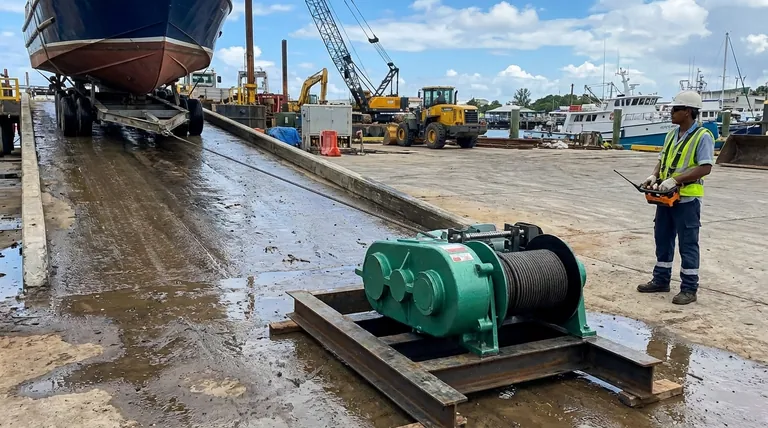
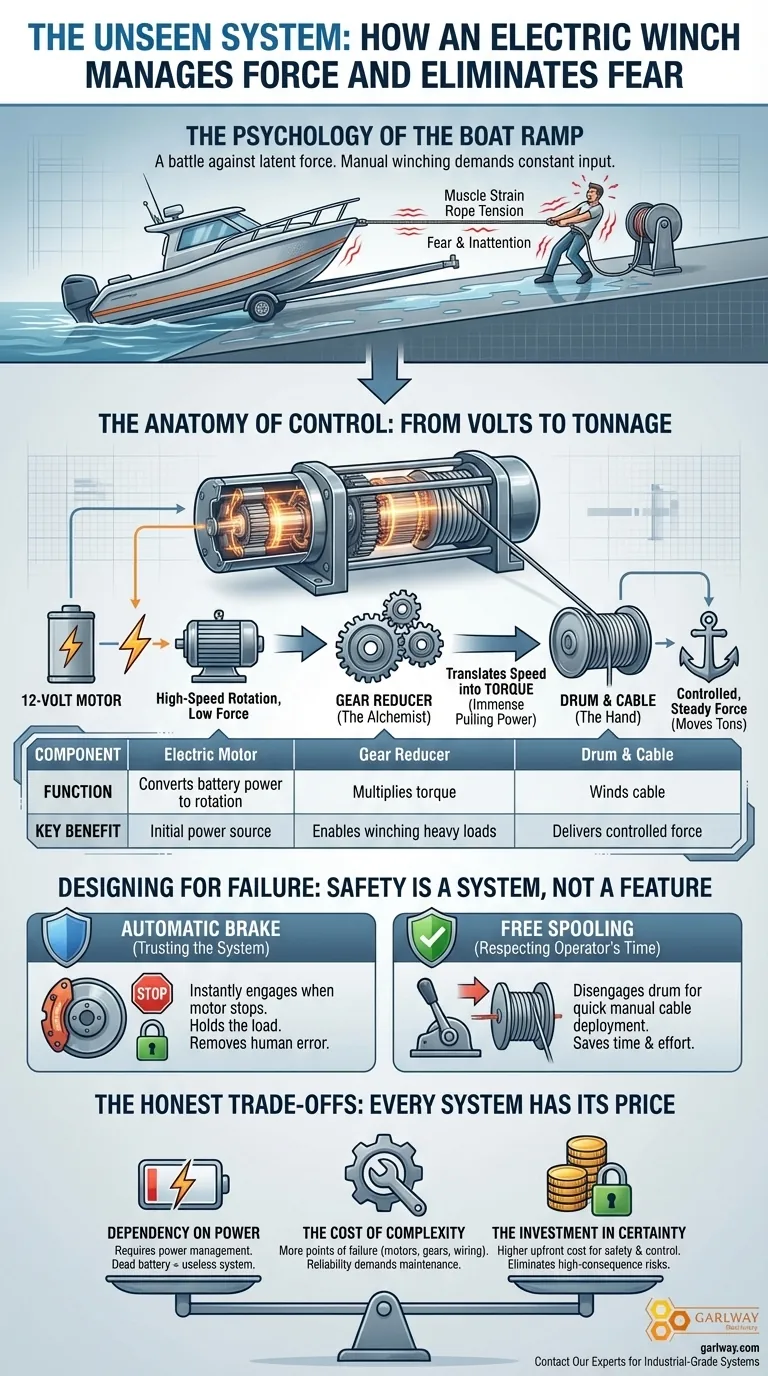
Picture a steep, wet boat ramp at the end of a long day. Gravity is not your friend. Your boat, weighing thousands of pounds, rests precariously on a trailer. The line between a smooth retrieval and a costly accident is razor-thin, measured in muscle strain, rope tension, and a moment of inattention.
This scenario isn't just a physical challenge; it's a psychological one. It’s a battle against the latent force stored in that inclined plane. A manual winch demands your constant physical input and undivided focus. Every crank is a negotiation with physics. The electric winch changes this negotiation entirely. It introduces a system between you and the raw force you're trying to control.
The Anatomy of Control: From Volts to Tonnage
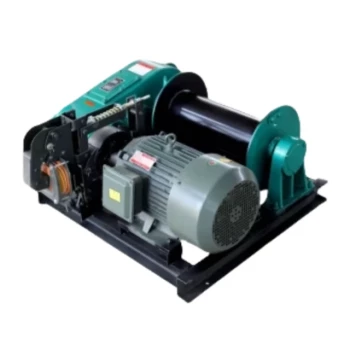
To appreciate an electric winch is to appreciate the elegance of applied physics. It’s not just a motor pulling a rope. It's a beautifully engineered system for converting fragile electrical current into immense, controllable mechanical power.
The Heart: The 12-Volt Motor
Everything starts with a simple electric motor. It draws a modest current from a battery, producing high-speed rotation. By itself, this rotation is useless against the inertia of a heavy boat. Its power is in speed, not strength.
The Alchemist: The Gear Reducer
This is where the magic happens. The gear reducer is a compact system of interlocking gears, a mechanical masterpiece designed for one purpose: to transmute speed into torque.
It takes the motor's fast, weak spin and channels it through a series of gears. Each stage slows the rotation down, but in doing so, multiplies its force exponentially. This is the unseen genius of the winch—a quiet, internal process that creates the power to move objects hundreds of times its own weight.
The Hand: The Drum and Cable
The gear reducer's slow, powerful rotation is finally delivered to the drum. As the drum turns, it coils the cable with relentless, steady force. This isn't the jerky, straining pull of muscle; it's the smooth, unflinching application of mechanical advantage. The system does the work, leaving the operator to simply direct it.
Designing for Failure: Why Safety is a System, Not a Feature
The true brilliance of an electric winch lies not in how it works, but in how it’s designed not to fail. It anticipates the most common and dangerous point of failure: the moment the pulling stops.
The Automatic Brake: Trusting the System
When the motor on an electric winch stops, an internal, automatic brake engages instantly. It's a simple, non-negotiable mechanism.
This single system removes the most significant risk factor: human error. The boat cannot slide back. Gravity is checked. This transforms the operator's role from a load-bearer into a supervisor, allowing them to operate from a safe distance, often with a remote control, with the psychological comfort that the machine will hold the line.
Free Spooling: Respecting the Operator's Time
A free-spool clutch disengages the drum from the gearbox, allowing the cable to be pulled out quickly by hand. This might seem like a minor convenience, but it's a profound design choice. It acknowledges that the operator's time and effort are valuable resources and that the system should work to conserve them at every step.
The Honest Trade-Offs: Every System Has Its Price
No system is without its dependencies. Opting for an electric winch is a conscious decision to trade simplicity for capability, and with that comes new responsibilities.
- Dependency on Power: Its strength is its weakness. A dead battery renders the entire system useless. This requires a new discipline of power management.
- The Cost of Complexity: With motors, gears, wiring, and brakes, there are more points of potential failure than a simple manual crank. Reliability demands maintenance.
- The Investment in Certainty: The higher upfront cost isn't for a motor; it's an investment in a system of safety and control. You are paying to eliminate the specific, high-consequence risks associated with manually managing heavy loads on an incline.
For professionals in construction and marine environments, these trade-offs are familiar. In industries where safety and efficiency are paramount, investing in a reliable system is the only logical choice. This is the philosophy behind GARLWAY's heavy-duty machinery, from winches to concrete batching plants. We build systems that manage force so our clients can focus on the work.
The table below summarizes the function of each core component:
| Component | Function | Key Benefit |
|---|---|---|
| Electric Motor | Converts battery power into rotational force. | Provides the initial power source. |
| Gear Reducer | Multiplies motor torque for immense pulling power. | Enables winching of heavy loads. |
| Drum & Cable | Winds the cable to pull the load. | Delivers controlled, steady force. |
| Automatic Brake | Locks when the motor stops, holding the load. | Critical safety feature against gravity. |
| Free Spooling | Allows quick, manual cable deployment. | Saves time and effort during setup. |
Choosing the right equipment is about understanding the underlying systems at play. It's about recognizing that the best tool isn't just the one with the most power, but the one that offers the most control.
For industrial-grade winching systems built on the principles of reliability and control, you need a partner who understands the physics of the job. Contact Our Experts
Visual Guide
Related Products
- Electric 120V Boat Winch by Badlands
- Electric and Hydraulic Winch for Heavy Duty Applications
- Small Electric Winch 120V and 240V for Compact Applications
- 12000 lb Electric Boat Trailer Winch with Windlass Anchor Warn
- Electric Hoist Winch Boat Anchor Windlass for Marine Applications
Related Articles
- How to Choose Between Reversible and Friction Electric Winches: A Transmission Guide
- How to Choose Between Manual and Electric Winches for Your Project
- When Automation Fails: The Critical Role of Manual Override in Electric Winches
- Beyond Brute Force: The Calculated Power of the Electric Winch
- How Electric Winches’ Engineering Enhances Efficiency and Safety in Heavy-Duty Applications