The Moment of Truth
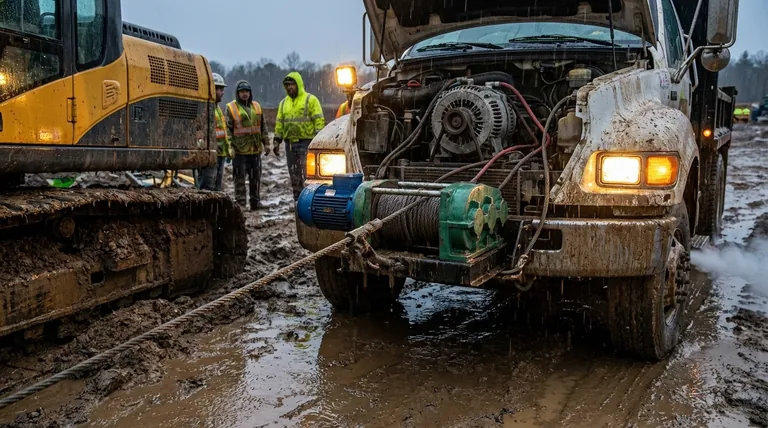
Imagine the scene: a remote construction site, rain-soaked earth, and a critical piece of equipment mired in mud. The project schedule is tight. Your only tool for recovery is the powerful 12V winch mounted to your truck. The instinct is to connect the cables to the battery and pull. It seems simple.
This moment, however, isn't about connecting a simple accessory. It's about engaging a complex electrical system. And misunderstanding that system is the single most common reason a recovery operation fails, turning a solvable problem into a crisis with a dead vehicle.
The Mental Model Error: A Battery is Not a Bucket
We tend to think of a battery as a self-contained bucket of power. When we need electricity, we dip into it. This mental model is fine for a flashlight, but for a high-demand tool like a winch, it's dangerously incomplete.
A winch under load can draw over 400 amps of current. Your vehicle's battery, even a heavy-duty one, cannot sustain this demand alone for more than a minute or two before its voltage collapses. Relying solely on the battery is like expecting a sprinter to run a marathon. It provides a heroic burst of energy, but it has no endurance.
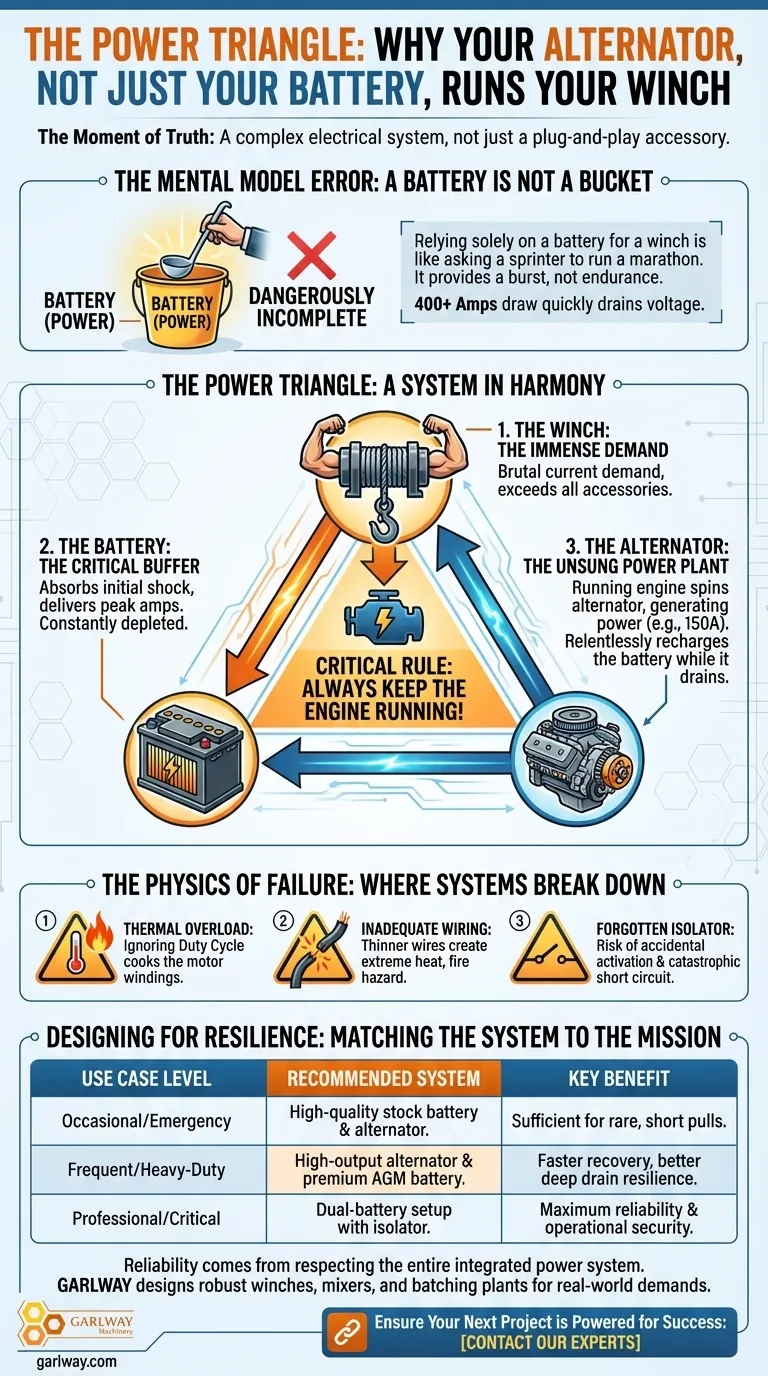
The Power Triangle: A System in Harmony
The reality is that successful winching depends on a three-part system working in perfect, stressed harmony: the winch, the battery, and the alternator.
1. The Winch: The Immense Demand
This is the workhorse, converting electrical energy into immense mechanical force. Its demand for current is brutal and immediate, far exceeding any other accessory on your vehicle.
2. The Battery: The Critical Buffer
The battery’s primary role is to act as a buffer. It absorbs the initial, massive shock of the winch's power draw, delivering the hundreds of amps needed to start the pull. It smooths out the peaks and troughs in demand. But it is constantly and rapidly being depleted.
3. The Alternator: The Unsung Power Plant
This is the true heart of the operation. While the winch is pulling, the running engine spins the alternator, which acts as the vehicle's onboard power generator. A standard alternator might produce 100-150 amps.
While that's less than the winch's peak draw, its job is not to power the winch directly. Its job is to aggressively and relentlessly recharge the battery as it's being drained. The alternator is the marathon runner, feeding power back into the system, ensuring the battery buffer never runs empty.
This is why the single most important rule of winching is: Always keep the engine running. With the engine off, you sever the connection to your power plant. You are running on a rapidly depleting reserve, guaranteeing you'll end up with a stuck vehicle and a dead one.
The Physics of Failure: Where Systems Break Down
Disrespecting this electrical triangle leads to predictable and dangerous failures. These are not random accidents; they are the direct consequence of pushing a system beyond its physical limits.
-
Thermal Overload (Ignoring the Duty Cycle): Winch motors generate colossal heat. The "duty cycle" (e.g., 1 minute on, 10 minutes off) isn't a friendly suggestion; it's a thermal law. Ignoring it will cook the motor's windings, leading to permanent failure.
-
Inadequate Wiring (The Fire Hazard): The heavy-gauge cables included with a winch are sized for a reason. Using thinner wires is like trying to send a fire hose's worth of water through a garden hose. The resistance will generate extreme heat, melting insulation and creating a severe fire risk.
-
The Forgotten Isolator (The Silent Threat): A proper installation includes a master isolator switch. This prevents accidental activation and ensures the thick, high-amperage cable isn't live when not in use, mitigating the risk of a catastrophic short circuit.
Designing for Resilience: Matching the System to the Mission
On a professional job site, equipment failure is not an option. Your electrical system must be prepared for the demands of the work.
| Use Case Level | Recommended System | Key Benefit |
|---|---|---|
| Occasional/Emergency | A high-quality stock battery and alternator. | Sufficient for rare, short-duration pulls. |
| Frequent/Heavy-Duty | Upgrade to a high-output alternator and a premium AGM (Absorbent Glass Mat) battery. | Faster recovery and better resilience to deep drains. |
| Professional/Critical | A dual-battery setup with an isolator, dedicating one battery to the winch while protecting the engine's starting battery. | Maximum reliability and operational security. |
Understanding your winch is about seeing it not as an add-on, but as the final component of an integrated power system. Reliability comes from respecting the limits and demands of that entire system.
On today's construction sites, productivity and safety are paramount. That’s why GARLWAY designs robust winches, concrete mixers, and batching plants engineered for the systemic demands of the real world. We provide equipment that integrates seamlessly and reliably into your workflow, ensuring you have the power you need, precisely when you need it.
To ensure your next project is powered by a system built for success, Contact Our Experts.
Visual Guide
Related Products
- Warn Winch Windlass Boat Trailer Winch
- Electric and Hydraulic Winch for Heavy Duty Applications
- Small Electric Winch 120V and 240V for Compact Applications
- 12000 lb Electric Boat Trailer Winch with Windlass Anchor Warn
- Quick Windlass Portable Winch for Truck and Boat Best Boat Winch
Related Articles
- Beyond the Bumper: The Critical System Choice in Powering Your Trailer Winch
- Force vs. Mass: The Critical Difference in Sizing a Boat Winch
- Lines of Force: The Unseen Geometry of a Boat Winch
- More Than a Number: The Engineering Psychology of Choosing a Boat Winch
- How to Choose and Optimize Winch Speed for Maximum Efficiency