The Illusion of Raw Power
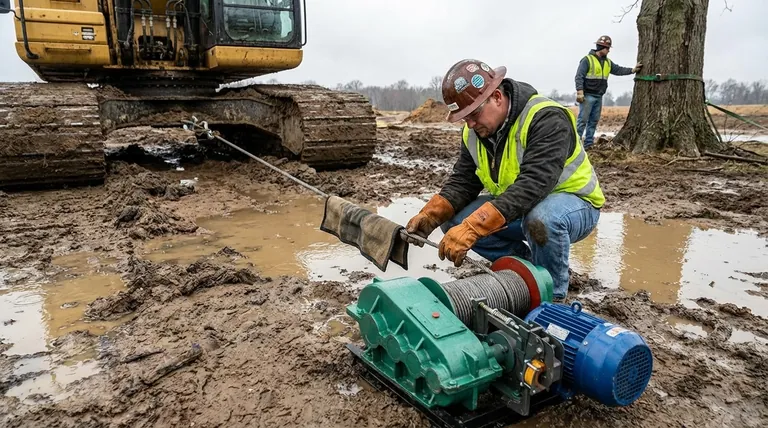
On a construction site, a heavy piece of equipment is mired in mud. The immediate instinct is to solve the problem with force. A powerful winch seems like the obvious answer—a mechanical hero to save the day.
This is the first psychological trap.
We mistake the winch's pulling capacity for the solution itself. But the true solution is not power; it is a disciplined process. A winch transforms electrical or hydraulic power into immense stored kinetic energy in a taut line. Managing that energy safely is a mental exercise, not a mechanical one.
The Pre-Pull: A Dialogue with Risk
The most critical moments of a winching operation happen before the line ever tightens. This is where professionals separate themselves from amateurs by resisting the powerful urge to "just get it done."
Resisting the Tyranny of Urgency
Pressure—from a deadline, from watching colleagues—makes us rush. But speed is the enemy of safety. The pre-pull protocol is a deliberate slowdown, a conscious choice to master the situation before applying force.
It begins with your equipment. Wearing thick leather gloves isn't just about comfort; it’s your first layer of defense against a steel cable's unforgiving burrs.
An Inspection is a Conversation
Look at your winch line. Is it frayed? Kinked? Are there broken strands? This isn't a checklist; it's a dialogue. The equipment is telling you its history and its limits. A deformed hook or a stressed shackle is shouting a warning. Ignoring it is choosing to accept an unknown, and potentially catastrophic, risk.
The Anchor: A Foundation of Trust
Your anchor point is the foundation of the entire operation. It must be "bomb-proof." A healthy, large tree or a substantial rock isn't just a convenient object; it's a partner in the pull. Anchoring to something weak is like building a house on sand. You must be able to trust it implicitly. Before you pull, you must ask: "Will this hold?" If there is any doubt, there is no doubt—find another anchor.
Execution: The Controlled Release of Energy
With the stage set, the pull itself becomes less about force and more about finesse. The goal is a slow, deliberate transfer of energy.
The Snap-Back Zone
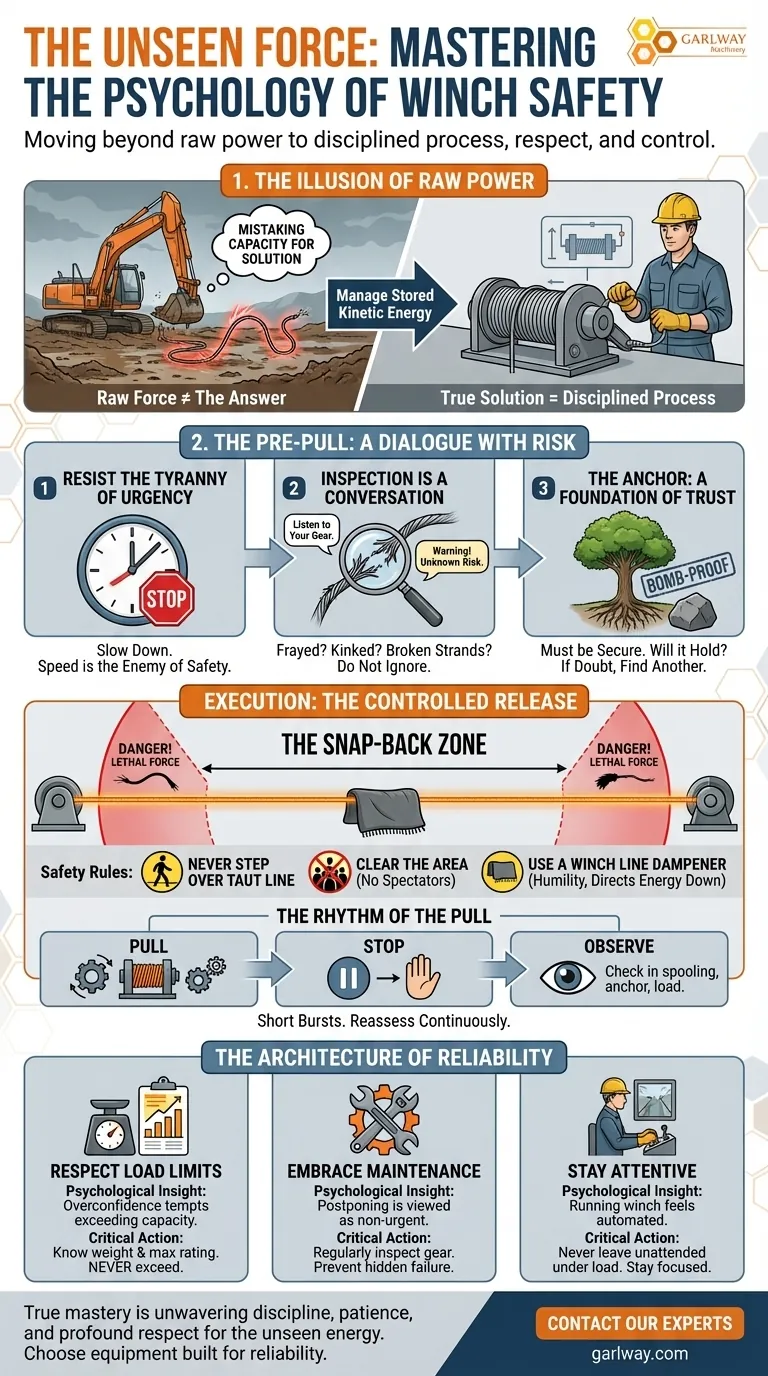
Imagine the taut winch line is a loaded spring, ready to release its energy in an instant. The most dangerous place to be is in the arc on either side of that line. This is the snap-back zone. A snapped cable can whip through this area with lethal force.
- Never step over a taut line. It’s a simple rule that acknowledges a deadly physical reality.
- Clear the area of everyone. Spectators do not belong in a high-energy operational zone.
- Use a winch line dampener. Placing a dampener, a heavy blanket, or a coat over the line’s midpoint is a profound act of professional humility. It is an acknowledgment that failure is always possible, and it prepares for that contingency by directing the energy downwards if the line breaks.
The Rhythm of the Pull
A continuous pull robs you of the ability to observe and react. The professional approach is to work in short, controlled bursts.
Pull. Stop. Observe.
Is the line spooling evenly onto the drum? "Bird-nesting"—where the line bunches to one side—can damage the rope and the winch itself. Is the anchor holding? Is the load shifting? Each pause is a chance to reassess. This methodical rhythm ensures you remain in control of the immense forces at play.
The Architecture of Reliability
The safety of any single operation rests on an invisible architecture of maintenance and understanding.
| Safety Principle | Psychological Insight | Critical Action |
|---|---|---|
| Respect Load Limits | Overconfidence tempts us to exceed rated capacity. Physics doesn't care about hope. | Always know your load weight and your winch's maximum rating. Never exceed it. |
| Embrace Maintenance | We postpone maintenance, viewing it as non-urgent. It is preventing future failure. | Regularly inspect your gear. A neglected winch is a hidden liability waiting for a crisis. |
| Stay Attentive | A running winch feels automated, but it's a live operation requiring full focus. | Never leave a winch unattended under load. Keep the winching vehicle's engine on. |
True mastery of a winch isn't measured by the weight of the load you can move. It is measured by your unwavering discipline, your patience, and your profound respect for the unseen energy you command. Professionals understand this, which is why they choose equipment built for reliability and control. A robust, well-engineered winch isn't a luxury; it's a critical component of a safe and efficient system. For construction companies and contractors who face these high-stakes scenarios daily, having machinery that performs predictably under pressure is non-negotiable.
When you're ready to equip your team with machinery that matches a professional's mindset, we can help. Contact Our Experts
Visual Guide
Related Products
- Warn Winch Windlass Boat Trailer Winch
- Electric and Hydraulic Winch for Heavy Duty Applications
- Small Electric Winch 120V and 240V for Compact Applications
- 12000 lb Electric Boat Trailer Winch with Windlass Anchor Warn
- Quick Windlass Portable Winch for Truck and Boat Best Boat Winch
Related Articles
- Beyond the Bumper: The Critical System Choice in Powering Your Trailer Winch
- Force vs. Mass: The Critical Difference in Sizing a Boat Winch
- Lines of Force: The Unseen Geometry of a Boat Winch
- More Than a Number: The Engineering Psychology of Choosing a Boat Winch
- How to Choose and Optimize Winch Speed for Maximum Efficiency