The Moment of Failure is Never About the Cable
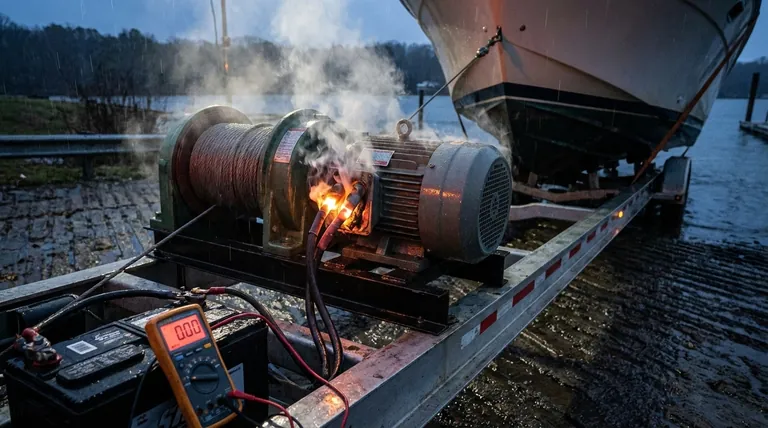
Imagine this: your boat is halfway up the launch ramp. The winch groans, slows, and then falls silent. The problem isn't the steel cable or the hardened gears. The problem is invisible. It’s the sudden, massive, and underestimated demand for electrical current that has starved the motor and brought the entire operation to a standstill.
This isn't just a mechanical failure; it's a systems failure. More accurately, it's a failure of imagination.
A Psychological Blind Spot
We are psychologically wired to focus on the tangible. We see the winch's heavy steel frame, feel the weight of the hook, and assess its strength in pounds or tons. We trust what we can see.
The electrical system, however, is abstract. It's a silent, unseen river of energy. We tend to treat it as a simple on/off utility rather than the powerful, dynamic engine it truly is. This cognitive bias—favoring the visible over the invisible—is why so many winch installations are dangerously under-engineered.
The Physics of Pull: Load is Everything
An electric winch motor's thirst for power is not constant. It's directly proportional to the physical work it's doing. Thinking of current draw as a single number is the first mistake.
The Idle Hum: No-Load Current
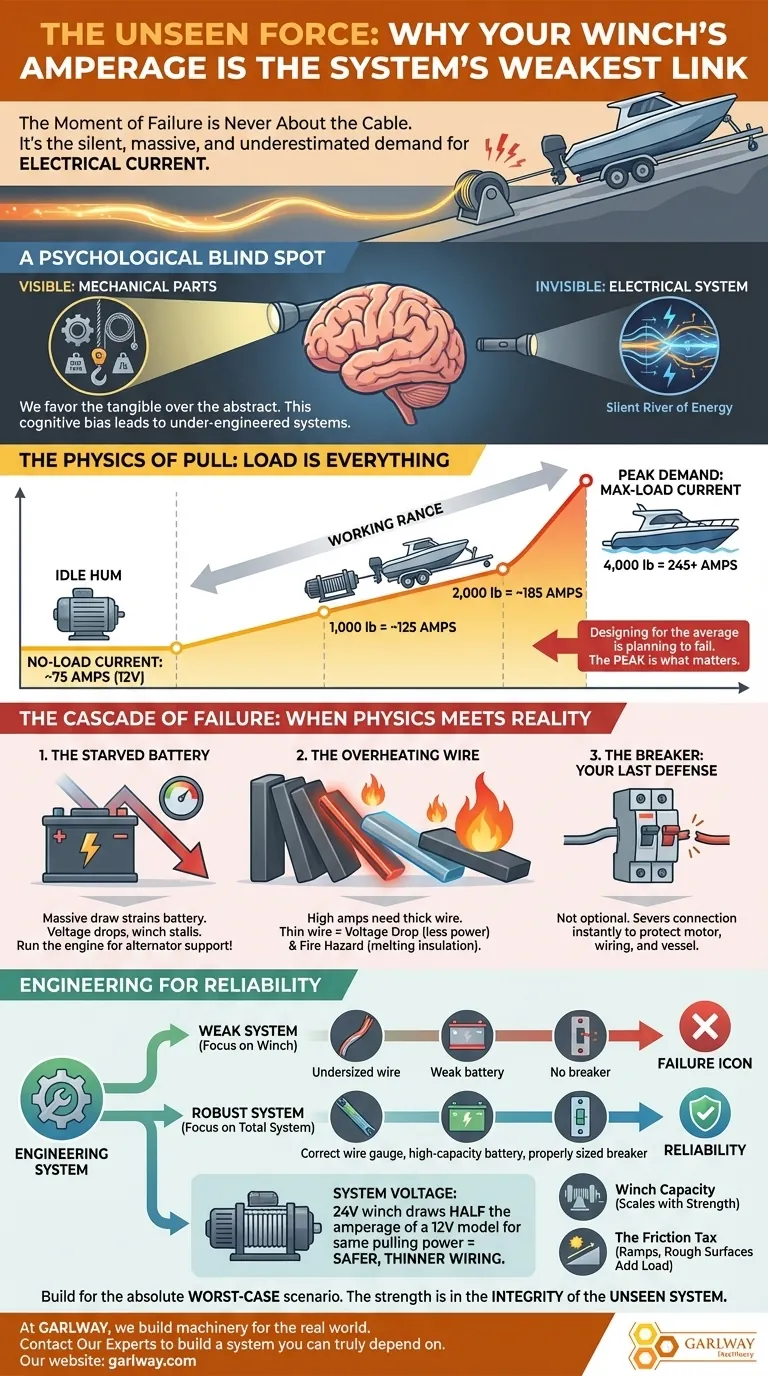
Even when spinning freely with no weight on the line, the motor and gears require significant energy. For a typical 12V winch, this baseline draw is around 75 amps. This is the cost of just being ready.
The Working Range: The Daily Pull
As the winch takes the strain of a boat on a trailer, the current draw climbs predictably.
- A 1,000-pound load might demand 125 amps.
- A 2,000-pound load could require 185 amps.
This is the zone of normal operation, where everything feels right. But the system's safety is not defined by the normal; it's defined by the extreme.
The Peak Demand: Max-Load Current
When the winch approaches its rated capacity, the motor is under immense strain. The current draw spikes dramatically to meet the demand.
Pulling a 4,000-pound load can surge the current to 245 amps or more. This peak number is the only one that matters when designing your electrical system. Designing for the average is planning to fail.
The Cascade of Failure: When Physics Meets Reality
Ignoring the peak current demand doesn't just reduce performance; it invites a cascade of failures that can damage equipment or even cause a fire.
1. The Starved Battery
A massive amperage draw puts an incredible strain on your battery. A weak, old, or undersized battery simply cannot supply the peak current required. The voltage will plummet, and the winch motor will stall. This is why you must run the engine while winching—the alternator is a critical power source, not just a battery charger.
2. The Overheating Wire
High amperage requires thick wire. Pushing 245 amps through a wire sized for 100 is like forcing a fire hose's worth of water through a garden hose. The wire will get hot. Extremely hot. This creates two problems:
- Voltage Drop: The resistance in the thin wire causes a significant drop in voltage by the time it reaches the motor, starving it of power and crippling its pulling force.
- Fire Hazard: The wire's insulation can melt, creating a short circuit and a very real risk of an electrical fire.
3. The Breaker: Your Last Defense
A correctly sized fuse or circuit breaker is not optional. It is the single most important safety device in the circuit. It is engineered to sever the connection instantly if the current exceeds a safe level, protecting the motor, the wiring, and the vessel itself.
Engineering for Reliability
A robust winch system accounts for every variable. The numbers are just a starting point; the real-world application is always more demanding.
| Variable | Impact on Current Draw |
|---|---|
| Winch Capacity | A 10,000-lb winch will draw far more current at every load level than a 3,000-lb model. Power demands scale with strength. |
| System Voltage | For the same pulling power, a 24V winch draws half the amperage of a 12V model. This allows for safer, thinner wiring. |
| The Friction Tax | The load isn't just the boat's weight. A steep ramp or a rough surface adds significant effective load and, therefore, current draw. |
Building a reliable system requires a simple shift in perspective: Stop focusing on the winch itself and start engineering the electrical system that supports it. This means sizing your wires, fuses, and battery for the absolute worst-case scenario—the maximum possible current draw listed by the manufacturer.
The strength of a winch is not in its cable, but in the integrity of the unseen system that powers it. At GARLWAY, we build machinery for the real world, focusing on the total system's reliability, from the motor's windings to the gauge of the power cable. We provide the robust winches and the system-level expertise to ensure they perform flawlessly under pressure.
To build a system you can truly depend on, Contact Our Experts.
Visual Guide
Related Products
- Warn Winch Windlass Boat Trailer Winch
- Electric and Hydraulic Winch for Heavy Duty Applications
- Small Electric Winch 120V and 240V for Compact Applications
- 12000 lb Electric Boat Trailer Winch with Windlass Anchor Warn
- Quick Windlass Portable Winch for Truck and Boat Best Boat Winch
Related Articles
- Beyond the Bumper: The Critical System Choice in Powering Your Trailer Winch
- Force vs. Mass: The Critical Difference in Sizing a Boat Winch
- Lines of Force: The Unseen Geometry of a Boat Winch
- More Than a Number: The Engineering Psychology of Choosing a Boat Winch
- How to Choose and Optimize Winch Speed for Maximum Efficiency