The Illusion of a Single Number
In moments of crisis—a construction vehicle mired in mud, a heavy load needing to be positioned with precision—we look for certainty. We see the 9,000-pound rating stamped on a winch and feel a sense of security. It's a big, reassuring number.
But this number, while important, tells only half the story. It describes the winch's mechanical strength, not its electrical hunger. The most critical failure points in a recovery operation often have nothing to do with a snapped cable, but with a silent, unseen electrical system pushed beyond its limits.
The central misunderstanding is a psychological one: we seek a single, static value for power consumption, but the reality is a dynamic, demanding range.
Load Determines Amperage: The Unseen Variable
A winch motor is not a lightbulb; it doesn't have a fixed wattage. Its consumption of electrical current (amperage) is a direct conversation with the physical world. The more resistance it meets, the more power it demands from your system.
The most critical concept is that a winch's amp draw is not a rating, but a demand. Preparing your electrical system for the maximum possible demand is the only path to reliable operation.
The Baseline: No-Load Draw
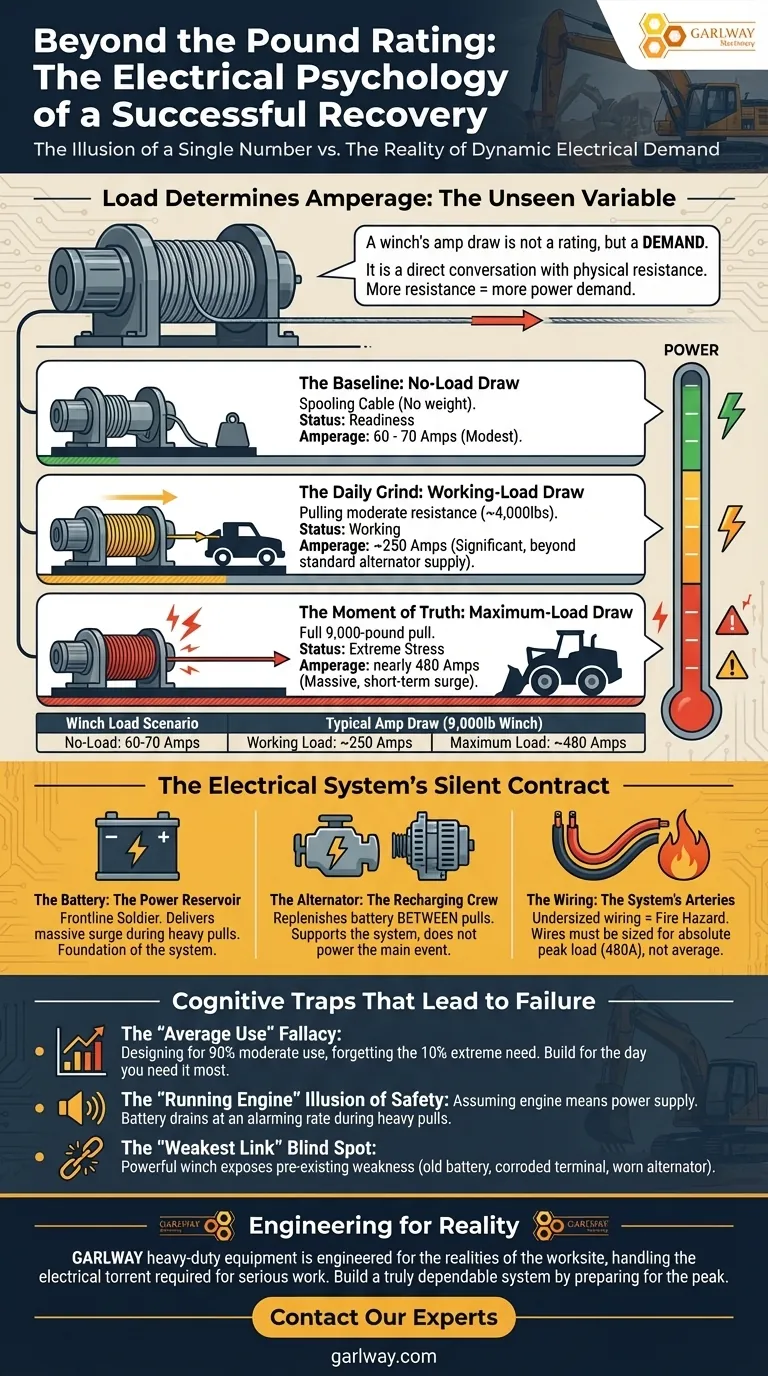
This is the energy required for the winch to simply operate. When spooling the cable in or out with no weight attached, a 9,000-pound winch might draw a modest 60-70 amps. It's a state of readiness, not of work.
The Daily Grind: Working-Load Draw
This is the common scenario. Pulling a vehicle through moderate resistance or lifting a significant, but not maximum, load. That same winch might now demand ~250 amps. This figure is already far beyond what a standard vehicle alternator can supply in real-time.
The Moment of Truth: Maximum-Load Draw
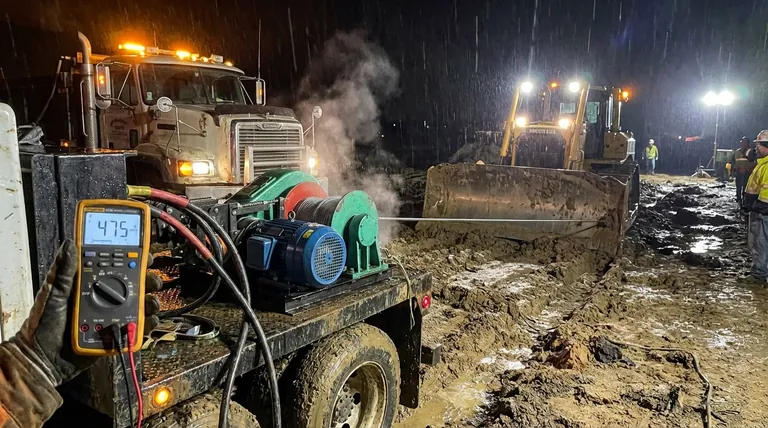
Here, the winch is strained to its mechanical limit. At a full 9,000-pound pull, the electrical demand can skyrocket to nearly 480 amps. This is a massive, short-term draw that puts the entire electrical system—battery, alternator, and wiring—under extreme stress.
| Winch Load Scenario | Typical Amp Draw (9,000lb Winch) |
|---|---|
| No-Load (Spooling Cable) | 60 - 70 Amps |
| Working Load (~4,000lbs) | ~250 Amps |
| Maximum Load (9,000lbs) | ~480 Amps |
The Electrical System's Silent Contract
Thinking your alternator powers the winch during a heavy pull is a dangerous misconception. It’s like believing a single medic can resupply an entire army in the heat of battle. A winch operation is an act of managed deficit spending, electrically speaking.
The Battery: The Power Reservoir
During a heavy pull, the winch is running almost exclusively on the stored power in your battery. The battery is the frontline soldier, delivering a massive surge of current that the alternator simply cannot match. A healthy, high-capacity battery isn't a luxury; it's the foundation of the entire system.
The Alternator: The Recharging Crew
With the engine running, the alternator's true job is to replenish the battery between pulls. It frantically works to restore the energy that was just spent. It supports the system, but it does not power the main event.
The Wiring: The System's Arteries
Undersized wiring is like trying to fight a fire with a garden hose. When faced with a 480-amp demand, inadequate cables will not only starve the winch motor of power, causing it to overheat and fail, but they will become a severe fire hazard themselves. Wires must be sized for the absolute peak load, not the average.
Cognitive Traps That Lead to Failure
The gap between a successful recovery and a stranded vehicle is often paved with simple, human cognitive biases.
-
The "Average Use" Fallacy: We design for the 90% of situations where the load is moderate, forgetting that the winch's entire purpose is to save us in the extreme 10%. Your system must be built for the day you need it most, not for a typical day.
-
The "Running Engine" Illusion of Safety: The sound of a running engine provides a false sense of security. We assume power is being generated and supplied, without realizing the battery is being drained at an alarming rate.
-
The "Weakest Link" Blind Spot: A powerful winch exposes any pre-existing weakness. An old battery, a corroded terminal, or a worn alternator will fail under the sudden, immense demand of a heavy pull.
Engineering for Reality
For professionals in construction and contracting, there is no room for error. The "maximum-load scenario" isn't a rare emergency; it's a Tuesday afternoon. The equipment must be designed with an inherent understanding of these peak electrical demands.
At GARLWAY, our heavy-duty winches, concrete mixers, and batching plants are engineered for the realities of the worksite. We know that reliability isn't just about mechanical strength; it's about building a cohesive system that can handle the electrical torrent required for serious work. Building a truly dependable system means acknowledging the physics and preparing for the peak.
To ensure your equipment is matched to the demands of your work, Contact Our Experts.
Visual Guide
Related Products
- Warn Winch Windlass Boat Trailer Winch
- Electric and Hydraulic Winch for Heavy Duty Applications
- Small Electric Winch 120V and 240V for Compact Applications
- 12000 lb Electric Boat Trailer Winch with Windlass Anchor Warn
- Quick Windlass Portable Winch for Truck and Boat Best Boat Winch
Related Articles
- Beyond the Bumper: The Critical System Choice in Powering Your Trailer Winch
- Force vs. Mass: The Critical Difference in Sizing a Boat Winch
- Lines of Force: The Unseen Geometry of a Boat Winch
- More Than a Number: The Engineering Psychology of Choosing a Boat Winch
- How to Choose and Optimize Winch Speed for Maximum Efficiency