The Illusion of Durability
A heavy-duty winch on a construction site feels permanent. Bolted to steel, its sheer mass projects an aura of invincibility. This is a powerful illusion.
In reality, a winch isn't a single, monolithic object. It's a complex system of interlocking dependencies: mechanical, electrical, and structural. Failure is almost never a sudden event; it's the final, visible symptom of a long, quiet process of neglect. The most dangerous assumption we can make is that a machine at rest is a machine that is fine.
The Psychology of Omission
We are biased toward action. We notice when a machine breaks, but we rarely notice the slow, creeping corrosion or the lubricant that is gradually losing its viscosity. Maintenance is an act of prevention, and the human mind struggles to value a problem that hasn't happened yet.
This isn't about laziness. It's a cognitive blind spot. The daily operational checks are easy to skip because the winch worked fine yesterday. But reliability isn't built on yesterday's performance; it's secured by today's discipline. A well-maintained winch isn't just a tool—it's a reflection of a professional culture that values process over luck.
A System, Not Just a Machine
To truly maintain a winch, we must stop seeing it as a single component and start seeing its interconnected systems. Each part tells a story about the health of the whole.
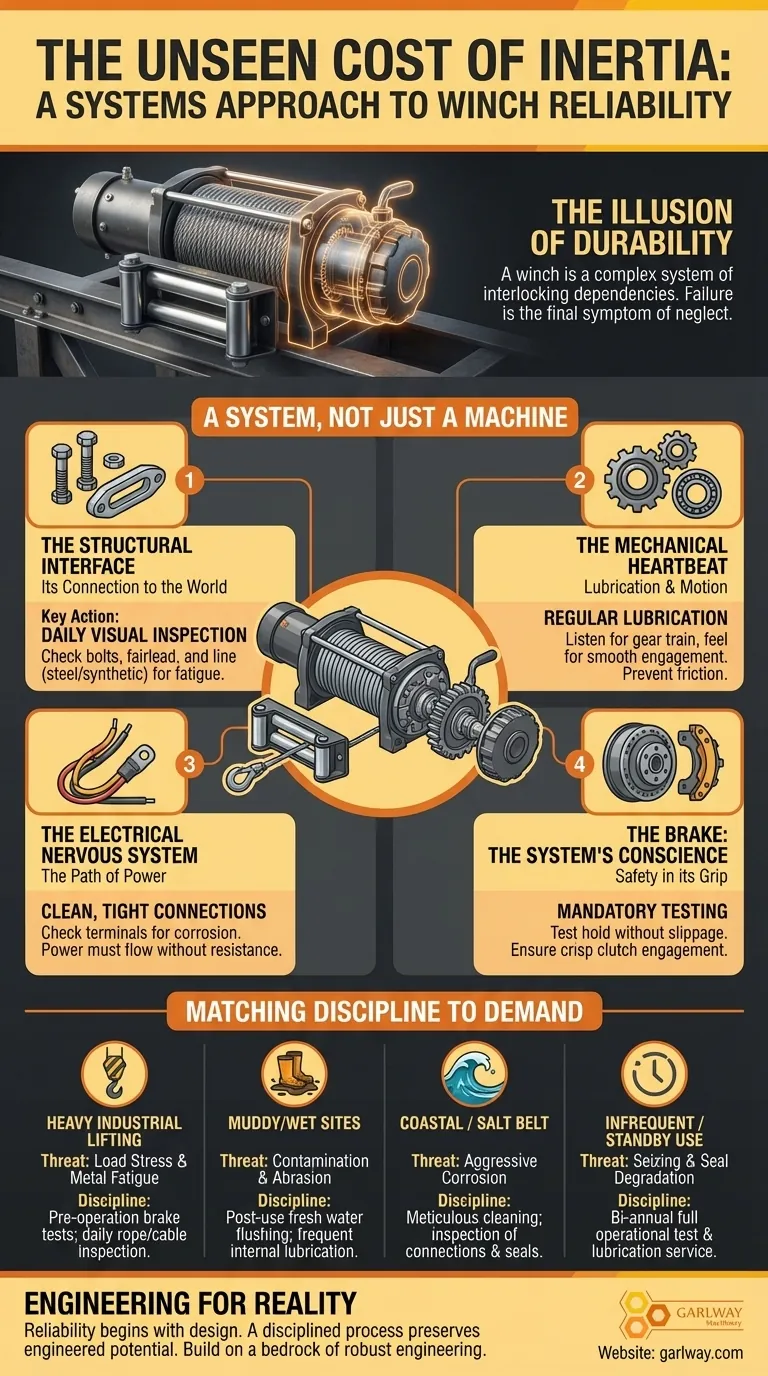
The Structural Interface: Its Connection to the World
The winch's mounting bolts and fairlead are its physical handshake with the job site. A loose bolt isn't just a loose bolt; it's a sign of harmonic vibration, a potential stress fracture in the making.
A daily visual inspection is crucial. Look for what’s out of place. Check the winch line—steel or synthetic—for any signs of fatigue. A kink in a steel cable or a fray in a synthetic rope is a silent scream, a warning of compromised integrity at the most critical point of contact.
The Mechanical Heartbeat: Lubrication and Motion
Inside the casing, the gears and bearings are the winch’s heart. Lubrication is its lifeblood. Without it, friction becomes a destructive force, grinding down precision-engineered surfaces and generating catastrophic heat.
Regularly lubricating all moving parts is non-negotiable. But it’s also about inspection. Listening to the gear train, feeling for smooth engagement—these are acts of mechanical empathy. They allow you to diagnose wear long before it leads to failure under a critical load.
The Electrical Nervous System: The Path of Power
For an electric winch, the wiring is its nervous system. Power must flow without resistance. The most common point of failure is not the motor itself, but the connections to it.
Corrosion on a terminal is like a clot in an artery. It chokes the flow of power, forcing the motor to work harder, overheat, and eventually burn out. A simple, regular check of all connections—ensuring they are clean, tight, and protected—is the single most effective way to guarantee the motor responds the moment you need it.
The Brake: The System's Conscience
Of all the components, the brake is the most sacred. It is the winch’s conscience—the one part that stands between a controlled operation and a disaster.
A winch brake doesn't just hold a load; it holds the safety of the entire site in its grip. Testing it isn't a suggestion; it's a moral obligation. It must hold without a hint of slippage. The clutch, too, must engage and disengage with crisp, predictable precision. A sticky clutch isn't an annoyance; it's a sign of internal contamination or wear that demands immediate attention.
Matching Discipline to Demand
Your environment is an active participant in your winch's lifecycle. A maintenance schedule cannot be static; it must be a living document that adapts to the reality of the work.
| Operational Focus | Primary Threat | Key Maintenance Discipline |
|---|---|---|
| Heavy Industrial Lifting | Load Stress & Metal Fatigue | Pre-operation brake tests; daily rope/cable inspection. |
| Muddy/Wet Construction Sites | Contamination & Abrasion | Post-use flushing with fresh water; frequent internal lubrication. |
| Coastal or "Salt Belt" Use | Aggressive Corrosion | Meticulous cleaning; inspection of electrical connections and seals. |
| Infrequent/Standby Use | Seizing & Seal Degradation | Bi-annual full operational test and lubrication service. |
Engineering for Reality
Maintenance is a partnership between the operator and the machine. A disciplined process can extend the life of any tool, but it can only preserve the potential that was engineered into it from the start. A winch built with inferior materials or loose tolerances will always be fighting a losing battle against the stresses of the job.
True reliability begins with design. At GARLWAY, our winches, concrete mixers, and batching plants are engineered for the harsh realities of the modern construction site. We build machines that don't just perform under pressure but are also designed for straightforward, effective maintenance. By starting with a foundation of robust engineering, we provide you with equipment worthy of your professional discipline.
To ensure your projects are built on a bedrock of reliability, you need the right tools and the right processes. Let us handle the first part. Contact Our Experts
Visual Guide
Related Products
- Warn Winch Windlass Boat Trailer Winch
- Electric and Hydraulic Winch for Heavy Duty Applications
- Small Electric Winch 120V and 240V for Compact Applications
- 12000 lb Electric Boat Trailer Winch with Windlass Anchor Warn
- Quick Windlass Portable Winch for Truck and Boat Best Boat Winch
Related Articles
- Beyond the Bumper: The Critical System Choice in Powering Your Trailer Winch
- Force vs. Mass: The Critical Difference in Sizing a Boat Winch
- Lines of Force: The Unseen Geometry of a Boat Winch
- More Than a Number: The Engineering Psychology of Choosing a Boat Winch
- How to Choose and Optimize Winch Speed for Maximum Efficiency