A Common and Dangerous Mistake
Imagine a seasoned boater, proud of their new 4,000-pound vessel. When it's time to buy a winch, their intuition screams, "Get the strongest one!" They see a 2,000 lb trailer winch and a 1,000 lb anchor winch. The choice seems obvious.
But this intuition, this mental shortcut, is dangerously flawed.
The mistake isn't in the math; it's in the underlying mental model. We instinctively link the size of the boat to the power of the winch. But in the world of physics, the boat's total weight is a critical factor for one job and almost completely irrelevant for another.
Understanding this distinction is everything.
Step One: Define the Force Vector
Before looking at specifications, you must answer a single question: is the primary force horizontal or vertical?
These are two entirely different physical challenges. The equipment designed for one is not interchangeable with the other.
The Trailer Winch: A Battle Against Friction
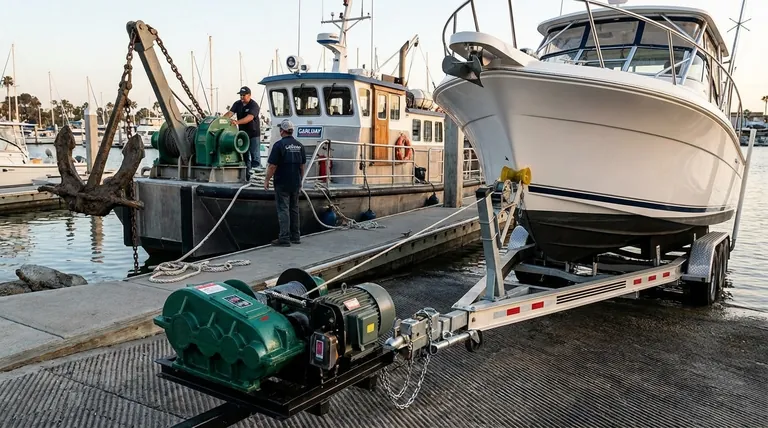
A trailer winch pulls your boat horizontally onto a set of rollers or bunks. It is not lifting the boat. It is fighting two main forces: the rolling friction of the trailer and the shallow angle of the boat ramp.
This is a game of leverage, not dead weight. The physics are more forgiving.
-
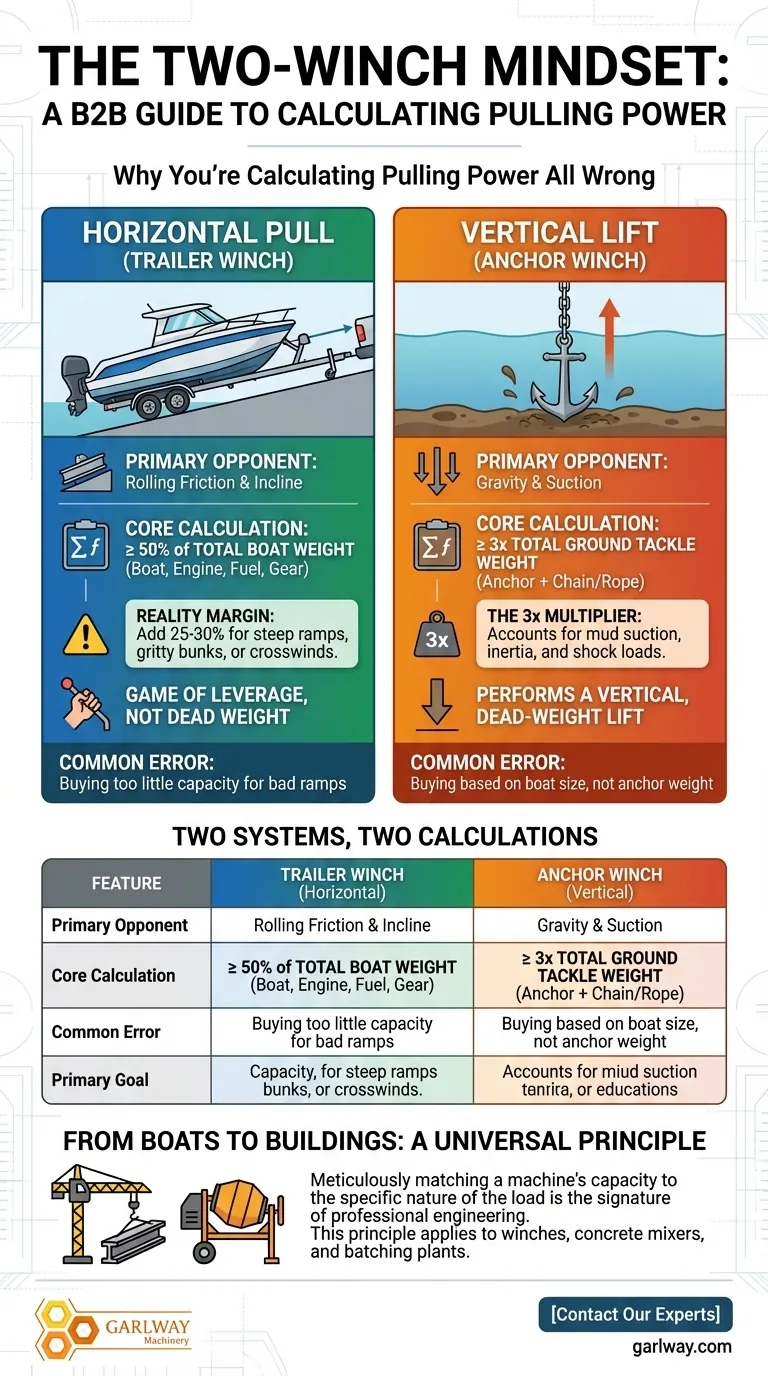
The Core Formula: A trailer winch needs a capacity of at least half your boat's fully loaded weight (boat, engine, fuel, gear). A 4,000 lb boat package requires a 2,000 lb winch.
-
The Reality Margin: This formula assumes a perfect world. A steep ramp, gritty bunks instead of smooth rollers, or a stiff crosswind can dramatically increase resistance. A wise mariner adds a 25-30% safety margin to the calculation.
The Anchor Winch: A Battle Against Gravity
An anchor winch, or windlass, does a completely different job. It performs a vertical, dead-weight lift.
The windlass couldn't care less about the size of your boat. Its sole job is to lift the "ground tackle"—the anchor and the full length of its chain or rope—straight up from the seabed.
-
The Ground Tackle Rule: The windlass must have a maximum pulling power of at least three times the total weight of your ground tackle.
-
The 3x Multiplier is Not Arbitrary: This isn't just a safety margin. It accounts for the immense suction force required to break an anchor free from a muddy bottom, the inertia of a heavy chain, and the shock loads from the boat pitching in waves during retrieval.
A common psychological error is to assume a big boat needs a big windlass. Wrong. The boat's engines are used to position the vessel directly over the anchor. The windlass only does the lifting. The boat's size only dictates how heavy your anchor needs to be in the first place.
Two Systems, Two Calculations
The mental model must shift from "one boat, one winch rule" to "two distinct physical systems."
| Feature | Trailer Winch (Horizontal Pull) | Anchor Winch / Windlass (Vertical Lift) |
|---|---|---|
| Primary Opponent | Rolling Friction & Incline | Gravity & Suction |
| Core Calculation | ≥ 50% of Total Boat Weight | ≥ 3x Total Ground Tackle Weight |
| The Common Error | Buying too little capacity for bad ramps | Buying based on boat size, not anchor weight |
| Primary Goal | Load the boat safely | Retrieve the anchor without manual strain |
From Boats to Buildings: A Universal Principle
This precise, physics-based approach to selecting equipment isn't just for mariners. It’s the signature of professional engineering.
The core principle—meticulously matching a machine's capacity to the specific nature of the load—is universal. Whether you are pulling a boat, hoisting steel beams on a construction site, or tensioning a cable, the distinction between a horizontal pull and a vertical lift is critical. The forces at play dictate the tool for the job.
At GARLWAY, our expertise is built on this foundation. We engineer heavy-duty construction machinery like winches, concrete mixers, and batching plants where these principles are mission-critical. Understanding load dynamics isn't just a feature; it's the core of safe and efficient operation.
For industrial applications that demand this level of precision, matching the right machine to the right physical task is paramount. Contact Our Experts
Visual Guide
Related Products
- Warn Winch Windlass Boat Trailer Winch
- Electric and Hydraulic Winch for Heavy Duty Applications
- Small Electric Winch 120V and 240V for Compact Applications
- Quick Windlass Portable Winch for Truck and Boat Best Boat Winch
- Hydraulic Winding Engine Harbor Freight Winch
Related Articles
- Beyond the Bumper: The Critical System Choice in Powering Your Trailer Winch
- Force vs. Mass: The Critical Difference in Sizing a Boat Winch
- Lines of Force: The Unseen Geometry of a Boat Winch
- More Than a Number: The Engineering Psychology of Choosing a Boat Winch
- How to Choose and Optimize Winch Speed for Maximum Efficiency