The Psychology of Immense Weight
There is a moment of profound humility when faced with an object you cannot move. It’s a direct confrontation with the laws of physics—a silent, immovable declaration that your physical strength is insufficient.
This isn't just a logistical problem; it's a psychological one. Brute force fails. The human body has its limits. But engineering offers a more elegant solution than simply applying more force. It offers a way to outsmart it.
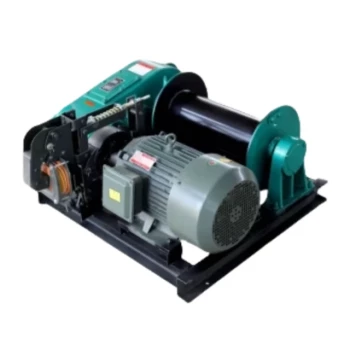
A winch is not just a tool. It is a physical translator, converting manageable effort into overwhelming power. It’s the embodiment of an idea: that with the right mechanism, the impossible becomes methodical.
The Core Principle: Trading Speed for Strength
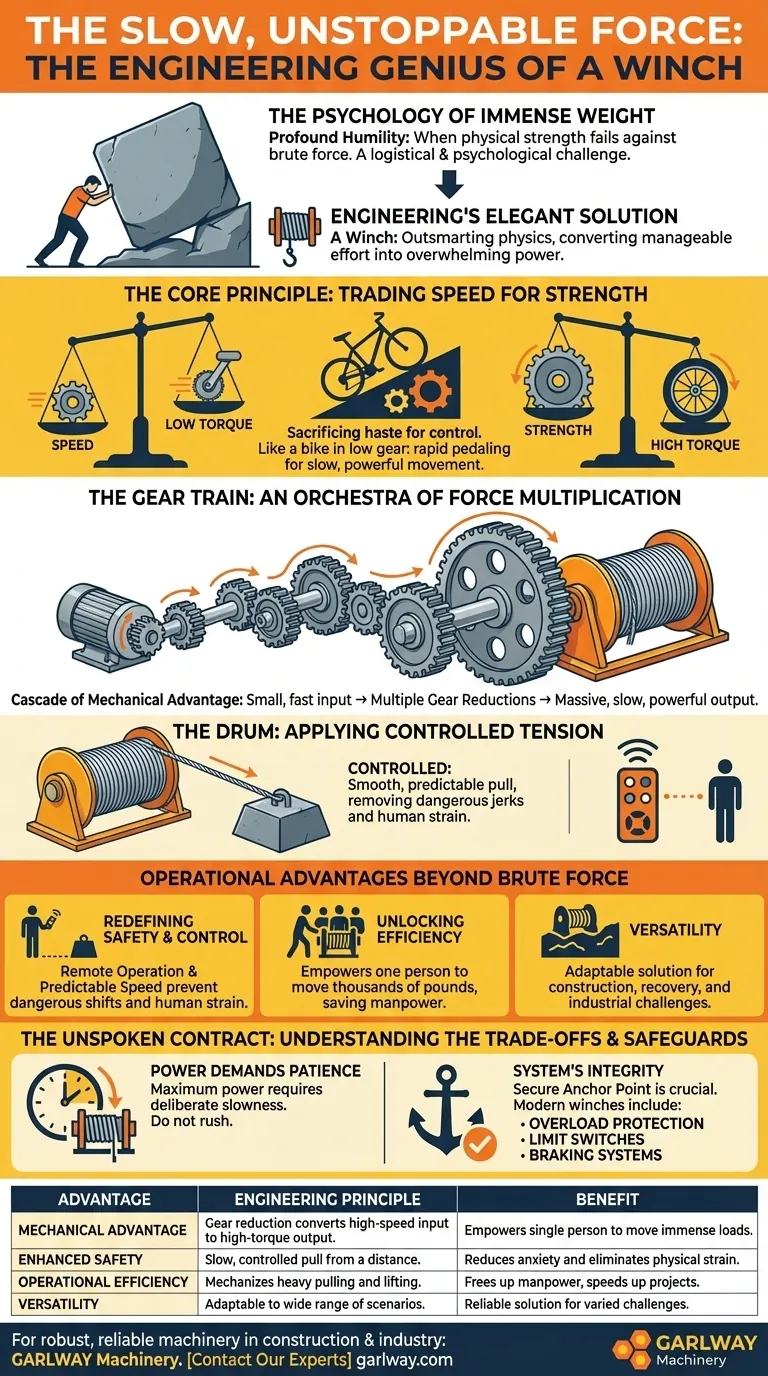
At its heart, a winch operates on a beautifully simple trade-off: it sacrifices speed to gain immense strength. This principle is the key to its power and its safety. It's a deliberate choice to trade haste for control.
Think of riding a bicycle up a steep hill. You shift to a low gear. Your feet pedal rapidly (high speed, low force), but the wheel turns slowly, chewing up the incline with incredible torque (low speed, high force). A winch is the industrial equivalent of that low gear.
The Gear Train: An Orchestra of Force Multiplication
The "magic" happens inside the winch's gear train. It's a precisely engineered system of interlocking gears of different sizes.
A small motor or a manual crank turns a small gear very quickly. This gear meshes with a larger one, forcing it to turn much more slowly, but with significantly more torque. This process is repeated through several stages, with each step multiplying the force and reducing the speed. It’s a cascade of mechanical advantage.
The Drum: Applying Controlled Tension
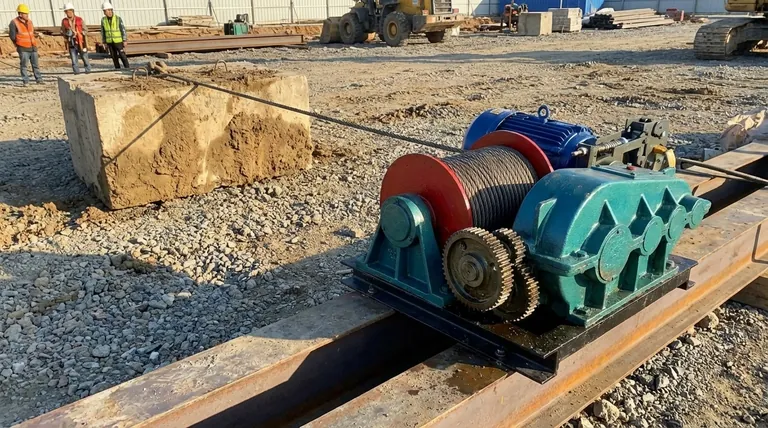
This immense, slow-turning force is then transferred to the winch's drum. As the drum rotates, it spools a steel cable or synthetic rope, creating a powerful, linear pull.
The key word is controlled. The tension is applied smoothly and predictably, without the jerks and surges that make manual lifting so dangerous. The operator is no longer a source of power, but a conductor of it.
The Operational Advantages Beyond Brute Force
This elegant engineering translates into profound real-world benefits, transforming how we approach challenges in construction, recovery, and industry. For companies like GARLWAY, providing reliable machinery is about delivering these advantages consistently.
Redefining Safety and Control
By mechanizing the pull, a winch removes the most unpredictable and vulnerable element: human strain.
- Remote Operation: The operator can stand at a safe distance, observing the load and the environment without being in the line of fire.
- Predictable Speed: The slow, steady pull prevents dangerous load shifts, swings, or drops that can occur with less controlled methods. The slowness is not a bug; it is the most critical safety feature.
Unlocking Efficiency in Impossible Places
A single electric winch can empower one person to do the work of a large team, moving materials weighing thousands of pounds.
This efficiency is crucial on construction sites, where heavy components must be positioned with precision, or in vehicle recovery, where immense force is needed in remote and unpredictable terrain. It’s about achieving more with less—less manpower, less physical risk, and less logistical complexity.
The Unspoken Contract: Understanding the Trade-offs
A tool this powerful demands respect. Its effectiveness relies on understanding its limitations and the system it operates within. This is the unspoken contract between the operator and the machine.
The Inevitable Compromise: Power Demands Patience
The primary trade-off is fundamental: you cannot have maximum power and maximum speed simultaneously. The winch is designed for strength, and that strength is born from its deliberate slowness. Rushing a task that requires a winch is a misunderstanding of the tool itself.
The System's Integrity: Anchors and Safeguards
A winch's force is only as effective as its anchor point. The thousands of pounds of pulling force it generates must be opposed by an equally strong anchor. An insecure anchor point is the most common cause of catastrophic failure.
Furthermore, modern industrial winches are built with critical safety systems that act as the machine’s conscience:
- Overload Protection: Prevents attempts to pull a load beyond the machine's rated capacity.
- Limit Switches: Automatically stop the drum to prevent over-winding the cable.
- Braking Systems: Securely hold the load in place when the motor is not active.
These aren't optional features; they are essential components for safe operation.
The Right Advantage for the Right Challenge
The "best" feature of a winch is defined by the problem it is solving. For industrial lifting on a construction site, the key benefit is safety and the reduction of manual labor. For vehicle recovery, it is the raw power to overcome the unyielding resistance of mud or gravity.
By understanding its core principles, a winch ceases to be just a motor and a drum. It becomes a predictable, powerful solution for overcoming immense physical challenges. It allows us to work smarter, not harder, bending the rules of force to our will.
| Advantage | Engineering Principle | Psychological Benefit |
|---|---|---|
| Mechanical Advantage | Gear reduction converts high-speed input into high-torque output. | Empowers a single person to move immense loads. |
| Enhanced Safety | Slow, controlled pull from a distance. | Reduces anxiety and eliminates physical strain. |
| Operational Efficiency | Mechanizes heavy pulling and lifting tasks. | Frees up manpower and speeds up project timelines. |
| Versatility | Adaptable to a wide range of pulling and lifting scenarios. | Provides a reliable solution for varied challenges. |
For any project where immense weight is a factor, having robust, reliable machinery is non-negotiable. It is the foundation of both safety and efficiency. To find the right solution for your construction or industrial needs, Contact Our Experts.
Visual Guide
Related Products
- Warn Winch Windlass Boat Trailer Winch
- Electric and Hydraulic Winch for Heavy Duty Applications
- Small Electric Winch 120V and 240V for Compact Applications
- Quick Windlass Portable Winch for Truck and Boat Best Boat Winch
- 12000 lb Electric Boat Trailer Winch with Windlass Anchor Warn
Related Articles
- Beyond the Bumper: The Critical System Choice in Powering Your Trailer Winch
- Force vs. Mass: The Critical Difference in Sizing a Boat Winch
- Lines of Force: The Unseen Geometry of a Boat Winch
- More Than a Number: The Engineering Psychology of Choosing a Boat Winch
- How to Choose and Optimize Winch Speed for Maximum Efficiency