The Allure of a Single Number
We have a deep-seated psychological trust in numbers. A single, bold number stamped on a piece of steel feels like a promise—a guarantee of strength. We see a winch rated for "2,000 lbs" and our mind quickly does the math: the load is 1,500 lbs, so we have a 500 lb buffer.
This cognitive shortcut is simple, satisfying, and often dangerously wrong.
The number on a winch isn’t a universal measure of its strength; it's a highly specific rating for a single, intended task. Misinterpreting that number is one of the most common and catastrophic mistakes in material handling, whether on a boat ramp or a construction site. It's a failure not of the equipment, but of understanding the physics it was designed to obey.
Two Worlds, One Word: "Capacity"
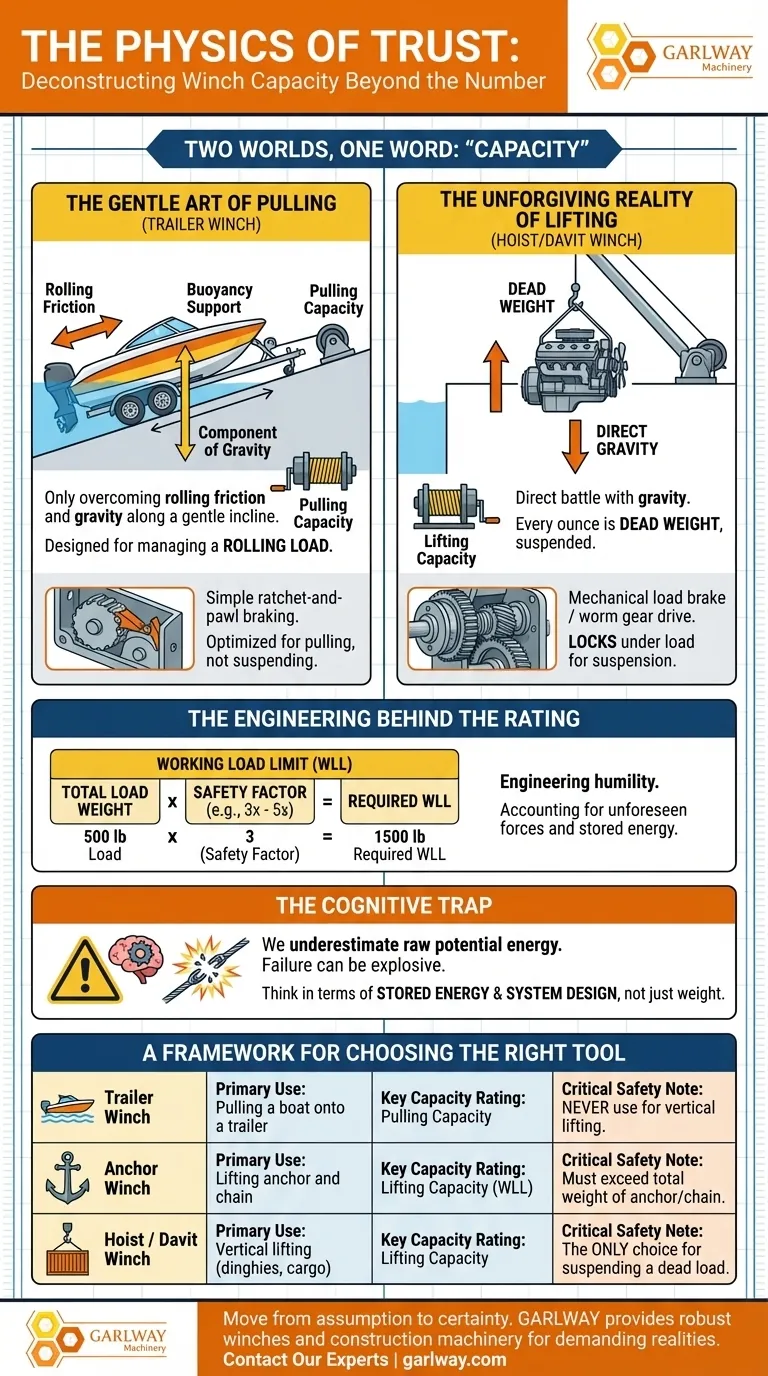
The term "capacity" splits into two fundamentally different worlds: the world of pulling and the world of lifting. The forces at play are completely distinct.
The Gentle Art of Pulling
Think of a trailer winch pulling a boat from the water. The winch isn't fighting the full, dead weight of the vessel. The boat is rolling on trailer bunks or rollers, and it's supported by the buoyancy of the water. The winch is only overcoming rolling friction and the force component of gravity along a gentle incline.
A winch with a 2,000 lb pulling capacity is engineered for precisely this scenario. It's designed to manage a rolling load, not to fight the full, unforgiving force of gravity.
The Unforgiving Reality of Lifting
Now, imagine using that same winch to lift a 1,500 lb engine block straight up. The entire dynamic changes. The winch is now engaged in a direct battle with gravity. Every ounce of the load is a dead weight, suspended in mid-air.
This is true lifting capacity. It requires not just a different power calculation but an entirely different engineering philosophy, especially concerning the braking system.
The Engineering Behind the Rating
A winch’s rating is the conclusion of a story written by engineers, accounting for gears, brakes, and the nature of the load itself.
Gearing, Brakes, and the Burden of Trust
A trailer winch typically uses a simple ratchet-and-pawl braking system. It’s designed to prevent the load from rolling backward, but it is not built to reliably and safely suspend a dead load. The gears are optimized for pulling power, not for the constant, life-or-death stress of suspension.
A true hoist or lifting winch, by contrast, incorporates a mechanical load brake or a worm gear drive. These systems are designed to lock under load, making it physically impossible for the weight to slip. The engineering assumes that failure is not an option.
Calculating the True Load: The Working Load Limit (WLL)
For any vertical lift, professionals don't just match the load to the capacity. They calculate a Working Load Limit (WLL). This involves taking the total weight of the object and multiplying it by a safety factor—often 3x to 5x.
A 500 lb load doesn't require a 500 lb winch; it requires a winch with a WLL of at least 1,500 lbs. This is engineering humility—a built-in acknowledgment that conditions are rarely perfect and that unforeseen forces can arise.
The Cognitive Trap: Why We Make This Mistake
The reason this error is so common is that it stems from a cognitive bias. We see the object and the winch, but we don't see the invisible forces.
We underestimate the raw potential energy stored in a suspended load. A overloaded winch doesn't just fail; it can release that energy explosively. A snapped cable doesn't just fall; it becomes a lethal whip. Stripped gears can send metal fragments flying.
The mistake is thinking about the problem in terms of weight, when we should be thinking about it in terms of stored energy and system design.
A Framework for Choosing the Right Tool
Making the right choice means moving from assumption to a deliberate process. The application dictates the tool, without exception.
| Winch Type | Primary Use | Key Capacity Rating | Critical Safety Note |
|---|---|---|---|
| Trailer Winch | Pulling a boat onto a trailer | Pulling Capacity | NEVER use for vertical lifting. |
| Anchor Winch | Lifting anchor and chain | Lifting Capacity (WLL) | Must exceed total weight of anchor/chain. |
| Hoist / Davit Winch | Vertical lifting (dinghies, cargo) | Lifting Capacity | The only choice for suspending a dead load. |
This distinction is not a matter of opinion or preference; it's a law of physics. On a construction site, this law is even more critical. The principle of matching a hoist's true lifting capacity to a load is identical whether you're lifting a dinghy or positioning a multi-ton concrete panel.
For industrial applications where safety and reliability are non-negotiable, choosing a partner who understands these first principles is critical. GARLWAY provides robust winches and other construction machinery built for the demanding realities of the job site. If you're ready to move from assumption to certainty for your next project, Contact Our Experts.
Visual Guide
Related Products
- Warn Winch Windlass Boat Trailer Winch
- Electric and Hydraulic Winch for Heavy Duty Applications
- Small Electric Winch 120V and 240V for Compact Applications
- 12000 lb Electric Boat Trailer Winch with Windlass Anchor Warn
- Quick Windlass Portable Winch for Truck and Boat Best Boat Winch
Related Articles
- Beyond the Bumper: The Critical System Choice in Powering Your Trailer Winch
- Force vs. Mass: The Critical Difference in Sizing a Boat Winch
- Lines of Force: The Unseen Geometry of a Boat Winch
- More Than a Number: The Engineering Psychology of Choosing a Boat Winch
- How to Choose and Optimize Winch Speed for Maximum Efficiency