The Illusion of a Simple Choice
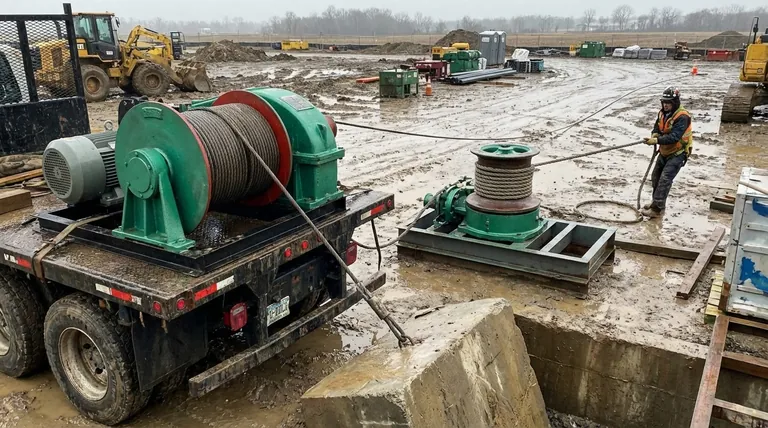
A heavy-duty truck, laden with materials, is mired in mud on a construction site. The solution seems obvious: a winch. The operator hooks up, engages the motor, and expects the problem to be solved.
But the real decision wasn't whether to use a winch; it was which kind of winch was installed on that truck months ago.
This is a common psychological blind spot. We see a category of tool—a "winch"—and assume uniformity. Yet, the choice between the two dominant designs, a drum winch and a capstan winch, reflects a fundamental difference in the philosophy of managing force and distance. It's a choice between a closed system and an open one.
The Core Principle: Containment vs. Flow
The distinction isn't about power sources or gear ratios. It's about a single, elegant question: what do you do with the rope?
The answer dictates everything that follows—the tool's limitations, its strengths, and even the mindset required of its operator.
The Drum Winch: A Philosophy of Containment
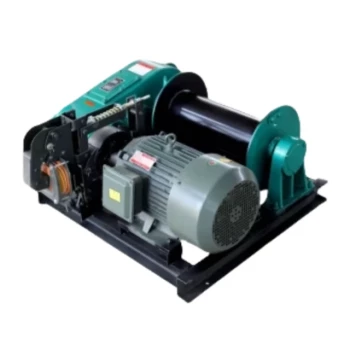
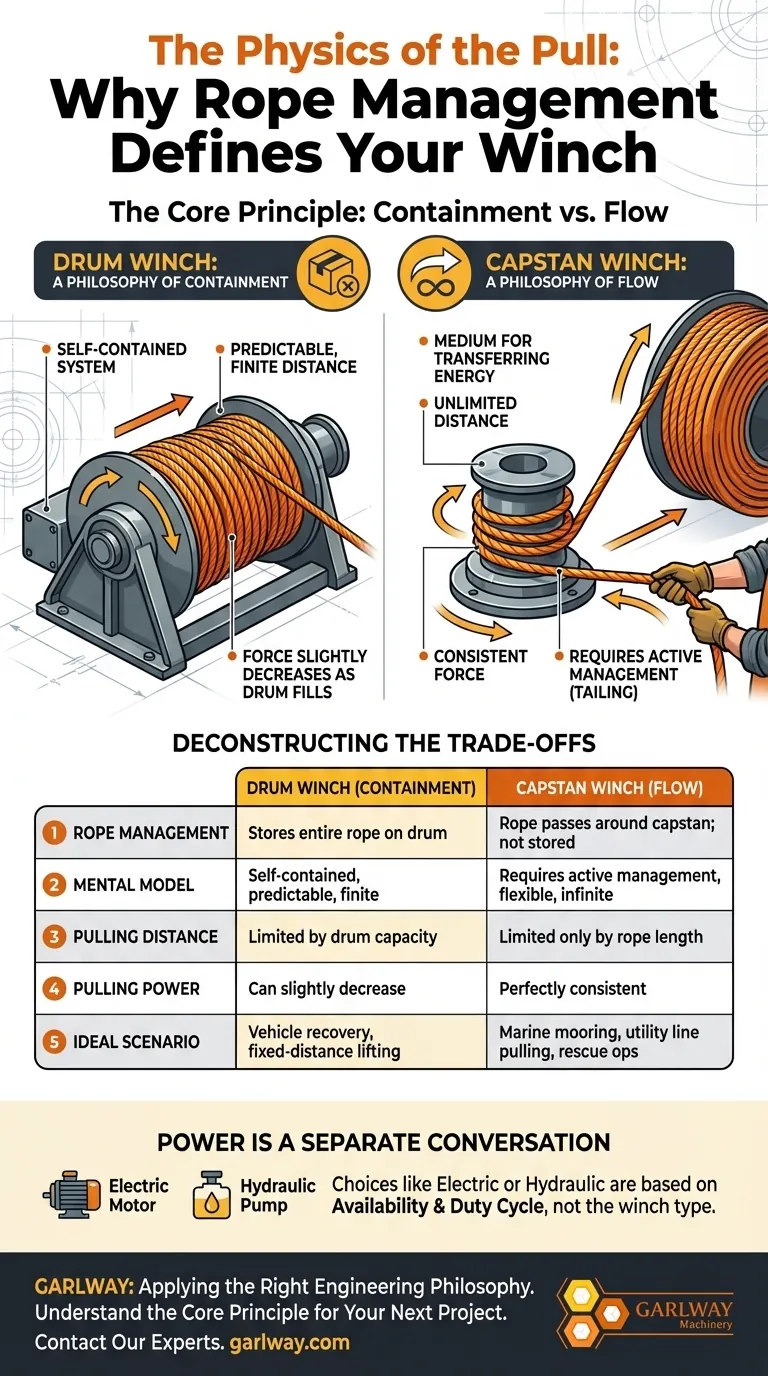
A drum winch is a self-contained universe. Its entire length of rope or cable is wound onto a single, central drum.
When you operate it, the drum turns, pulling the load and storing the line simultaneously. It's a beautifully simple, integrated system. The entire problem and its solution are held within the machine's physical frame.
- The Appeal: Its beauty lies in its predictability. You have a fixed length of rope, and you know it's always ready. There are no external variables to manage. For a known task, like pulling a vehicle onto a flatbed, this containment is a powerful advantage.
- The Constraint: Its boundary is absolute. You cannot pull an inch farther than the length of rope the drum can hold. Furthermore, as the rope layers up on the drum, the effective diameter increases, slightly reducing pulling force with each rotation. It’s a closed system with a hard limit.
The Capstan Winch: A Philosophy of Flow
A capstan winch treats the rope not as something to be stored, but as a medium for transferring energy.
The rope is wrapped a few times around a much smaller, rotating drum (the capstan head). The immense friction generated between the rope and the head is what creates the pulling force. The rope flows through the system; it is not stored there.
- The Appeal: Its power is in its freedom. Because the rope isn't stored, your pulling distance is limited only by the length of rope you have on hand, not by the machine's capacity. The pulling force remains perfectly consistent because the diameter of the capstan never changes.
- The Constraint: This freedom demands engagement. The operator must actively manage the slack end of the rope—a process called "tailing"—to maintain tension. It requires more skill and transforms the operator from a simple button-pusher into an active participant in the physics of the pull.
Deconstructing the Trade-Offs
The decision between these two philosophies hinges entirely on the nature of the work. It is a classic engineering trade-off between simplicity and flexibility.
| Feature | Drum Winch (Containment) | Capstan Winch (Flow) |
|---|---|---|
| Rope Management | Stores the entire rope on the drum | Rope passes around the capstan; is not stored |
| Mental Model | Self-contained, predictable, finite | Requires active management, flexible, infinite |
| Pulling Distance | Limited by drum capacity | Limited only by the length of your rope |
| Pulling Power | Can slightly decrease as the drum fills | Perfectly consistent |
| Ideal Scenario | Vehicle recovery, fixed-distance lifting | Marine mooring, utility line pulling, rescue ops |
Power Is a Separate Conversation
It’s easy to confuse the pulling method with the power source. Both drum and capstan winches can be powered by electric motors, hydraulic systems, or even manual force.
The choice of power is a secondary decision, based on factors like:
- Availability: Do you have access to a vehicle's 12V system or a hydraulic pump?
- Duty Cycle: Do you need the sustained, relentless power of hydraulics for continuous industrial use, or the convenient power of an electric motor for intermittent tasks?
For construction companies, matching the right mechanism with the right power source is critical for efficiency and safety.
Choosing the Right System for the Job
On a modern construction site, where efficiency is paramount, these distinctions are not academic. Using a drum winch for a task that requires pulling a cable through a conduit hundreds of feet long isn't just inefficient; it's impossible. Using a complex capstan system for simple vehicle recovery is over-engineering.
At GARLWAY, we understand that construction machinery isn't just about raw power; it's about applying the right engineering philosophy to the right problem. Our range of robust winches, concrete mixers, and batching plants are all designed with a deep understanding of the real-world physics of the job site.
Choosing the right winch is about understanding the core principle of how it manages the line. It's about deciding whether you need the predictable simplicity of a closed system or the limitless potential of an open one. When you understand that, the choice becomes clear. To ensure you have the right tool for your next project, Contact Our Experts.
Visual Guide
Related Products
- Best 18000 Pound Drum Anchor Trailer Winch
- Warn Winch Windlass Boat Trailer Winch
- Electric and Hydraulic Winch for Heavy Duty Applications
- Portable Small Trailer Winch
- Heavy Duty Electric Boat Winch Windlass Anchor
Related Articles
- Beyond the Bumper: The Critical System Choice in Powering Your Trailer Winch
- How Anchor Winch Technology Transforms Fishing Efficiency Through Smart Relocation
- How to Choose the Right Winch for Heavy-Duty Applications: A Scenario-Based Guide
- How to Choose the Right Trailer-Mounted Winch for Your Industry Needs
- How Trailer-Mounted Winches Cut Costs by Replacing Auxiliary Equipment