The Illusion of a Simple Choice
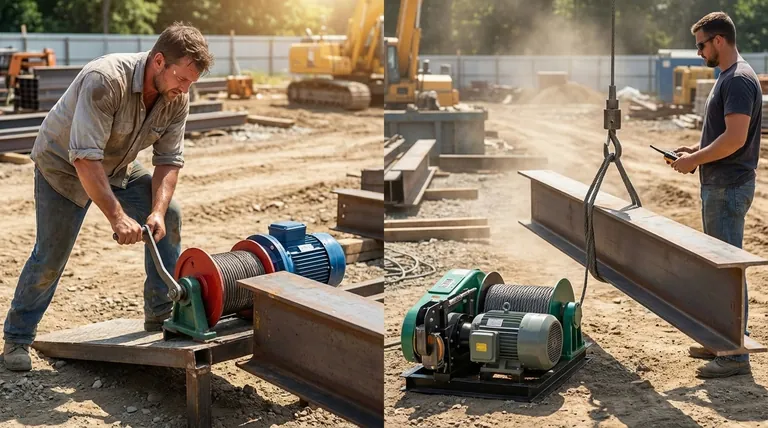
Imagine a steel beam needs to be positioned on a small construction site. The sun is high. One scenario involves a contractor grabbing the crank of a manual winch. The work begins. Every turn is a negotiation between muscle, gravity, and the gear ratio. The process is slow, deliberate, and physically taxing. The contractor’s focus isn't just on the load; it's on their own endurance.
Now, picture the same scene with an electric winch. The contractor stands back, remote in hand, with a clear view of the entire operation. With the press of a button, a motor whirs to life, and the beam moves smoothly into place.
The difference here isn't just about convenience. It's a fundamental distinction between applying human capital and applying mechanical power. The choice between a manual and electric winch seems like a simple budget decision, but it’s actually a strategic choice about where to invest your most valuable resources: time, energy, and focus.
The Mechanics of Effort vs. The Automation of Power
At their core, both winches solve the same physics problem. But they approach it from philosophically different starting points.
The Elegance of the Manual Winch
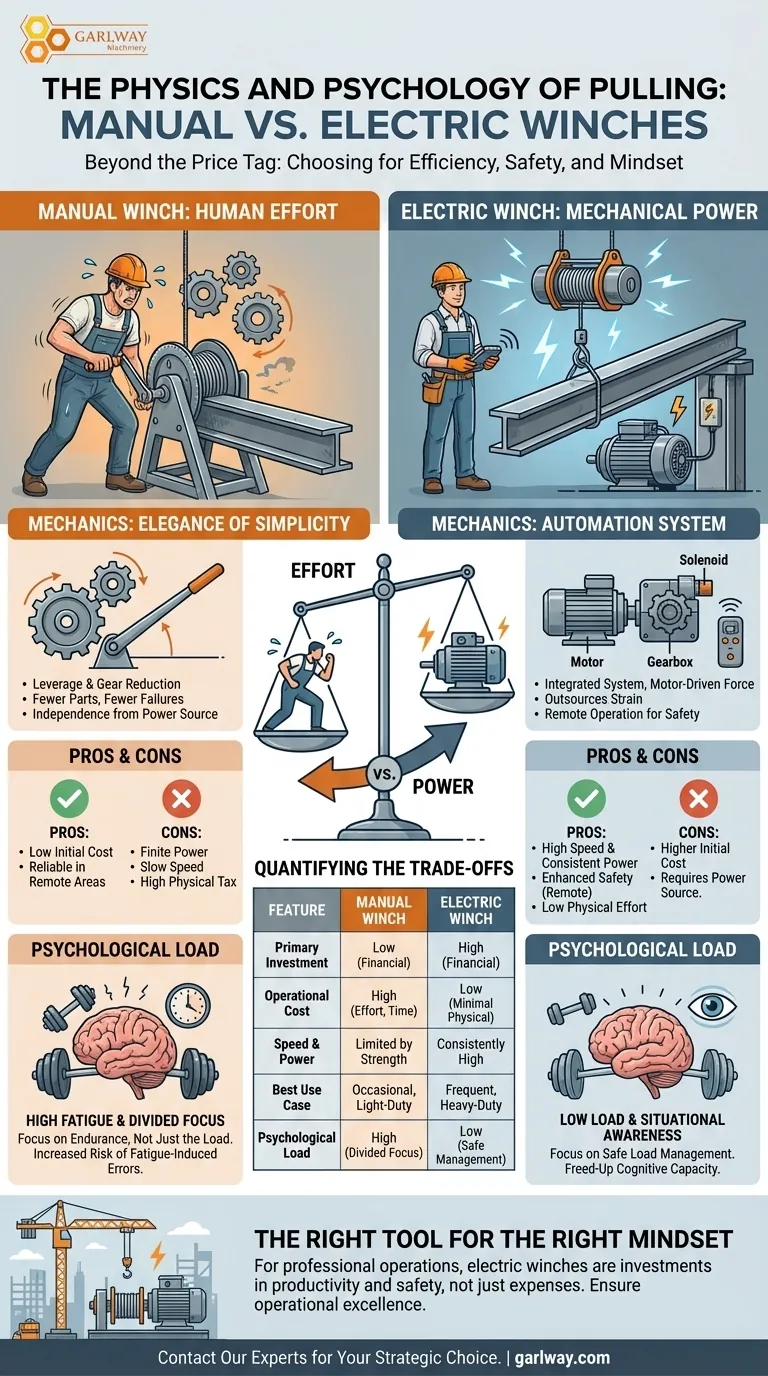
A manual winch is a beautiful piece of mechanical simplicity. It’s a direct application of leverage and gear reduction—a pure conversation between human effort and physical force.
- Simplicity: With fewer moving parts, there are fewer potential points of failure.
- Independence: It requires no battery, no motor, no external power source. It works anywhere you can stand and turn a crank.
But this simplicity comes at a cost that isn’t listed on the price tag. The pulling power is finite, limited directly by your own strength. The slow speed turns significant jobs into grueling, time-consuming tasks. The real cost is human fatigue—a factor that directly correlates with mistakes and accidents.
The Electric Winch: A System for Outsourcing Strain
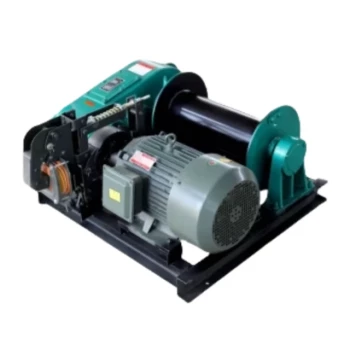
An electric winch is not just a motor attached to a drum. It's an integrated system designed to remove the variable of human exhaustion from a high-stakes equation.
- The Motor & Gearbox: This is the heart of the system, converting electrical energy into immense pulling force, doing in seconds what could take a person many minutes of strenuous labor.
- The Solenoid & Remote: This is the brain. The ability to operate the winch from a safe distance isn’t a luxury; it’s a critical safety feature. It changes your vantage point, allowing for better situational awareness and keeping you out of the direct line of a tensioned cable.
By automating the physical effort, an electric winch frees up the operator's cognitive capacity to focus on the task itself—guiding the load, monitoring the surroundings, and ensuring the safety of the entire operation.
Quantifying the Trade-Offs
The decision hinges on understanding both the obvious and the hidden costs. The initial price is just the beginning of the story.
| Feature | Manual Winch | Electric Winch |
|---|---|---|
| Primary Investment | Low (Financial Capital) | High (Financial Capital) |
| Operational Cost | High (Human Effort, Time, Fatigue) | Low (Minimal Physical Effort) |
| Speed & Power | Limited by operator strength | Consistently high, motor-driven |
| Best Use Case | Occasional, light-duty, budget-constrained tasks | Frequent, heavy-duty, professional operations |
| Psychological Load | High (Focus divided between effort and task) | Low (Focus is entirely on safe load management) |
For professional construction companies and contractors, the calculation is clear. While a manual winch saves money upfront, an electric winch saves time and reduces risk on every single job. That efficiency compounds. A task that takes 5 minutes instead of 30 frees up a worker for other critical duties. It means hitting deadlines and reducing the likelihood of fatigue-induced errors.
The Right Tool for the Right Mindset
Ultimately, the choice isn't about which winch is "better" in a vacuum. It's about aligning the tool with the demands of the work.
For a hobbyist pulling a small boat onto a trailer once a summer, the simplicity and low cost of a manual winch are perfectly logical. The investment of physical effort is minimal and infrequent.
But for a construction business like those served by GARLWAY, where equipment is a core part of daily operations, the mindset shifts. Winches aren't just tools; they are assets that directly impact productivity and safety. In this context, the power, speed, and remote-controlled safety of an electric winch are not expenses—they are investments in operational excellence.
Choosing the right equipment is the foundation of any successful project. To ensure your operations are built on a bedrock of power, safety, and efficiency, Contact Our Experts.
Visual Guide
Related Products
- Warn Winch Windlass Boat Trailer Winch
- Electric and Hydraulic Winch for Heavy Duty Applications
- Small Electric Winch 120V and 240V for Compact Applications
- 12000 lb Electric Boat Trailer Winch with Windlass Anchor Warn
- Quick Windlass Portable Winch for Truck and Boat Best Boat Winch
Related Articles
- Beyond the Bumper: The Critical System Choice in Powering Your Trailer Winch
- Force vs. Mass: The Critical Difference in Sizing a Boat Winch
- Lines of Force: The Unseen Geometry of a Boat Winch
- More Than a Number: The Engineering Psychology of Choosing a Boat Winch
- How to Choose and Optimize Winch Speed for Maximum Efficiency