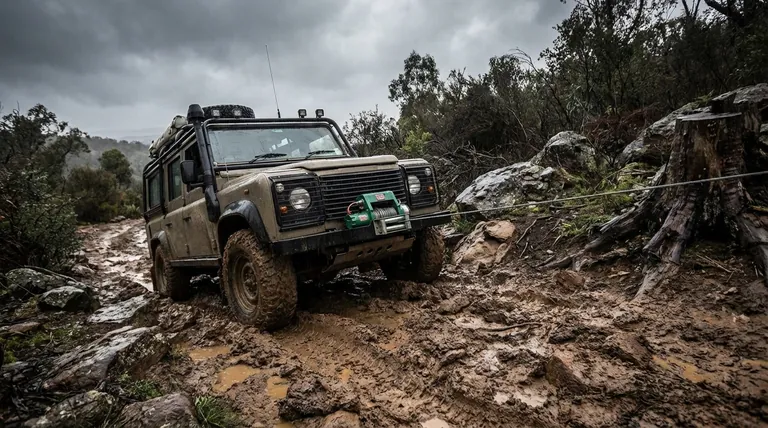
The Allure of a Simple Formula
There's a comforting certainty in formulas. In the world of vehicle recovery, the standard rule is to take your vehicle's Gross Vehicle Weight (GVW) and multiply it by 1.5. The result is your minimum winch capacity.
This calculation feels safe. It's easy to remember and simple to execute. But this psychological comfort hides a dangerous oversimplification. A winch doesn't pull your vehicle's spec sheet; it pulls against the stubborn, unpredictable forces of the real world.
The formula is a baseline for safety, nothing more. The true test of a winch is dictated not by the vehicle, but by the resistance of the environment it's stuck in.
A Winch Fights Resistance, Not Just Mass
Imagine a 10,000 lb vehicle, perfectly balanced on a flat, frictionless surface. A small motor could move it.
Now, imagine that same vehicle sunk to its axles in thick, wet mud on a 20-degree incline, with a wheel wedged against a fallen log.
The weight of the vehicle hasn't changed. But the force required to move it has multiplied exponentially. This is the critical distinction. Your winch isn't just pulling weight; it's fighting a collection of parasitic forces that want to keep you stuck.
Deconstructing the Forces of "Stuck"
To choose the right tool, you must first respect the problem. The forces working against your recovery efforts are layered and cumulative.
The Physics of Suction: The "Suck Factor"
Deep mud, snow, or wet sand creates a powerful vacuum effect around the tires and undercarriage. This "suck factor" can add thousands of pounds of resistance. It's the same force that makes it so difficult to pull your boot out of thick mud, scaled up to the size of a multi-ton machine.
It’s a force that is entirely invisible on a vehicle's specification sheet.
The Unforgiving Math of Gravity
Pulling a vehicle up an incline is a direct fight against gravity. The steeper the slope, the more of the vehicle's own weight the winch must overcome in addition to every other resistive force.
A steep grade can dramatically increase the effective load, pushing a winch rated by the simple 1.5x formula far beyond its operational limits.
The Drag of Obstacles and Damage
Resistance isn't always environmental. It can be mechanical.
- A vehicle wedged against a rock or log.
- Wheels that are damaged and refuse to turn.
- Axles buried in debris.
Each of these issues introduces immense drag. The winch must now overcome the vehicle's weight, environmental suction, the force of gravity, and the mechanical friction of a compromised machine.
The Cognitive Biases in Choosing a Winch
This brings us to two common decision-making errors, both rooted in a misunderstanding of risk.
The Peril of "Good Enough"
Choosing an undersized winch based on the simple GVW formula is a failure of foresight. It’s a bet that you will only ever get stuck in the most ideal conditions.
When an undersized winch overheats, its motor can fail. When its cable snaps under a load it was never meant to handle, the result is not just inconvenience; it's a catastrophic safety failure.
The Hidden Costs of "More is More"
The instinct to overcompensate by buying the largest possible winch also has drawbacks. An oversized winch adds significant weight to the front of a vehicle, negatively impacting suspension performance and handling.
Its higher power draw places immense strain on the vehicle’s electrical system. It's an inefficient solution born from fear, not from a precise understanding of the problem.
From Formula to Philosophy: A Practical Guide
The right winch isn't the one that meets a formula. It's the one that matches your reality. Your decision should be guided by your intended application.
- For occasional recovery in moderate conditions: The baseline
GVW x 1.5rule is a reliable and safe guideline. - For extreme off-roading or construction site recovery in deep mud, steep terrain, or unpredictable conditions: You need a greater margin of safety. Consider a capacity closer to
GVW x 2.0. - For specialized utility tasks like loading heavy equipment onto a trailer: The calculation changes entirely, needing to account for the object's weight plus the trailer's incline and rolling friction.
Summary of Forces
| Factor | Impact on Required Winch Capacity |
|---|---|
| Vehicle Weight (GVW) | The baseline for your calculation (GVW x 1.5) |
| Deep Mud / Sand | Can add thousands of pounds of suction |
| Steep Incline | Gravity multiplies the effective vehicle load |
| Obstacles / Damage | Adds significant mechanical drag |
Selecting the right winch is an engineering decision that requires a clear understanding of the forces at play. It demands an appreciation for the physics of the situation, ensuring your equipment is a solution, not another liability. At GARLWAY, we provide durable, high-performance winches for construction and recovery operations where failure is not an option. We understand the physics, and we build for the reality of the field.
To ensure your equipment is perfectly matched to the challenges you face, Contact Our Experts.
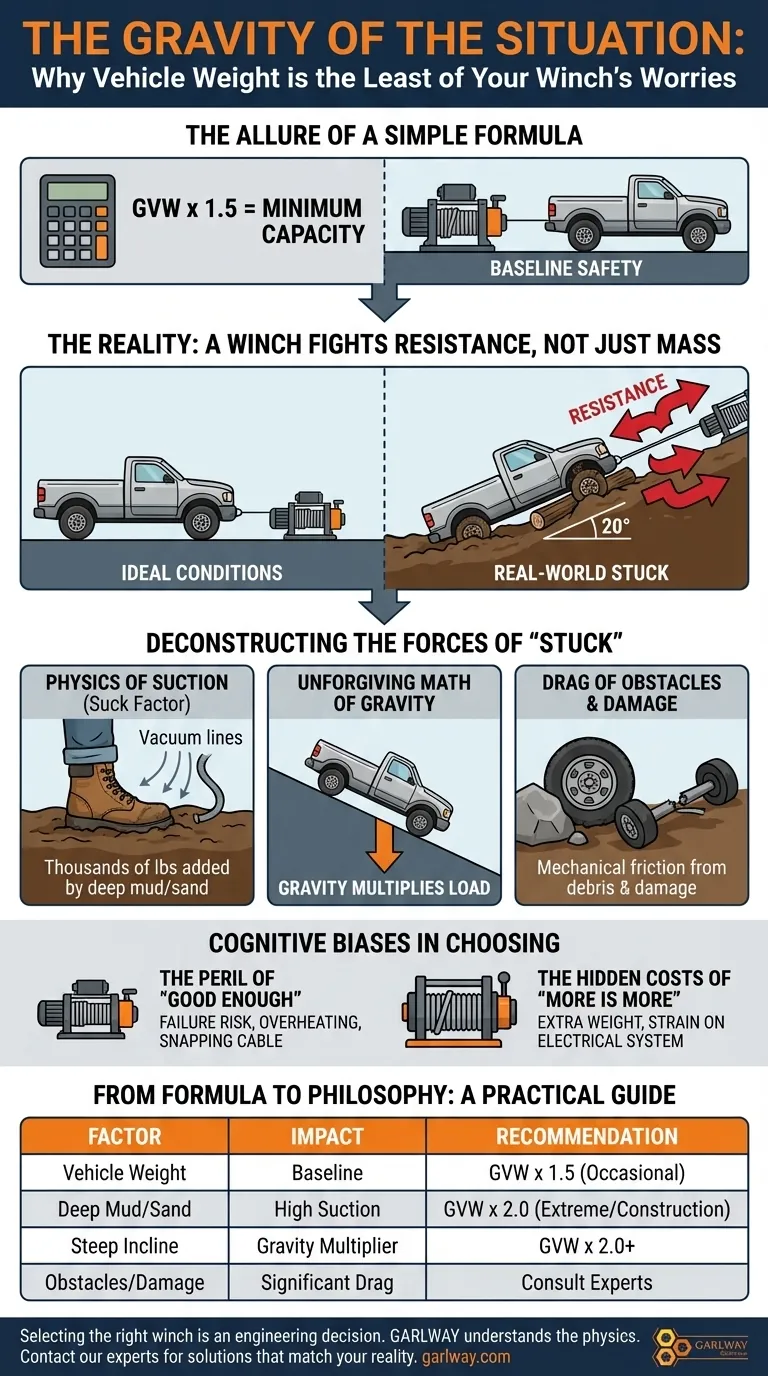
Visual Guide
Related Products
- Warn Winch Windlass Boat Trailer Winch
- Electric and Hydraulic Winch for Heavy Duty Applications
- Small Electric Winch 120V and 240V for Compact Applications
- Quick Windlass Portable Winch for Truck and Boat Best Boat Winch
- Hydraulic Winding Engine Harbor Freight Winch
Related Articles
- Beyond the Bumper: The Critical System Choice in Powering Your Trailer Winch
- Force vs. Mass: The Critical Difference in Sizing a Boat Winch
- Lines of Force: The Unseen Geometry of a Boat Winch
- More Than a Number: The Engineering Psychology of Choosing a Boat Winch
- How to Choose and Optimize Winch Speed for Maximum Efficiency





