The Moment of Truth Comes Before the Crisis
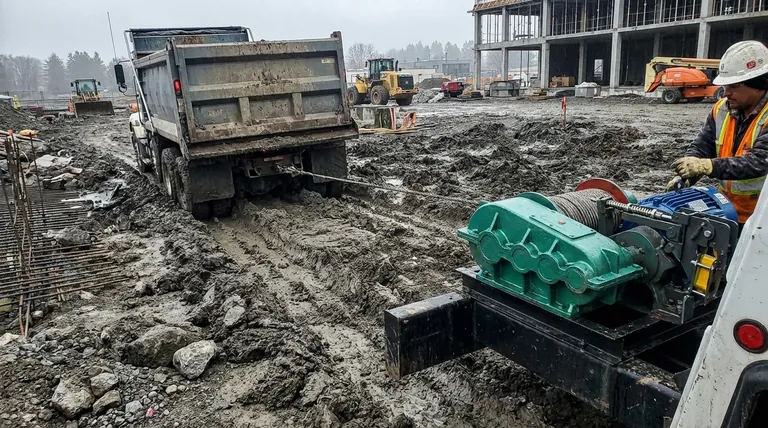
A loaded dump truck is axle-deep in mud on a remote construction site. Every minute it sits idle, the project schedule slips, and costs mount. The recovery vehicle arrives, its winch a promise of a quick solution.
But the success of that recovery wasn't determined in the mud. It was determined months earlier, in an office or a workshop, when someone made a calculated decision about which winch to purchase.
Choosing a winch is not about buying the most powerful model. It's a disciplined exercise in systems thinking—a sober assessment of weight, environment, and the psychology of risk.
The Foundation: Physics Over Brute Force
The single most important factor in winch selection is its rated capacity. The decision begins with a simple, non-negotiable formula.
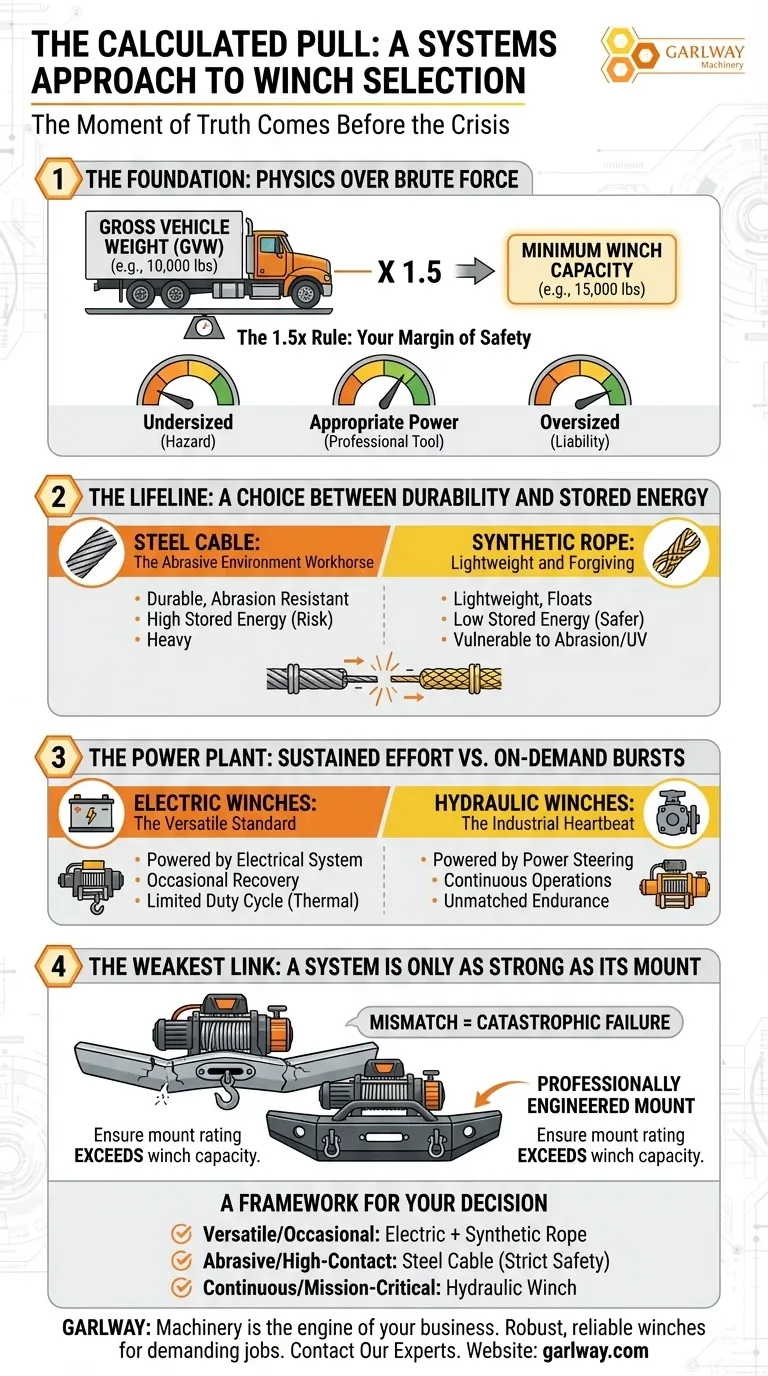
The 1.5x Rule: Your Margin of Safety
First, find your vehicle's Gross Vehicle Weight (GVW). This is the fully-loaded weight, including fuel, cargo, and equipment.
Then, multiply it by 1.5.
Gross Vehicle Weight (GVW) x 1.5 = Minimum Winch Capacity
A 10,000 lb construction vehicle requires a winch rated for at least 15,000 lbs. This multiplier isn't arbitrary; it's a crucial margin of safety. It accounts for the immense additional forces of suction from mud, the resistance of an incline, or the friction of dragging a dead weight.
The Cognitive Trap of "Bigger is Better"
There's a natural inclination to believe that more power is always the safer bet. This is a cognitive trap. A massively oversized winch adds hundreds of pounds of dead weight to the front of your vehicle, negatively impacting suspension, handling, and even braking.
The goal is not maximum power; it is appropriate power. An undersized winch is a hazard. An oversized one is a liability. An appropriately sized one is a professional tool.
The Lifeline: A Choice Between Durability and Stored Energy
The line connecting your winch to an anchor point is a vessel of immense force. Your choice between traditional steel and modern synthetic rope is fundamentally a decision about how you want to manage that energy.
Steel Cable: The Abrasive Environment Workhorse
On a construction site littered with rebar, sharp rocks, and debris, steel wire rope is the traditional choice. It is exceptionally durable and highly resistant to abrasion.
However, it is heavy and unforgiving. Its most critical characteristic is the vast amount of kinetic energy it stores under load. If it snaps, it becomes a lethal projectile. Using steel requires strict safety protocols and an acceptance of this inherent risk.
Synthetic Rope: Lightweight and Forgiving
Synthetic rope is a modern marvel of material science. It is dramatically lighter than steel—often light enough to float—making it easier and safer to handle.
Its greatest advantage is safety. If it fails, it releases far less kinetic energy, falling to the ground rather than whipping through the air. For many, this safety margin is non-negotiable. The trade-offs are a higher initial cost and a vulnerability to abrasion and UV damage, demanding more diligent inspection and care.
The Power Plant: Sustained Effort vs. On-Demand Bursts
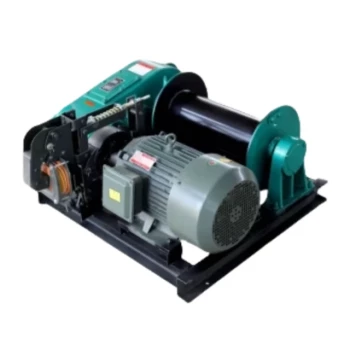
The motor is the heart of the winch. The choice between electric and hydraulic power is a choice about your operational tempo and reliability needs.
Electric Winches: The Versatile Standard
Powered by the vehicle's electrical system, electric winches are the common choice for their versatility and ease of installation. They are perfect for the short, intense pulls characteristic of occasional recovery.
Their limitation is thermal. Under a long, heavy load, they generate significant heat and can tax the vehicle's battery and alternator, sometimes requiring rest periods to cool down.
Hydraulic Winches: The Industrial Heartbeat
Hydraulic winches are the choice for professionals whose business relies on uptime. Tapping into the vehicle's power steering pump, they can run continuously as long as the engine is running, without the risk of overheating.
For commercial, industrial, or heavy construction applications where long, consistent pulls are the norm, a hydraulic winch isn't a luxury; it's an operational necessity. Their reliability and endurance are unmatched.
The Weakest Link: A System is Only as Strong as its Mount
A 20,000 lb winch is useless if it's bolted to a bumper that can only withstand 8,000 lbs of force. The winch, the rope, and the motor are only components in a larger recovery system.
The winch mount or bumper is the foundation of that system. Ensure it is professionally engineered and rated to handle forces exceeding the maximum pull of your winch. A mismatch here is a catastrophic failure waiting to happen.
A Framework for Your Decision
Ultimately, the right winch is a reflection of your operational reality.
- For Versatile & Occasional Use: An electric winch sized according to the 1.5x rule, equipped with a synthetic rope, offers the best balance of performance and safety.
- For Abrasive, High-Contact Environments: A steel cable may offer superior durability, but it demands uncompromising safety discipline.
- For Continuous, Mission-Critical Operations: A hydraulic winch provides the unmatched reliability and duty cycle required for industrial and heavy construction work.
At GARLWAY, we understand that for construction companies and contractors, machinery is not a hobby—it's the engine of your business. We provide robust, reliable winches and batching plants designed for the demanding realities of the job site.
To ensure your recovery system is a reliable asset, not a potential liability, it pays to consult with people who understand the physics and the stakes. Contact Our Experts
Visual Guide
Related Products
- Warn Winch Windlass Boat Trailer Winch
- Electric and Hydraulic Winch for Heavy Duty Applications
- Small Electric Winch 120V and 240V for Compact Applications
- Hydraulic Winding Engine Harbor Freight Winch
- Quick Windlass Portable Winch for Truck and Boat Best Boat Winch
Related Articles
- Beyond the Bumper: The Critical System Choice in Powering Your Trailer Winch
- Force vs. Mass: The Critical Difference in Sizing a Boat Winch
- Lines of Force: The Unseen Geometry of a Boat Winch
- More Than a Number: The Engineering Psychology of Choosing a Boat Winch
- How to Choose and Optimize Winch Speed for Maximum Efficiency