The Weight of a Bad Decision
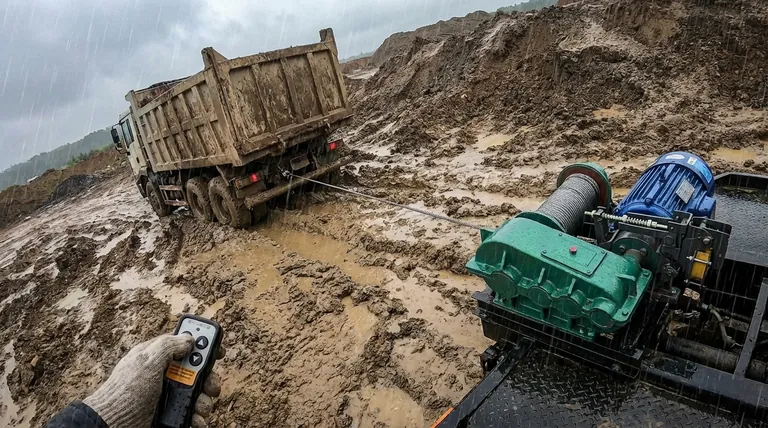
Imagine a loaded dump truck, axles swallowed by the mud of a rain-soaked construction site. The project deadline looms. Every minute of delay costs money and credibility. In this moment, the electric winch mounted on your recovery vehicle isn't just a tool; it's the fulcrum on which the entire day's success pivots.
This isn't a hypothetical. It's a scenario where physics and human psychology collide. Choosing the right winch is less about a simple calculation and more about a sober assessment of a future crisis.
The Illusion of a Simple Formula
The industry standard for selecting a winch is beautifully simple:
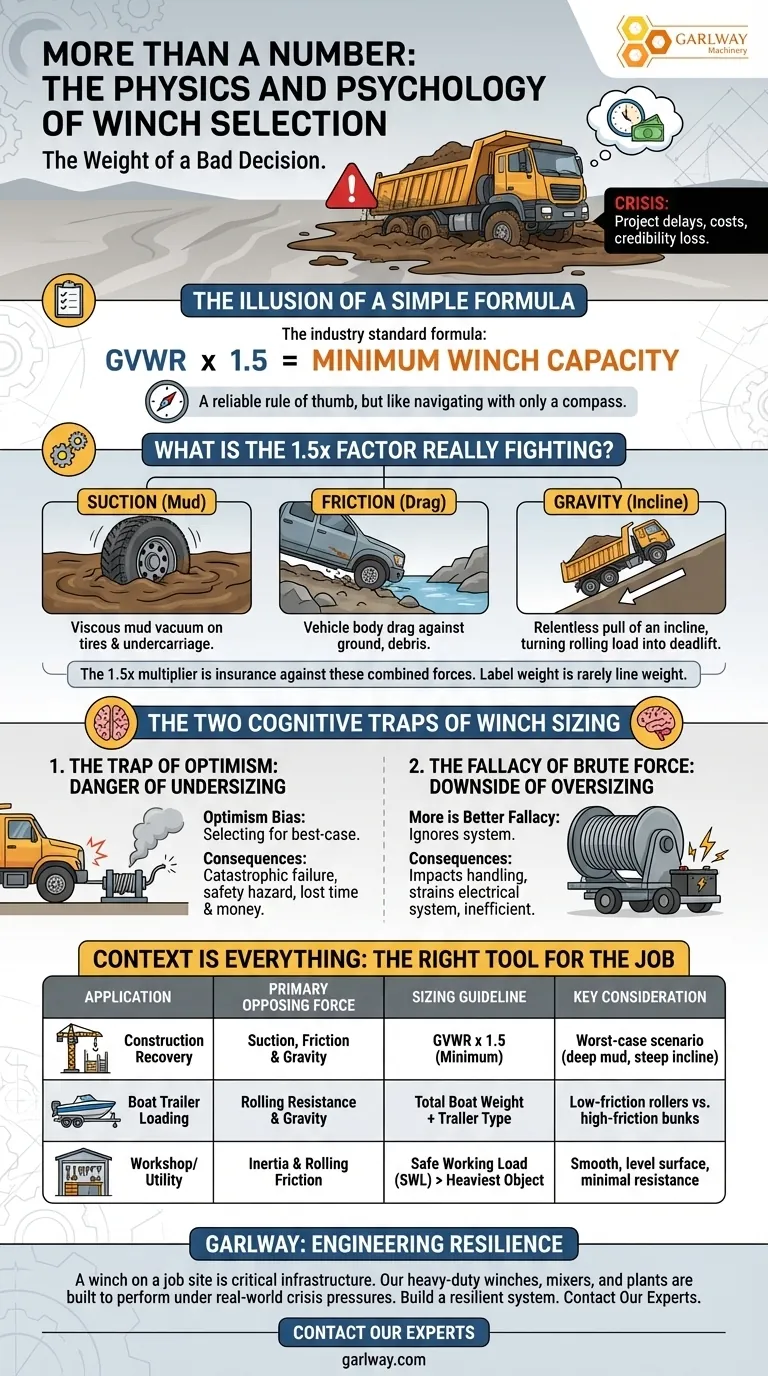
Gross Vehicle Weight Rating (GVWR) x 1.5 = Minimum Winch Capacity
This formula is the bedrock of safe winch selection. It provides a crucial buffer, a nod to the fact that you're never just pulling a vehicle's static weight. It’s a reliable rule of thumb that gives us a sense of control.
But relying on it blindly is like navigating with only a compass and no map. It tells you a direction, but not what lies in the terrain ahead.
What Is the 1.5x Factor Really Fighting?
That "safety factor" is an engineer's humble admission that the real world is messy. It's a single number meant to represent a host of complex, invisible forces that turn a simple pull into a battle against physics.
Your winch isn't just pulling a 5-ton truck. It's fighting:
- Suction: The thick, viscous mud that creates a powerful vacuum on the tires and undercarriage.
- Friction: The drag of the vehicle's body against the ground, debris, or water.
- Gravity: The relentless pull of an incline, which can turn a rolling load into a deadlift.
The 1.5x multiplier is your insurance policy against these combined forces. It acknowledges that the weight on the label is rarely the weight on the line.
The Two Cognitive Traps of Winch Sizing
Choosing a winch capacity is an exercise in risk management, and our brains are notoriously prone to certain biases when assessing risk.
1. The Trap of Optimism: The Danger of Undersizing
It's tempting to think, "I'll probably never get that stuck." This is optimism bias. It leads to selecting a winch that can handle the best-case scenario, not the worst.
An undersized winch under extreme load doesn't just fail; it fails catastrophically. The motor overheats, components strain, and the line can snap. This isn't just an equipment failure; it's a project failure and a serious safety hazard. The initial cost saving evaporates in a cloud of lost time, repair bills, and potential injury.
2. The Fallacy of Brute Force: The Downside of Oversizing
The opposite reaction is to assume more is always better. While safer than undersizing, a dramatically oversized winch carries its own penalties.
It's a solution that ignores the system as a whole. This massive tool adds significant weight to the front of a vehicle, impacting suspension and handling. Its power demands a more robust electrical system, drawing huge amperage that can tax batteries and alternators. It's inefficient, like using a sledgehammer to crack a nut.
Context is Everything: The Right Tool for the Job
The right mental model for choosing a winch depends entirely on the task. The forces at play change with the environment.
| Application | Primary Opposing Force | Sizing Guideline | Key Consideration |
|---|---|---|---|
| Construction Recovery | Suction, Friction & Gravity | GVWR x 1.5 (Minimum) | Worst-case scenario (deep mud, steep incline) |
| Boat Trailer Loading | Rolling Resistance & Gravity | Total Boat Weight + Trailer Type | Are you fighting low-friction rollers or high-friction bunks? |
| Workshop/Utility | Inertia & Rolling Friction | Safe Working Load (SWL) > Heaviest Object | Assumes a smooth, level surface with minimal resistance. |
A winch powerful enough to pull a loader from a ditch is overkill for pulling a boat onto a trailer. The physics of the problem are different. The former is a dead-weight recovery against immense resistance; the latter is overcoming rolling friction on a controlled incline.
At GARLWAY, we engineer machinery for the demanding world of construction. We understand that a winch on a job site isn't a recreational accessory; it's a critical piece of operational infrastructure. Our range of heavy-duty electric winches, concrete mixers, and batching plants are built not just to meet a specification, but to perform reliably under the pressures of a real-world crisis.
Choosing the right equipment isn't just about matching numbers. It's about building a resilient system that won't fail when you need it most. Let our experience guide you. Contact Our Experts
Visual Guide
Related Products
- Warn Winch Windlass Boat Trailer Winch
- Electric and Hydraulic Winch for Heavy Duty Applications
- Small Electric Winch 120V and 240V for Compact Applications
- 12000 lb Electric Boat Trailer Winch with Windlass Anchor Warn
- Quick Windlass Portable Winch for Truck and Boat Best Boat Winch
Related Articles
- Beyond the Bumper: The Critical System Choice in Powering Your Trailer Winch
- Force vs. Mass: The Critical Difference in Sizing a Boat Winch
- Lines of Force: The Unseen Geometry of a Boat Winch
- More Than a Number: The Engineering Psychology of Choosing a Boat Winch
- How to Choose and Optimize Winch Speed for Maximum Efficiency