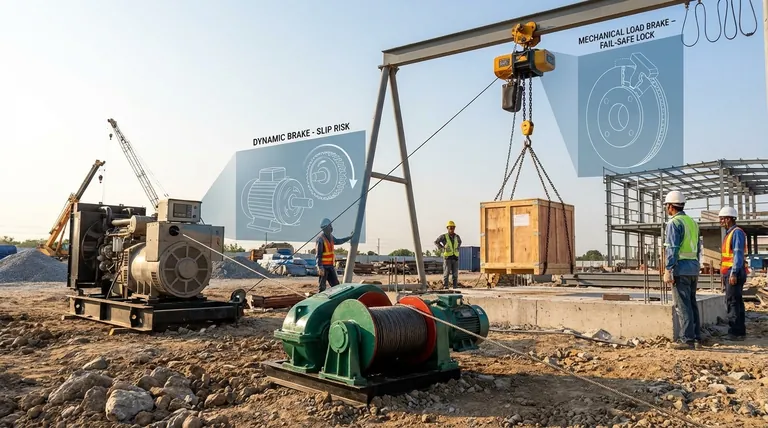
The Illusion of Similarity
On a busy construction site, an electric winch and an electric hoist can look deceptively similar. Both have a motor, a drum, and a steel cable. Both are designed to move heavy things. This apparent similarity creates a dangerous cognitive trap: the assumption that they are interchangeable.
We are wired to use the tool that is most available. If a winch is mounted on the truck and you need to lift a load a few feet, the temptation is to use it. But this isn't a matter of convenience. It's a matter of physics and design philosophy. The most important difference between these tools is not what they do, but how they are designed to fail.
A Tale of Two Philosophies: Horizontal Force vs. Vertical Trust
The purpose of a tool shapes every aspect of its design. To understand the winch and the hoist, you have to understand the fundamentally different problems they were built to solve.
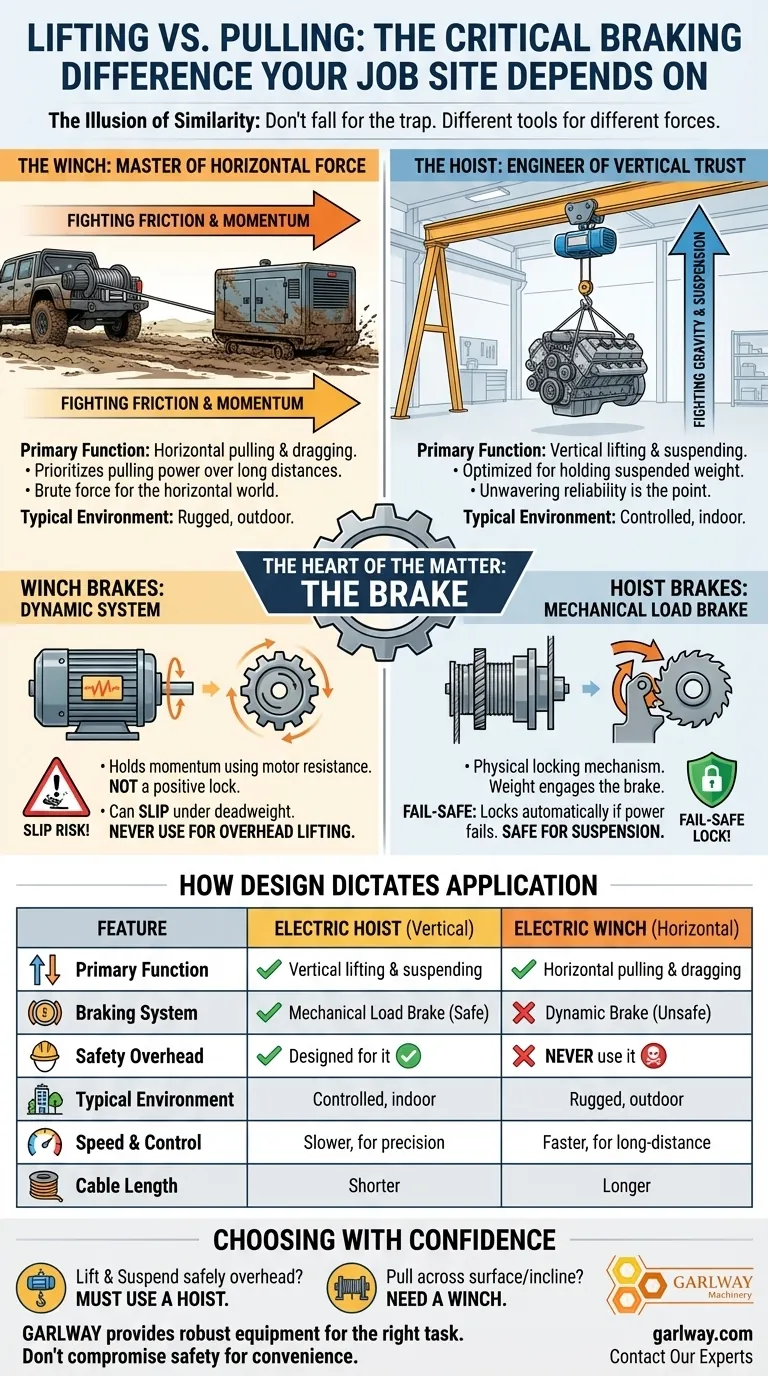
The Winch: A Master of Horizontal Force
A winch is designed to wage a war against friction. Its job is to pull a load across a surface, whether it's dragging a generator across uneven ground, pulling a vehicle from the mud, or moving heavy materials up an incline.
Its engineering prioritizes pulling power, often over long distances. It is a machine of brute force and endurance, built to conquer the horizontal world.
The Hoist: An Engineer of Vertical Trust
A hoist, by contrast, is locked in a constant, quiet battle with gravity. Its sole purpose is to lift a load, suspend it securely overhead, and lower it with precision.
Its entire being is optimized for this vertical responsibility. Think of workshops, warehouses, and assembly lines. In these environments, the absolute, unwavering reliability to hold a suspended weight is not a feature—it is the entire point.
The Heart of the Matter: The Brake
If you remember only one thing, let it be this: the defining difference between a winch and a hoist is the brake. This is not a minor detail; it is the system that separates safe operation from catastrophic failure.
Winch Brakes: Designed to Hold Momentum
Winches typically use a dynamic braking system. This system cleverly uses the resistance of the motor itself to slow down and hold the load. It’s effective for managing the momentum of a rolling object, like a vehicle on a slope.
However, a dynamic brake is not a positive lock. It was never designed to suspend a "deadweight" load against the direct, relentless pull of gravity. Under that specific strain, it can slip. That slip can be disastrous.
Hoist Brakes: Engineered for Fail-Safe Suspension
Hoists employ a mechanical load brake. This is a fundamentally different concept. It's a physical locking mechanism, often designed so that the weight of the load itself helps to engage the brake more securely.
It is a true fail-safe. If power is cut or the motor fails, the brake automatically locks, preventing the load from falling. This design principle—assuming failure and building in a physical lock—is what makes it safe to stand under a load suspended by a hoist.
How Design Dictates Application
The core differences in philosophy and braking mechanics create practical distinctions in how these tools are built and used.
| Feature | Electric Hoist | Electric Winch |
|---|---|---|
| Primary Function | Vertical lifting & suspending | Horizontal pulling & dragging |
| Braking System | Mechanical Load Brake (Safe for suspension) | Dynamic Brake (Unsafe for suspension) |
| Safety Overhead | Designed for it | Never use it |
| Typical Environment | Controlled, indoor | Rugged, outdoor |
| Speed & Control | Slower, for precision | Faster, for long-distance pulling |
| Cable Length | Shorter, for fixed lift heights | Longer, for extended reach |
The High Cost of Misunderstanding
Using a winch as a makeshift hoist is one of the most dangerous mistakes one can make on a job site. It's not "making do"; it's ignoring the fundamental laws of mechanical safety. The dynamic brake is simply not rated to hold a suspended load. The risk of slippage and dropped loads is unacceptably high, threatening equipment, property, and human lives.
Conversely, using a hoist for a pulling task is not dangerous, but it is deeply inefficient. Its slow speed, short cable, and design for vertical lifts make it the wrong tool for any horizontal application.
Choosing with Confidence
The right choice begins with a clear understanding of your objective. The question is simple:
- Is your primary goal to lift something and suspend it safely overhead? You must use a hoist.
- Is your primary goal to pull something across a surface or up an incline? You need a winch.
On complex construction projects, efficiency and safety are paramount. Equipping your teams with the right tool for the job isn't an expense; it's an investment in productivity and risk mitigation. GARLWAY provides robust electric winches and other construction machinery engineered for the demanding environments contractors face globally. We ensure you have the right equipment, designed for the right task.
Understanding the deep engineering principles behind your tools is the first step to a safer, more effective worksite. If you are unsure which solution best fits your project's needs, Contact Our Experts.
Visual Guide
Related Products
- Warn Winch Windlass Boat Trailer Winch
- Electric and Hydraulic Winch for Heavy Duty Applications
- Small Electric Winch 120V and 240V for Compact Applications
- 12000 lb Electric Boat Trailer Winch with Windlass Anchor Warn
- Quick Windlass Portable Winch for Truck and Boat Best Boat Winch
Related Articles
- Beyond the Bumper: The Critical System Choice in Powering Your Trailer Winch
- Force vs. Mass: The Critical Difference in Sizing a Boat Winch
- Lines of Force: The Unseen Geometry of a Boat Winch
- More Than a Number: The Engineering Psychology of Choosing a Boat Winch
- How to Choose and Optimize Winch Speed for Maximum Efficiency





