Selecting the right winch isn’t just about pulling power—it’s about aligning technical capabilities with real-world demands. Whether you’re configuring marine deck systems or retrofitting mining haulage equipment, understanding load dynamics, environmental stressors, and duty cycles ensures optimal performance and safety. This guide translates operational scenarios into precise technical requirements, backed by industry standards and practical case studies.
Key Factors in Working Condition Analysis
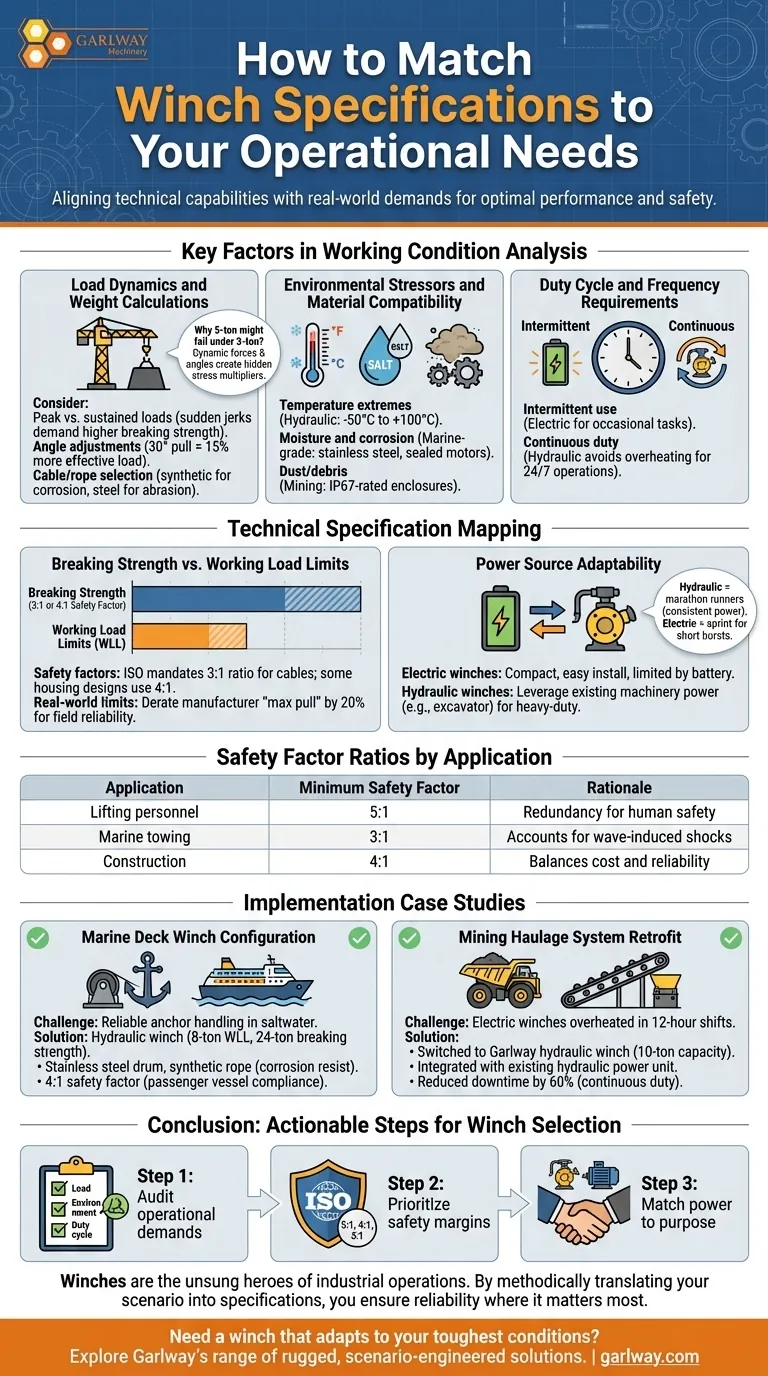
Load Dynamics and Weight Calculations
Winches must handle more than static weights. Consider:
- Peak vs. sustained loads: Sudden jerks (e.g., recovering stuck vehicles) demand higher breaking strength than steady lifts.
- Angle adjustments: A 30° pull angle increases effective load by 15%—factor this into working load limits (WLL).
- Cable/rope selection: Synthetic ropes excel in corrosion-prone environments, while steel cables withstand abrasion in mining.
Ever wondered why a 5-ton winch might fail under a 3-ton load? Dynamic forces and angles often create hidden stress multipliers.
Environmental Stressors and Material Compatibility
- Temperature extremes: Hydraulic winches (operating from -50°C to +100°C) outperform electric models in Arctic or foundry settings.
- Moisture and corrosion: Marine-grade winches need stainless steel components and sealed motors.
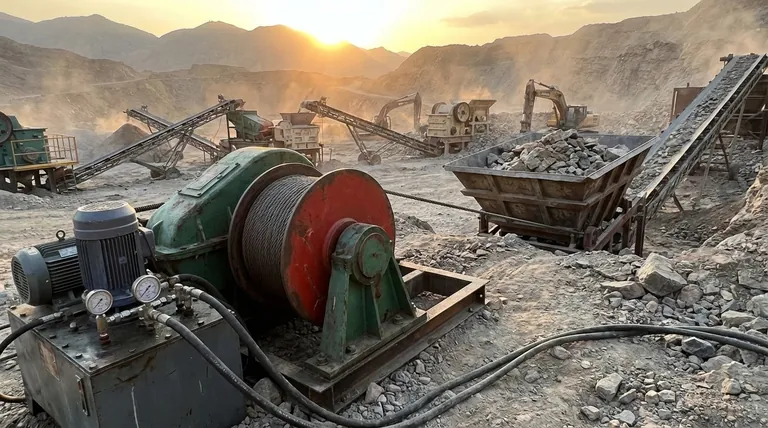
- Dust/debris: Mining applications require IP67-rated enclosures to prevent particulate ingress.
Duty Cycle and Frequency Requirements
Match winch type to usage patterns:
- Intermittent use: Electric winches suffice for occasional recovery tasks.
- Continuous duty: Hydraulic systems avoid overheating in 24/7 operations like conveyor belt tensioning.
Technical Specification Mapping
Breaking Strength vs. Working Load Limits
- Safety factors: ISO mandates a 3:1 ratio (breaking strength to WLL) for cables; some housing designs use 4:1.
- Real-world limits: Manufacturer "max pull" ratings often assume ideal conditions—derate by 20% for field reliability.
Power Source Adaptability
- Electric winches: Compact and easy to install but limited by battery capacity.
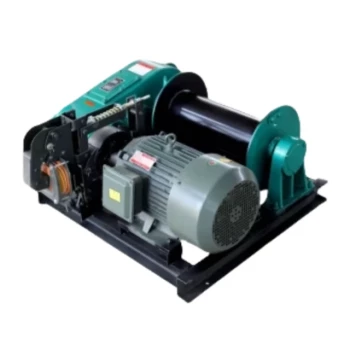
- Hydraulic winches: Leverage existing machinery power (e.g., excavator hydraulic circuits) for heavy-duty tasks.
Think of hydraulic winches as marathon runners—consistent power over long durations—while electric models sprint for short bursts.
Safety Factor Ratios by Application
| Application | Minimum Safety Factor | Rationale |
|---|---|---|
| Lifting personnel | 5:1 | Redundancy for human safety |
| Marine towing | 3:1 | Accounts for wave-induced shocks |
| Construction | 4:1 | Balances cost and reliability |
Implementation Case Studies
Marine Deck Winch Configuration
Challenge: A ferry needed reliable anchor handling in saltwater.
Solution:
- Hydraulic winch with 8-ton WLL (24-ton breaking strength).
- Stainless steel drum and synthetic rope to resist corrosion.
- 4:1 safety factor for passenger vessel compliance.
Mining Haulage System Retrofit
Challenge: Electric winches overheated during 12-hour shifts.
Solution:
- Switched to a Garlway hydraulic winch with 10-ton capacity.
- Integrated with the site’s existing hydraulic power unit.
- Reduced downtime by 60% with continuous duty capability.
Conclusion: Actionable Steps for Winch Selection
- Audit operational demands: Map load peaks, environmental hazards, and duty cycles.
- Prioritize safety margins: Never compromise on ISO safety factors.
- Match power to purpose: Hydraulic for endurance, electric for simplicity.
Winches are the unsung heroes of industrial operations—tools that move mountains, secure vessels, and keep workers safe. By methodically translating your scenario into specifications, you ensure reliability where it matters most.
Need a winch that adapts to your toughest conditions? Explore Garlway’s range of rugged, scenario-engineered solutions.
Visual Guide
Related Products
- Warn Winch Windlass Boat Trailer Winch
- Electric and Hydraulic Winch for Heavy Duty Applications
- Small Electric Winch 120V and 240V for Compact Applications
- Quick Windlass Portable Winch for Truck and Boat Best Boat Winch
- Hydraulic Winding Engine Harbor Freight Winch
Related Articles
- Beyond the Bumper: The Critical System Choice in Powering Your Trailer Winch
- Force vs. Mass: The Critical Difference in Sizing a Boat Winch
- Lines of Force: The Unseen Geometry of a Boat Winch
- More Than a Number: The Engineering Psychology of Choosing a Boat Winch
- How to Choose and Optimize Winch Speed for Maximum Efficiency