When your work demands heavy lifting, towing, or precise load management, selecting the right trailer-mounted winch isn’t just about power—it’s about matching technology to your specific challenges. Whether you’re in logging, marine operations, or construction, the wrong choice can lead to inefficiencies, safety risks, or even equipment failure. This guide breaks down the key winch types, their ideal applications, and practical criteria to help you make an informed decision.
Trailer-Mounted Winch Types Explained
Twin Bull-Wheel Winches: Power and Versatility
Twin bull-wheel winches excel in high-torque scenarios like off-road recovery and logging. Their dual-wheel design distributes load evenly, reducing wear on cables and providing consistent pulling power. Unlike single-drum systems, they handle irregular loads (e.g., fallen trees or stuck vehicles) with minimal slippage.
Best for:
- Heavy-duty towing
- Uneven terrain recovery
- Industries requiring variable load management
Ever wondered how rescue teams extract vehicles from mud pits? Twin bull-wheels provide the grip needed without overloading the system.
Drum Winches: Precision and Compact Design
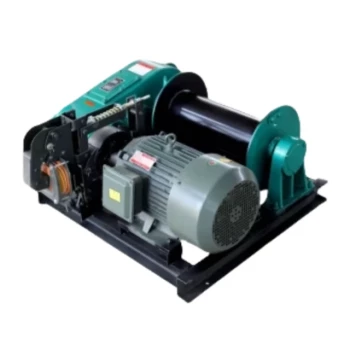
Drum winches wind cables or ropes onto a rotating cylinder, offering controlled, incremental movement. Their compact size suits confined spaces, while mechanical braking systems enhance safety for precise lifts.
Best for:
- Construction sites (e.g., lifting steel beams)
- Scenarios requiring measured cable deployment
- Light- to medium-duty applications
Capstan Winches: Marine and Heavy-Duty Specialization
Capstan winches use a rotating spindle to grip ropes without storing them, making them ideal for marine environments or block-and-tackle setups. Key advantages include:
- Unlimited rope length: Unlike drum winches, capstans accommodate any rope length, critical for deep-water anchoring.
- Safety: Ropes reduce injury risks if snapped, and operators control tension manually, standing clear of the pull line.
- Constant power: No force reduction from cable accumulation.
Best for:
- Marine towing and mooring
- Heavy industrial pulling (e.g., pipeline installation)
Key Selection Criteria for Your Needs
Matching Winch Capacity to Load Requirements
Calculate your peak load weight (including safety margins) and choose a winch with at least 1.5x that capacity. Overloading strains components, while underutilization wastes fuel and efficiency.
Fuel Efficiency vs. Torque: Petrol or Diesel?
- Petrol winches: Lighter, quieter, and better for intermittent use (e.g., recovery operations).
- Diesel winches: Higher torque and fuel economy for continuous heavy loads (e.g., construction sites).
Industry-Specific Applications
- Logging: Twin bull-wheels handle unpredictable loads and rough terrain.
- Marine: Capstan winches resist corrosion and manage dynamic water forces.
- Construction: Drum winches offer precision for vertical lifts, but ensure they meet safety standards to avoid compromising structural crumple zones.
Did you know? The Empire State Building’s construction relied heavily on winches to lift steel beams—proof of their enduring role in large-scale projects.
Real-World Insights and Best Practices
Case Study: Off-Road Recovery with Twin Bull-Wheel Winches
A forestry team in Oregon reduced vehicle recovery time by 40% after switching to twin bull-wheel winches. The system’s even load distribution prevented cable snap incidents during steep-slope recoveries.
Maintenance Tips to Extend Winch Lifespan
- Lubricate moving parts monthly to prevent rust and friction damage.
- Inspect cables/ropes for fraying, especially in saltwater environments.
- Store under cover when idle to protect from UV and moisture.
Conclusion: Actionable Advice for Your Winch Investment
- Define your primary use case (e.g., marine towing vs. construction lifts).
- Prioritize safety features like manual tension control or corrosion resistance.
- Consult industry benchmarks—tools like Garlway’s winch lineup are engineered for these specialized demands.
Whether you’re anchoring a ship or lifting beams skyward, the right winch transforms brute force into reliable, measurable results. Choose wisely, and your equipment will repay you with years of dependable service.
Related Products
- Warn Winch Windlass Boat Trailer Winch
- 12000 lb Electric Boat Trailer Winch with Windlass Anchor Warn
- Best 18000 Pound Drum Anchor Trailer Winch
- Portable Small Trailer Winch
- Electric and Hydraulic Winch for Heavy Duty Applications
Related Articles
- Beyond the Bumper: The Critical System Choice in Powering Your Trailer Winch
- Force vs. Mass: The Critical Difference in Sizing a Boat Winch
- Lines of Force: The Unseen Geometry of a Boat Winch
- More Than a Number: The Engineering Psychology of Choosing a Boat Winch
- How to Choose and Optimize Winch Speed for Maximum Efficiency