The Conversation Before the Lift
Every time a hoist lifts a load, it's asking a question of physics. The answer is either a successful lift or a catastrophic failure.
The pre-use inspection is the operator's chance to check the math beforehand. It's not a bureaucratic ritual; it's a focused, hands-on dialogue with the machine. You are looking for the small whispers that precede a loud, sudden break.
This process transforms a simple checklist from a piece of paper into the most critical safety tool on the job site.
Reading the Language of Steel: The Load Path
The integrity of a lift depends entirely on an unbroken chain of components, from the hoist body to the load itself. This "load path" is where the most immense forces are concentrated.
The Hook: A Study in Stress Concentration
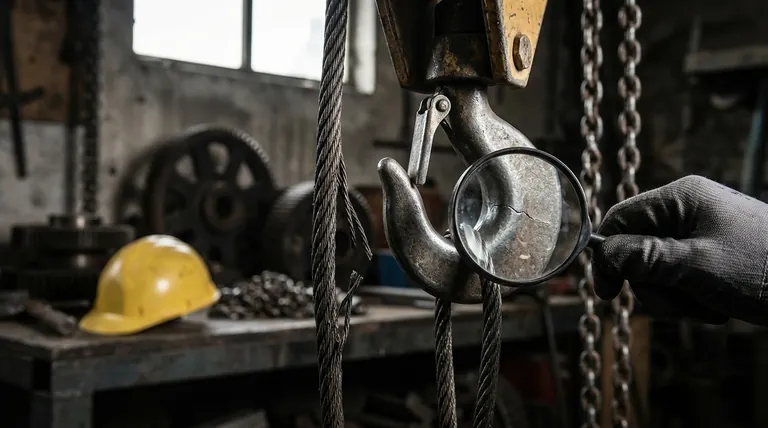
The first component to interrogate is the hook. Your eyes and hands are looking for anything that disrupts the smooth continuity of the metal.
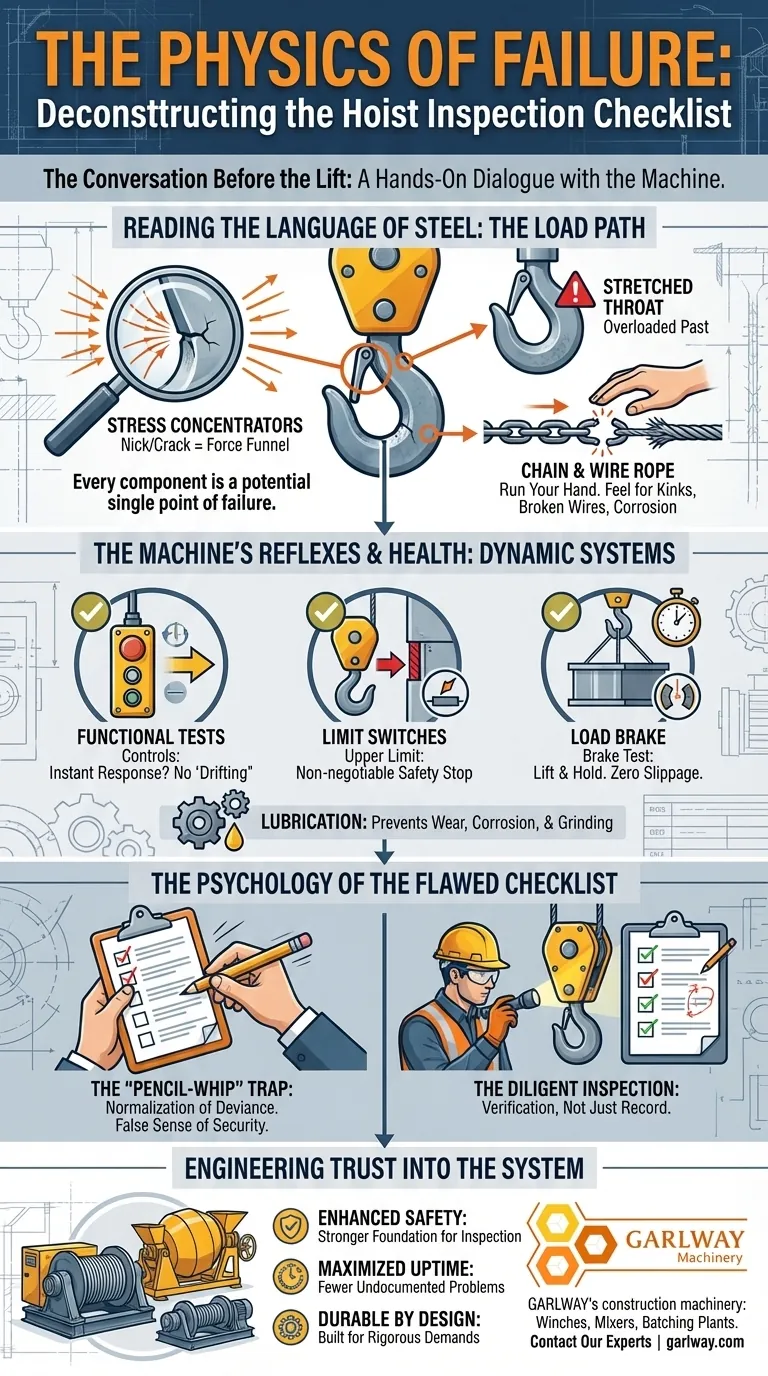
A nick, a gouge, or a small crack is not a cosmetic flaw. In the world of material science, it's a stress concentrator. Under load, all the force that should be distributed across the hook's body funnels into that one tiny weak point. It's how a microscopic flaw can initiate a complete fracture.
You must also check for a stretched throat opening. This is the hook's silent confession that it has been overloaded in the past. It’s a warning that its structural integrity is already compromised.
The Chain or Wire Rope: A Series of Single Points of Failure
A chain is a sequence of individual links, and a wire rope is a weave of individual strands. Each one is a potential point of failure.
Run your hand along its length (with appropriate PPE). You're feeling for kinks, broken wires, corrosion, or wear. Each defect is a chapter in the equipment's operational story, and you must decide if that story is about to have a very bad ending.
The Machine's Reflexes and Health
Beyond the static load path, you have to test the hoist's dynamic systems—its ability to respond to your commands safely and predictably.
Functional Tests: The Final Verification
This is the live-fire exercise before the real work begins.
- Controls: Do they respond instantly? Any delay or "drifting" after you release the button is a sign of a problem in the control system or the brake.
- Limit Switches: The upper limit switch is a non-negotiable safety feature. It prevents the hook block from colliding with the hoist body. You must test it. It's the only thing that stops a moment of inattention from becoming a major equipment failure.
- Load Brake: This is the most crucial test. Lift the load just a few inches and hold. The brake must hold it firm, with zero slippage. A slipping brake is an uncontrolled descent waiting to happen.
Lubrication: The Difference Between Smooth and Seized
Proper lubrication is the lifeblood of any mechanical system. A dry, gritty chain or rope isn't just noisy; it's actively grinding itself into a weakened state. Insufficient lubrication accelerates wear and invites corrosion, shortening the equipment's lifespan and compromising its safety.
The Psychology of the Flawed Checklist
The biggest risk in this process isn't a faulty component; it's a faulty mindset. The assumption that everything is fine is the most common precursor to an accident.
The "Pencil-Whip" Trap
Simply ticking boxes without performing a physical, hands-on check creates a false sense of security. This is the normalization of deviance. It's a cognitive bias where we slowly lower our standards over time, accepting small risks until they accumulate into a disaster.
The checklist isn't the task. The inspection is the task. The checklist is merely the record.
Engineering Trust into the System
An operator's diligence is the final line of defense. But the reliability of that defense is profoundly influenced by the quality of the equipment they are inspecting. When equipment is engineered for durability and safety from the ground up, the inspection becomes a process of verification, not a hunt for inevitable defects.
This is the principle behind GARLWAY's construction machinery. We provide winches, mixers, and batching plants designed for the rigorous demands of the modern job site.
- Enhanced Safety: Our equipment is built with robust safety features, providing a stronger foundation for your inspection protocols.
- Maximized Uptime: Reliable performance means fewer undocumented "operational problems" for the next operator to discover.
- Durable by Design: We build machinery that withstands the stresses of heavy use, ensuring that a thorough inspection confirms readiness, not reveals a hidden weakness.
A diligent inspection process paired with reliable equipment creates a system of safety that protects both people and projects. Don't let your first line of defense be your only one.
Visual Guide
Related Products
- Electric Hoist Winch Boat Anchor Windlass for Marine Applications
- Electric and Hydraulic Winch for Heavy Duty Applications
- Hydraulic Winding Engine Harbor Freight Winch
- Portable Cement Mixer with Lift Concrete Machine
- 12000 lb Electric Boat Trailer Winch with Windlass Anchor Warn
Related Articles
- How Boat Anchor Winches Prevent Injuries and Enhance Marine Safety
- Why Boat Anchor Winches Earn "Best Accessory" Status: A Deep Dive into User Satisfaction Drivers
- How to Install a Hoist Winch Safely: Avoiding Critical Mistakes
- How to Debug Hoist Winches Safely: Electrical Checks & Mechanical Adjustments
- How to Optimize Hoist Winch Safety: A Systematic Protocol for Accident Prevention