The Allure of a Simple Machine
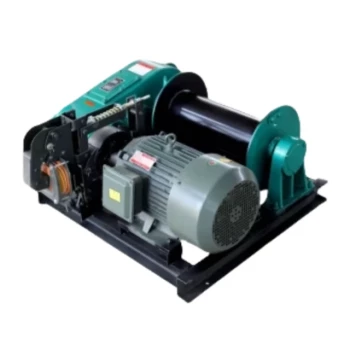
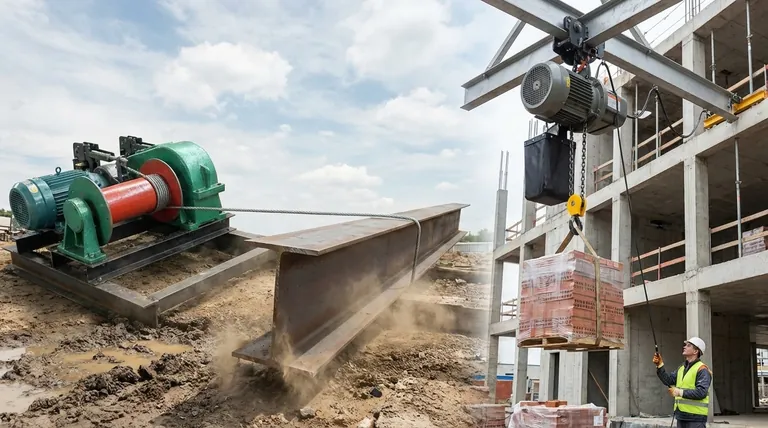
Imagine a construction site. A heavy steel beam needs to be moved into position. On the back of the site truck sits a powerful winch, its steel cable gleaming. The temptation is immense: it’s right there, it has the power, and it looks almost identical to a hoist.
This is a common scene, and it's rooted in a simple cognitive error: we assume that tools that look similar must function similarly. But in the world of heavy machinery, this assumption is a blueprint for disaster. The functional gap between a winch and a hoist is not a small detail—it's a chasm defined by a single, critical purpose.
A Tale of Two Forces: Pulling vs. Lifting
The DNA of a machine is dictated by the problem it was born to solve. For winches and hoists, those problems are fundamentally different forces of nature.
The Winch: A Master of Horizontal Force
A winch lives in a world of friction and inertia. Its purpose is to pull, drag, and haul a load across a surface. Think of recovering a mired vehicle or dragging heavy materials across a yard.
The primary enemy is the resistance of the load against the ground. The engineering reflects this. Winches, like the robust construction models from GARLWAY, are designed for high torque and long cable lengths to conquer distance and friction. Their job is to start a load moving and keep it moving horizontally.
The Hoist: A Negotiator with Gravity
A hoist operates in a different reality. Its adversary is the relentless, unforgiving, and constant pull of gravity. Its primary function is not just to lift a load, but to hold it suspended safely overhead.
This is a world where failure is not an option. Lifting an engine block, a pallet of bricks, or expensive equipment requires a machine built on a philosophy of absolute security. The engineering challenge is not overcoming friction, but creating a system that can reliably defy gravity, even if power is cut.
The Decisive Component: A Brake Designed for Trust
While motors and cables might look the same, the braking system is where the two machines diverge completely. It is the heart of their design philosophy and the sole guarantor of safety in a vertical lift.
Dynamic Braking: The Illusion of Control
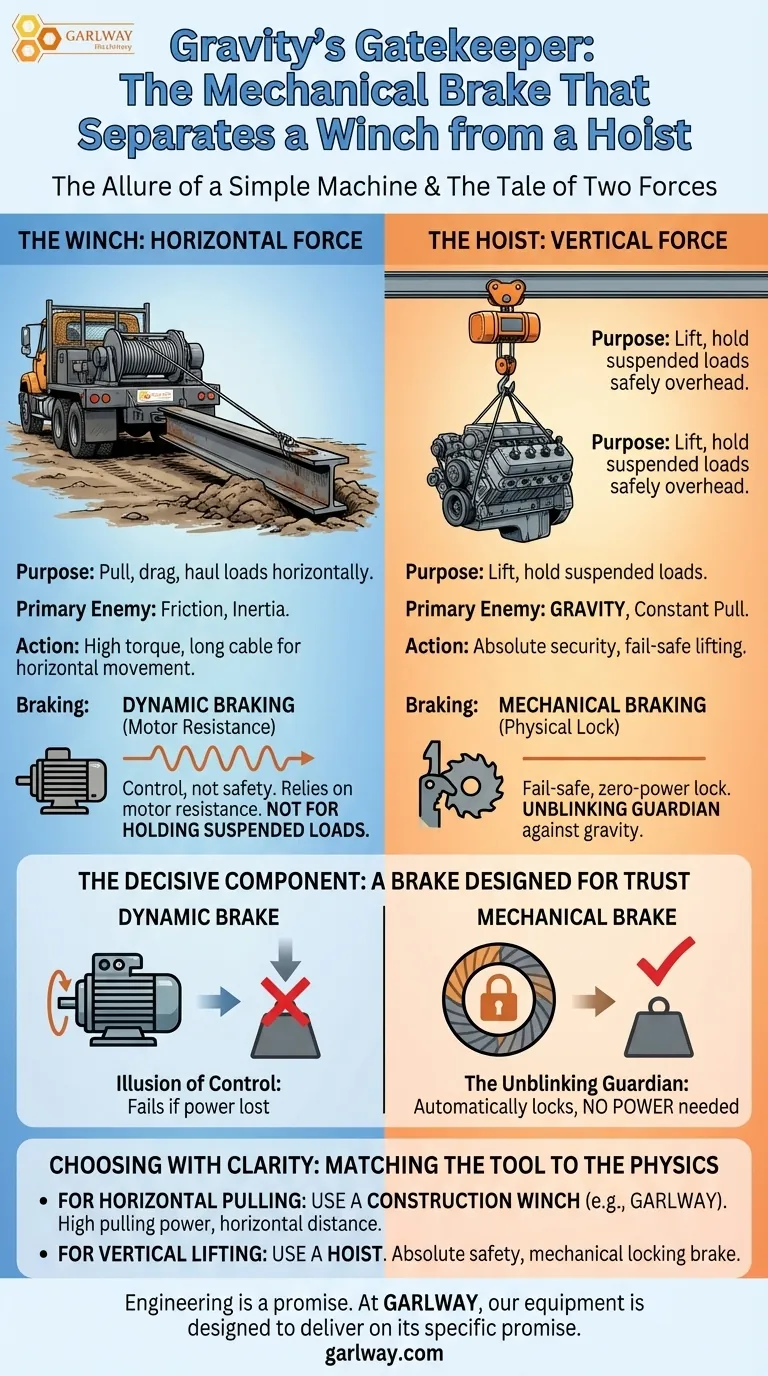
Most standard winches employ a dynamic braking system. This system uses the resistance of the winch’s own motor to slow and stop the drum. It's effective for managing the momentum of a horizontal pull.
However, it was never designed to hold a dead-weight, suspended load. It's a control mechanism, not a safety lock. If power is lost or the motor fails, a dynamic brake will not prevent a suspended load from plummeting.
Mechanical Braking: The Unblinking Guardian
A hoist uses a mechanical brake. This is a physical, load-bearing lock—often a friction-plate or pawl-and-ratchet system—that automatically engages the instant the motor stops.
It requires no power to operate. It is designed to fail-safe, locking the load in place. This brake is the gatekeeper against gravity. It’s the engineered promise that a suspended load will stay suspended, protecting both people and property below.
The Anatomy of a Mistake
Confusing these tools isn't a sign of incompetence; it's often a byproduct of job site pressure and a misunderstanding of the physics at play. The "it's good enough for this one little lift" mindset is a dangerous gamble.
The primary risk is catastrophic brake failure. Using a standard winch as a hoist introduces a scenario where the only thing preventing a multi-ton load from falling is a system never designed for that stress.
The only exception is a winch that is explicitly rated for lifting. These are specialized, hybrid machines built to a higher standard, and they always incorporate the mechanical locking brake of a hoist. The exception proves the rule: for vertical lifting, the brake is everything.
Choosing with Clarity: Matching the Tool to the Physics
Making the right choice isn't about picking a brand; it's about respecting the physics of the task. Your decision boils down to the direction of force.
-
For horizontal pulling: Dragging materials, positioning heavy skids, or vehicle recovery. Your need is high pulling power over a distance.
- Solution: A purpose-built construction winch. GARLWAY winches are engineered precisely for these high-torque, demanding horizontal applications found on every construction site.
-
For vertical lifting: Hoisting materials to an upper floor, workshop engine lifts, or suspending any load overhead. Your need is absolute safety against gravity.
- Solution: A hoist, with its non-negotiable mechanical locking brake.
Engineering is a promise. A winch promises to pull. A hoist promises to hold. On a professional job site, understanding the difference is fundamental to ensuring safety and efficiency. At GARLWAY, our equipment is designed to deliver on its specific promise, providing contractors with machinery they can trust to do the job right.
To ensure your equipment perfectly matches the physics of your work, Contact Our Experts.
Visual Guide
Related Products
- Warn Winch Windlass Boat Trailer Winch
- Electric and Hydraulic Winch for Heavy Duty Applications
- Hydraulic Winding Engine Harbor Freight Winch
- Small Electric Winch 120V and 240V for Compact Applications
- Quick Windlass Portable Winch for Truck and Boat Best Boat Winch
Related Articles
- Beyond the Bumper: The Critical System Choice in Powering Your Trailer Winch
- Force vs. Mass: The Critical Difference in Sizing a Boat Winch
- Lines of Force: The Unseen Geometry of a Boat Winch
- More Than a Number: The Engineering Psychology of Choosing a Boat Winch
- How to Choose and Optimize Winch Speed for Maximum Efficiency