The Psychology of Being Stuck
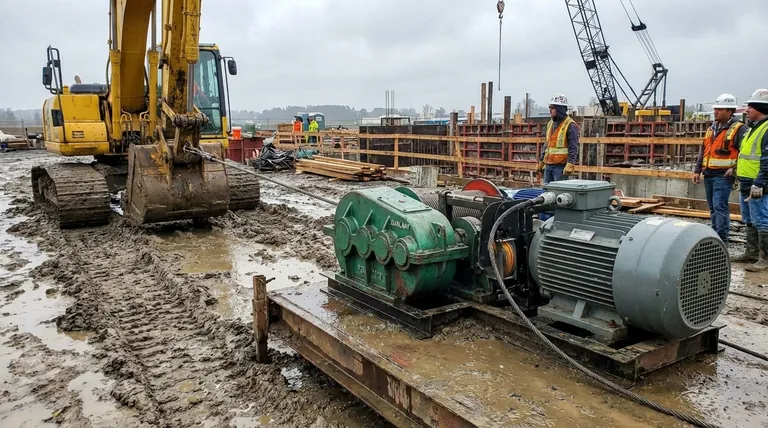
Picture a construction site after a week of rain. A critical piece of machinery, wheels sunk deep in the mud, has brought a section of the project to a standstill. The engine roars, but the tires only dig a deeper grave.
This is a state of physical helplessness. It's a battle of force against friction and gravity, and the machine is losing.
In these moments, the problem isn't a lack of power, but a lack of leverage. The solution isn't more brute force; it's the focused, controlled application of it. This is the fundamental purpose of a winch: to restore control over an impossible physical reality.
A Machine That Multiplies Intent
A winch is a beautiful piece of engineering because it's a near-perfect force multiplier. It doesn’t create energy. It masterfully converts it.
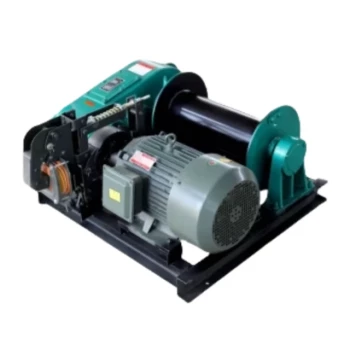
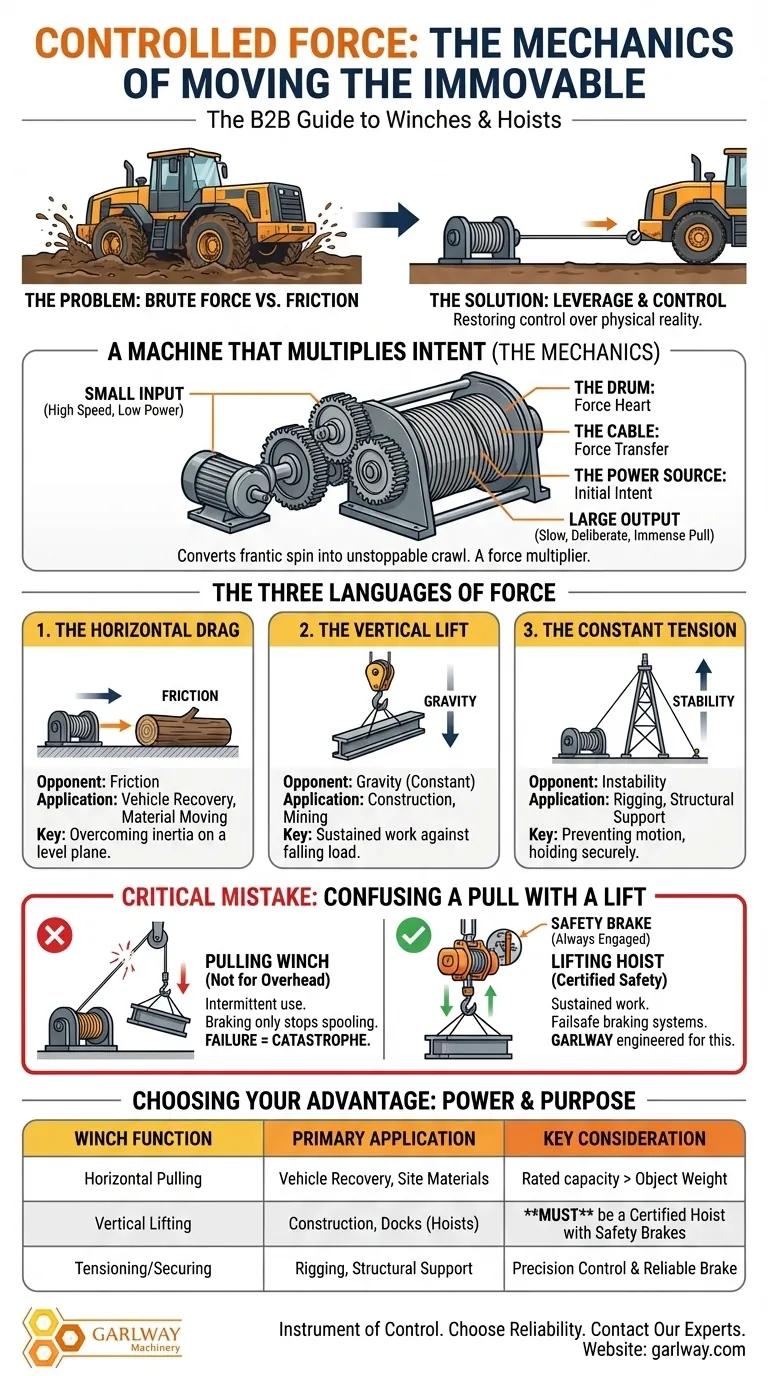
The genius lies in its reduction gear mechanism. A small motor, whether electric or hydraulic, spins at high speed with relatively low power. The gears inside the winch convert this high-speed rotation into a slow, deliberate, and immensely powerful pull at the drum.
It transforms a frantic spin into an unstoppable crawl. This mechanical advantage allows a small input to overcome a massive obstacle, granting a single operator the strength of many.
- The Drum: The heart around which the force is wound.
- The Cable: The sinew that transfers the force.
- The Power Source: The initial intent, converted into work.
The Three Languages of Force
A winch's purpose is not singular; it speaks three distinct "languages" of force, each suited to a different challenge. Understanding which language you need to speak is critical.
1. The Horizontal Drag
This is the most common dialect. Pulling the aforementioned machine from the mud. Dragging timber in a forestry operation. Moving a heavy component across a workshop floor. The primary opponent is friction. It's about overcoming inertia and resistance on a relatively level plane.
2. The Vertical Lift
This is a conversation with gravity, and gravity always gets the last word. Lifting is fundamentally different from pulling. When you hoist a multi-ton concrete form or a steel beam hundreds of feet in the air, the forces at play are constant and unforgiving. The load isn't just heavy; it's actively trying to fall.
3. The Constant Tension
Sometimes, the goal is not movement but stillness. A winch can be used to hold a load securely, to tension a guy wire, or to brace a structure while other work is performed. This is the subtle language of stability, preventing motion rather than creating it.
The Critical Mistake: Confusing a Pull with a Lift
Here lies the most dangerous misunderstanding in the world of winches. A winch designed for pulling a vehicle is not safe for lifting a load overhead.
The reason is in the design philosophy.
A pulling winch is built for high loads over short, intermittent periods. Its braking system is designed primarily to prevent the cable from spooling out when the motor stops.
A lifting hoist, however, is engineered with failure in mind. It has specialized braking systems—often mechanical load brakes—that automatically engage if power is lost. It's built for sustained work against gravity, where a failure isn't an inconvenience, it's a catastrophe.
On a professional construction site, this distinction isn't academic; it's a core principle of safety. Equipment from specialized suppliers like GARLWAY is engineered with this explicit difference in mind. Their construction-grade winches and hoists are purpose-built for the unique demands of vertical lifting and heavy material handling, ensuring the braking systems and duty cycles match the high-stakes environment.
Choosing Your Advantage: Power and Purpose
The final piece of the puzzle is matching the winch's power source and design to the job at hand. The purpose dictates the tool.
| Winch Function | Primary Application | Key Consideration |
|---|---|---|
| Horizontal Pulling | Vehicle recovery, moving materials on-site | Rated capacity must exceed vehicle/object weight. |
| Vertical Lifting | Construction, mining, docks (as a hoist) | Must be a certified hoist with appropriate safety brakes. |
| Tensioning/Securing | Rigging, temporary structural support | Precision control and a reliable brake are essential. |
Ultimately, a winch is an instrument of control. Choosing the right one is less about the maximum weight it can move and more about understanding the nature of the force you need to apply.
Understanding these principles is the first step. The next is choosing equipment built for the unforgiving demands of the modern construction industry, where reliability is the bedrock of safety and efficiency. Contact Our Experts
Visual Guide
Related Products
- Warn Winch Windlass Boat Trailer Winch
- Electric and Hydraulic Winch for Heavy Duty Applications
- Small Electric Winch 120V and 240V for Compact Applications
- 12000 lb Electric Boat Trailer Winch with Windlass Anchor Warn
- Quick Windlass Portable Winch for Truck and Boat Best Boat Winch
Related Articles
- Beyond the Bumper: The Critical System Choice in Powering Your Trailer Winch
- Force vs. Mass: The Critical Difference in Sizing a Boat Winch
- Lines of Force: The Unseen Geometry of a Boat Winch
- More Than a Number: The Engineering Psychology of Choosing a Boat Winch
- How to Choose and Optimize Winch Speed for Maximum Efficiency